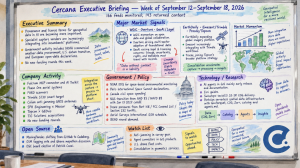
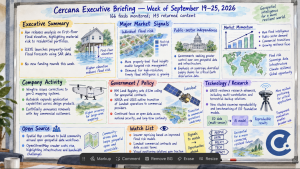
Cercana Executive Briefing: Week of June 6 – June 12, 2026

162 feeds monitored. Published June 12, 2026.

Executive Summary

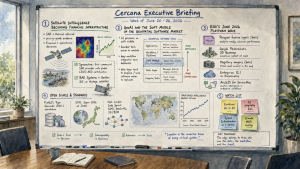
Two stories defined the week, and they point in opposite directions. Sovereign Earth-observation capacity moved from rhetoric to procurement. Airbus announced a European space-intelligence consortium, won a €345 million ESA contract for next-generation Copernicus radar instruments, and did both in the same Berlin Air Show window. Canada, meanwhile, described its space sector as entering an “infrastructure era,” backed by a $200 million spaceport commitment. Independent sensing capacity is increasingly being treated as national infrastructure rather than a commercial convenience.

At the same time, the geospatial AI conversation turned more skeptical just as the technology appears more capable. A sharp analytical piece argued that Earth-observation foundation models have largely solved the architecture problem: dozens of capable models now exist, but few run in production. That deployment-gap thesis landed alongside new research models and broader commentary questioning the returns from the AI boom. The convergence to watch is this: capital and national strategy are flowing into sensing infrastructure faster than the analytics layer is proving it can operationalize. The market is moving past the demo phase, where advantage shifts from building models to deploying them against real decisions.

Major Market Signals

Sovereign Earth Observation Becomes an Infrastructure Category

The clearest pattern of the week was the treatment of independent Earth-observation and ISR capacity as strategic infrastructure. Airbus Defence and Space signed a memorandum of understanding with Rohde & Schwarz, constellr, Orbint, and HPS to build a sovereign satellite-based Earth-observation and ISR solution. Separately, Airbus won a €345 million ESA contract, routed through Thales Alenia Space, for Copernicus Sentinel-1 NG radar instruments. Canada’s State of the Space Sector report and its $200 million spaceport investment were framed around infrastructure, while Unseenlabs placed the first foreign private satellite aboard Japan’s H3 vehicle.

The throughline is independence. Each move reduces reliance on foreign sensing, launch, or industrial capacity. For decision-makers, Earth-observation procurement is beginning to carry the political weight of energy, telecom, and defense infrastructure. Vendors with credible sovereign positioning will receive stronger consideration in public tenders, especially where national autonomy, resilience, and security sit behind the procurement language.

The Foundation-Model Deployment Gap Goes Public

A widely shared analysis crystallized a tension the market has been circling for months: roughly 58 remote-sensing foundation models appeared in three years, benchmark performance is strong across sensors and resolutions, and yet the models largely do not run in production. Framing the bottleneck as deployment rather than capability changes where the market should look for advantage.

That argument arrived in the same week as a new Stanford poverty-prediction model and commentary on diminishing AI returns. Together, they point toward a coming reallocation of attention and budget. Model development is no longer the whole story. Integration, validation, governance, operations, and user trust now determine whether a benchmark becomes an operational decision. The next wave of spending will favor vendors that can close that last mile, not those announcing another model.

Digital Twins Push Toward the Built and Subterranean Environment

Several independent threads converged on a more operational view of digital twins. A “smart pixels” concept was floated as the building block for next-generation built-environment twins. Arup and Ordnance Survey reached a milestone on a national heat-network zoning model tied to the UK’s 2050 targets. A substantive piece examined the limits of subsurface mapping, where the hardest construction question often remains what lies beneath the jobsite.

Taken together, the momentum is moving digital twins away from glossy 3D visualization and toward decision-grade models of infrastructure that is difficult to see: utilities, heat networks, underground assets, and the built environment as it actually operates. That is where AEC and public-works procurement appears to be heading. It favors firms that can fuse survey, sensor, engineering, and authoritative reference data into models that support planning, construction, maintenance, and risk decisions.

Notable Company Activity

Product Releases

  • Vexcel: Launched a 7.5cm aerial imagery program, doubling resolution from 15cm, beginning in the United States before expanding to Europe. The move escalates competition in high-resolution aerial imagery.
  • Planet: Confirmed that its Pelican-11 testbed spacecraft will launch next month to validate second-generation technology and 30cm imaging, marking another step in the company’s commercial constellation strategy.
  • Teledyne FLIR OEM: Released the Boson SX8, positioned as the first NDAA-compliant 8µm SXGA LWIR thermal module. The compliance angle is especially relevant for defense and dual-use procurement.
  • Latapult: Launched Regions Plus for advanced land-intelligence and GIS workflows, deepening the land-analytics tooling segment.

Partnerships

  • Airbus × Rohde & Schwarz, constellr, Orbint, HPS: Announced a sovereign space-intelligence consortium for Earth observation and ISR, the week’s marquee example of European industrial collaboration around sensing autonomy.
  • Arup × Ordnance Survey: Reached a major milestone on a national heat-network zoning model supporting the UK government’s target for heat networks to supply a fifth of all heat by 2050.

Funding & M&A

  • Bluebeam: Advanced its AI strategy with new Bluebeam Max capabilities and the acquisition of mbue, extending AI into AEC document and design workflows under the Nemetschek Group.
  • Beca: Acquired Queensland environmental firm CQG Consulting, whose strengths include GIS and surveying. The deal continues the pattern of engineering and environmental services firms absorbing spatial capability.

Government and Policy Developments

Public-sector activity this week reinforced the sovereignty theme and the steady institutionalization of geospatial capacity. The ESA Sentinel-1 NG award keeps Europe’s flagship open Earth-observation program on a renewal path, with the contract structure routing prime work through Thales Alenia Space. The Copernicus model continues to pair open data policy with sustained industrial investment.

Canada’s framing of its space sector as critical infrastructure, paired with a concrete spaceport commitment, shows mid-tier space nations competing on owned launch and sensing capacity rather than access to data alone. In Australia, AURIN secured $14 million in new federal funding directed at urban climate and coastal-development challenges, sustaining national research data infrastructure as a policy priority. In the UK, the Arup and Ordnance Survey heat-network zoning work shows the national mapping agency embedded in decarbonization delivery rather than serving only as a basemap provider. New Zealand’s use of the SouthPAN satellite-augmentation system to improve forestry accuracy shows how precise positioning infrastructure quietly underwrites productivity in primary industries.

The common market implication is that governments are funding the spatial backbone for climate, infrastructure, and sovereignty objectives. Suppliers aligned to those mandates will operate in a stronger demand environment than firms selling generic geospatial capability.

Technology and Research Trends

The center of gravity in geospatial technology is shifting from model-building to model-deployment, and the week’s research reflected both the ambition and the friction. Foundation models remain the dominant research vector, with new poverty-prediction work from Stanford, findings that pixel diversity improves model performance, and continued benchmark expansion across optical and SAR sensors. The louder conversation, however, was about why so little of this work reaches production. The gap between benchmark performance and operational adoption is becoming one of the defining technical problems of the sector.

Underneath the AI headlines, the cloud-native and tooling layer continued to mature. Practical experiments such as running a U-Net directly inside the GDAL command line, fixes for Sentinel-2 pipelines migrating to the new Copernicus Data Space Ecosystem, and continued QGIS plugin development all point to an ecosystem investing in the plumbing that makes analytics repeatable. Earth-observation monitoring products advanced as well, with the World Settlement Footprint Tracker offering 10-metre urban-expansion updates every six months. The direction is clear: the market is rewarding infrastructure that operationalizes data and models, not novelty for its own sake.

Open Source Ecosystem Signals

Open source had a productive, if unflashy, week. The strongest pattern was the continued convergence of open tooling and digital-sovereignty arguments. GeoSolutions released MapStore 2026.01, advancing one of the more complete open-source WebGIS platforms with improved 3D and analytics capabilities. GeoLibre 1.0 positioned itself as a free, cloud-native GIS that runs across browser, desktop, and Jupyter environments. It is early, but it reflects an effort to package open geospatial capability for anywhere-execution. The QGIS plugin ecosystem stayed active, and the Overture Maps Foundation published a substantive recap of its third annual member summit, pointing to continued governance momentum among its 30-plus member organizations.

The sovereignty-and-open-source connection sharpened in commentary asking whether European organizations should move away from American big-tech dependencies. That thread connects directly to the week’s sovereign-infrastructure developments. For executives weighing open-source dependencies, ecosystem health and governance are now strategic considerations. The same autonomy logic driving sovereign Earth observation is being applied to the software stack, and well-governed open projects are increasingly being framed as a hedge against vendor and geopolitical lock-in.

Watch List

  • Crowdsourced scans as defense data: A report that roughly 30 billion Pokémon Go environmental scans are being used for military drone navigation surfaces a dual-use and privacy question the industry has not yet fully addressed: consumer-collected spatial data feeding defense applications.
  • The high-resolution aerial arms race: Vexcel’s jump to 7.5cm and Planet’s 30cm testbed in the same week suggest resolution competition is reaccelerating across both aerial and satellite tiers. Pricing and refresh-rate pressure may follow downstream.
  • Anywhere-execution open GIS: GeoLibre 1.0’s browser, desktop, and Jupyter model is early, but a genuinely portable cloud-native GIS could pressure both desktop incumbents and hosted platforms if adoption builds.
  • Subsurface mapping demand: Renewed attention to the limits of subsurface sensing points to an underserved market around decision-grade underground digital twins.
  • AI-returns skepticism reaching geospatial: Commentary on the AI boom’s hypothetical returns and the “business of fear” around climate narratives indicates that geospatial AI enthusiasm is entering a more critical, ROI-focused phase.

Top Posts of the Week

  1. The Deployment Gap of Geospatial Foundation ModelsClairvoyint AI – The week’s sharpest analysis, reframing the Earth-observation foundation-model story from model capability to the unsolved problem of production deployment.
  2. Airbus Defence and Space sovereign space intelligence consortiumGeoConnexion – The marquee partnership crystallizing Europe’s push for sovereign Earth-observation and ISR capacity.
  3. Canada’s Space Sector Is Entering Its Infrastructure EraGoGeomatics – Frames national Earth-observation and launch capacity as critical infrastructure, capturing a posture now shared across multiple governments.
  4. Smart Pixels: The Building Block for the Next Evolution of Digital TwinsGeo Week News – Points to where digital-twin work is heading: decision-grade models of the built and hidden environment.
  5. Pokémon Go Player Scans Being Used for Military Drone NavigationThe Map Room – A dual-use and privacy flashpoint over consumer-collected spatial data feeding defense applications.

Cercana Executive Briefing is generated from 162 feeds aggregated by geofeeds.me.

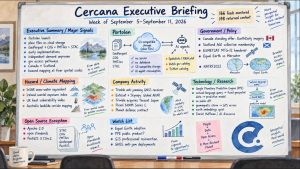
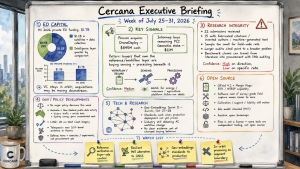
Cercana Executive Briefing: Week of May 30 – June 5, 2026

162 feeds monitored. Published June 5, 2026.

Executive Summary

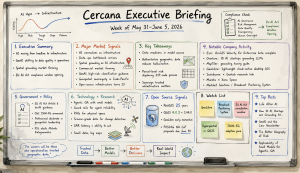
This week’s clearest development is a shift in how the industry is talking about AI. In “Life After AI,” Bill Dollins argues that the technology is crossing the threshold every general-purpose platform eventually crosses, from headline to infrastructure. No one now treats “in the cloud” as the remarkable fact about a product. AI is moving toward the same invisibility. The operational consequence is straightforward: the distinguishing question is no longer which model an organization can access, but whether its geospatial data can support real decisions. The GeoAI hype cycle is not ending so much as settling into a data quality and operations question.

In parallel, Overture Maps Foundation documented how ten AI startups are using open geographic data as a grounding layer for LLMs that otherwise struggle with spatial reasoning. Clairvoyint AI published an analysis of parcel-level risk modeling displacing ZIP-code proxies in insurance. Taken together, the pattern is becoming clearer: geographic truth is turning into a critical dependency for AI systems that operate in the physical world, and the market for spatially grounded AI is beginning to form.

Leaders should also note that draft guidance on high-risk AI system classification under the EU AI Act has now been issued for stakeholder consultation. GeoAI applications sit close enough to that scope that compliance planning now belongs in the current cycle, not a later one.

Major Market Signals

AI Normalizes as Infrastructure — The Data Operations Bottleneck Arrives

Bill Dollins’ “Life After AI” (geoMusings, June 4) captures the moment well: every general-purpose technology eventually stops being the subject and becomes part of the foundation. The web did it. Cloud did it. AI is approaching the same threshold. The significance of the post lies less in novelty than in timing. Dollins has been developing the related argument across several recent pieces: once AI recedes into background infrastructure, the distinguishing capability becomes the quality of the geospatial data it operates on. Organizations that have invested in clean, well-maintained, spatially accurate data pipelines will outperform those that expect the model to compensate for weak data. For vendors, that shifts differentiation toward pipeline quality, governance, and spatial accuracy. For buyers, it shifts evaluation away from model benchmarks and toward data readiness.

Spatial Grounding as AI Infrastructure — A Commercial Market Forms

Overture Maps Foundation documented how ten AI startups are using its open geospatial dataset to anchor LLMs to physical reality (“How 10 AI Startups are Grounding AI in the Real World with Overture,” June 4). The problem they are addressing is structural. LLMs trained on static, fragmented internet text have no reliable model of physical space at inference time. They hallucinate addresses, mislocate entities, and fail at spatial reasoning tasks. Overture, and more broadly any authoritative, maintained geographic knowledge base, is becoming infrastructure for that problem rather than merely one more dataset.

Separately, Clairvoyint AI published “The Better Geography of Risk” (June 2), arguing that ZIP codes are mail-routing artifacts rather than meaningful risk proxies, and that parcel-level ground truth is now economically viable in insurance at scale. Taken together, the two pieces point to a commercial market taking shape around spatially grounded AI, enabled by higher-resolution geographic data and aimed at industries such as insurance, logistics, real estate, and emergency response that require physical-world accuracy.

EU AI Act High-Risk Classification — Compliance Window Opens for GeoAI

The GeoAI and the Law Newsletter (June 4) reported that the European Commission issued draft guidelines for stakeholder consultation on classifying high-risk AI systems under Article 6 of the EU AI Act. Applications that make consequential decisions involving physical location, including infrastructure management, environmental monitoring, land-use planning, and defense, are close enough to the core of the guidance to merit immediate attention. The consultation period is open now, which gives organizations building or deploying GeoAI systems a finite window to assess whether their applications are likely to be classified as high-risk and what that would mean for certification, documentation, and liability exposure. This is no longer a future compliance issue. Geo Week News published a parallel analysis the same week, reinforcing that regulatory pressure is beginning to consolidate from multiple directions.

Geospatial Sovereignty Reaches Strategic Doctrine in the Indo-Pacific

The inaugural session of the Indo Pacific GeoIntelligence Forum 2026 opened this week with an explicit argument: strategic sovereignty requires informational sovereignty, and geospatial intelligence sits at the center of that relationship. Lt Gen Chandele’s address emphasized the growing importance of data centricity and networked geospatial decision-making in modern military operations. The forum’s language around connected systems and data-driven decision-making mirrors themes already visible in Australian, Canadian, and European geospatial policy discourse. What is new here is the Indo-Pacific institutional setting and the direct linkage between geospatial data infrastructure and strategic national capability. For commercial vendors, that reads as a demand signal: defense and intelligence procurement in the region is likely to center on sovereign, trusted geospatial data infrastructure rather than cloud-dependent or foreign-hosted platforms.

Open-Source Infrastructure Turns 25 — And Keeps Shipping

PostGIS turned 25 years old this week. The first post to the PostGIS user list was timestamped May 31, 2001. GeoObserver marked the anniversary, and the milestone deserves attention because PostGIS remains the spatial database under a substantial share of the world’s GIS infrastructure. The same week, QGIS released patch updates for both the current stable branch, 4.0.3 “Norrköping,” and the long-term release branch, 3.44.11 “Solothurn,” across Windows, Linux, and macOS. Maintenance across two parallel release tracks reflects a mature open-source governance posture. For executives evaluating enterprise dependencies, this week served as another reminder that QGIS and PostGIS are neither fragile community projects nor legacy holdovers. They are active platforms with coordinated release management and long operating histories.

Notable Company Activity

Product Releases

  • Esri: ArcGIS Velocity for ArcGIS Enterprise completed its public beta this week, suggesting the product is moving toward general availability. ArcGIS Velocity is Esri’s real-time analytics and event-driven processing capability; bringing it to Enterprise, rather than ArcGIS Online alone, extends real-time geospatial processing to organizations with on-premises or hybrid deployments. Esri also previewed ArcGIS Pro features and BIM/CAD integrations planned for announcement at the 2026 User Conference.
  • Overture Maps Foundation: Published documentation of ten commercial AI startups using Overture data as a spatial grounding layer for LLMs. This is less a product release than a market-development signal: Overture is positioning its open dataset as infrastructure for AI systems that require physical-world accuracy.
  • MapTiler: Released a technical guide to tuning geocoding search results, including parameter-level configuration advice. Incremental, but it points to continued investment in geocoding as a differentiated commercial service.
  • Open Geospatial Solutions (YouTube): Released two videos this week introducing and updating GeoLibre, described as a lightweight, cloud-native desktop GIS. GeoLibre v0.5.0 significantly expanded geospatial data format support. This remains an early-stage open-source project and belongs on the watch list.

Partnerships

  • Swinburne University × Geotab: Launched an AI-powered research hub focused on mobility and transport data. The partnership combines academic remote sensing and spatial science capabilities with Geotab’s telematics platform, pointing to growing institutional interest in vehicle-as-sensor applications for urban geospatial AI in Australia.
  • Murata × Xona Space: Signed an MOU on integrating Xona’s LEO satellite navigation signals into Murata components for industrial applications, another sign of a broadening LEO PNT market.
  • University of Western Australia × Seabed 2030: UWA Oceans Institute joined as a Seabed 2030 partner, extending the initiative’s research base in the Southern Hemisphere.

New Entrants

  • Merkhet Solutions: The National Association of Broadcasters launched Merkhet Solutions as an independent company to commercialize the Broadcast Positioning System (BPS), a GPS-independent terrestrial timing and positioning technology that uses existing high-power broadcast infrastructure. BPS has been in development since 2021; the spinout marks a transition from R&D to deployment.

Funding & M&A

No notable funding or acquisition activity appeared in the feeds this week.

Government and Policy Developments

The EU AI Act moved this week from legal text toward draft compliance guidance. The European Commission published draft guidelines for stakeholder consultation on the classification of high-risk AI systems under Article 6 of the Act. Applications that make consequential decisions using location data, particularly in infrastructure, environmental, land management, and defense settings, sit close to the heart of what the Act treats as high-risk. The consultation window is open now, which gives organizations operating geospatial AI systems in or for European markets a limited period to assess likely classification and begin compliance planning. GeoAI and the Law Newsletter, still the most consistent legal and regulatory voice in the monitored feeds, identified this as the week’s primary regulatory watch item.

The OGC also announced an extension to GeoJSON through the newly published Features and Geometries JSON (JSON-FG) Standard. JSON-FG does not replace GeoJSON; it extends it upward by adding capabilities the original format lacked, including feature identifiers, coordinate reference system support, and geometry type extensions. For developers building on GeoJSON-based APIs, this is worth watching as JSON-FG begins to appear in OGC-compliant implementations.

The World Geospatial Industry Council and several university partners announced what they describe as the world’s first professional doctorate in geospatial leadership. The program is aimed at working professionals in senior roles rather than traditional research candidates. Whatever its eventual market traction, the announcement suggests an industry conversation that has moved beyond training GIS analysts and toward developing geospatial executives.

FIG also elected Michalis Kalogiannakis as its new president, a result that reflects a broader generational and geographic shift in global surveying and spatial data governance.

Technology and Research Trends

The agentic GIS thread advanced on two fronts this week. Dollins published “Applicability of Small Models for Agentic QA” (June 2), describing practical work on using small language models as a kind of jury pool to assess agreement across generated outputs in agentic workflows. The key point is that agentic pipelines tend to fail in specific, diagnosable ways, and agreement checking at the output stage is one practical mitigation. Geo Jobe published “Agents on Guard Rails: Making AI More Consistent and Reliable” (June 3), making the complementary argument that as agents take on more complex and repetitive tasks, reliability begins to matter more than raw capability. Together, the two pieces suggest that the agentic GIS conversation is moving away from architecture debates and toward production readiness.

Overture Maps’ documentation of spatial grounding also has a technical significance distinct from its market significance. The underlying pattern, providing a curated and authoritative geographic knowledge base at inference time to prevent spatial hallucination, is likely to recur well beyond the ten startups Overture highlighted. In effect, this is retrieval-augmented generation applied to physical space, and it is likely to become standard practice wherever AI systems need to reason about location.

EarthDaily continued its science-grade data differentiation campaign with “Why Science-Grade Data Matters for Change Detection” (June 3), showing how calibrated surface reflectance in both natural color and false color supports more reliable multi-temporal analysis than uncalibrated imagery. ICEYE published a piece that framed SAR latency not as a technical specification but as an operational capability, the ability to act, which neatly captures the defense sector’s movement from archive-oriented toward near-real-time EO procurement.

The Spatial Edge (June 4) covered research linking global trade patterns to pollution mortality through geospatial analysis of cross-border pollution flows and also noted continuing progress in EO embeddings standardization. Both point to geospatial analysis operating at macroeconomic scale rather than being confined to infrastructure or land use.

Toward Data Science published “Small Data, Big Maps: Training Geospatial ML Models When Samples Are Scarce” (June 4), addressing the persistent challenge of geospatial ML work where labeled training data is limited. Transfer learning, active learning, and semi-supervised approaches are among the techniques discussed. Accessible technical writing on this problem remains relatively scarce, so the piece stands out.

Open Source Ecosystem Signals

PostGIS reached its 25th anniversary on May 31, 2026. The original mailing list post from Dave Blasby was timestamped May 31, 2001. GeoObserver’s note on the anniversary was brief, but the milestone carries a larger implication: PostGIS has become critical infrastructure for the global geospatial industry while remaining open source throughout. It has outlasted multiple generations of commercial geospatial platforms.

QGIS released patch updates for both active release tracks this week: version 4.0.3 “Norrköping,” the current stable release, and version 3.44.11 “Solothurn,” the long-term release. Dual-track maintenance suggests that the QGIS community is managing the 3.x-to-4.x transition with a familiar level of discipline.

A newer signal came from Open Geospatial Solutions, which published two videos this week introducing GeoLibre, a lightweight, cloud-native desktop GIS. The first introduced the concept; the second documented version 0.5.0, which significantly expanded format support. The pace of communication and the explicit framing suggest an active project still in its early phase.

Oslandia also announced a webinar on creating QGIS plugins in 2026, a small but useful indicator that the plugin ecosystem is already engaging with the implications of QGIS 4.x.

FOSS4G North America issued a call for Community of Practice proposals ahead of a June 30 deadline. Even at this early stage, the call provides a view into the topics the conference community considers mature enough to organize around.

Watch List

  • GeoLibre: Two videos in two days introduced and updated a new lightweight, cloud-native desktop GIS. The project appears to be moving quickly in its early stage. Watch for community uptake and contributor momentum.
  • Broadcast Positioning System (Merkhet Solutions): The NAB’s commercial spinout for GPS-independent terrestrial positioning moves this technology from R&D toward deployment. If coverage develops as its broadcast infrastructure heritage suggests, it could become a meaningful resilient PNT option for industrial and critical infrastructure use.
  • EU AI Act High-Risk Classification — Consultation Window: The stakeholder consultation period on high-risk AI system classification is open. Organizations with GeoAI applications in European markets should already be evaluating exposure.
  • Hyperspectral in QGIS: Open Geospatial Solutions published a tutorial on working with Planet Tanager hyperspectral data, 426 bands, in QGIS using the HyperCoast plugin. This is the first tutorial-level hyperspectral item to appear in the feeds in months and may indicate the beginning of broader practitioner uptake.
  • OGC JSON-FG adoption pace: The JSON-FG Standard was formally announced this week. Watch how quickly OGC-compliant implementations begin advertising support and whether developer tooling follows.

Top Posts of the Week

  1. Life After AIgeoMusings by Bill Dollins — AI is crossing the threshold from headline technology to foundational infrastructure, shifting attention toward data readiness and operational maturity.
  2. How 10 AI Startups are Grounding AI in the Real World with OvertureOverture Maps Foundation — A clear view of spatial grounding becoming a critical infrastructure layer for LLMs operating in the physical world.
  3. GeoAI and the Law NewsletterGeoAI and the Law — The European Commission’s draft high-risk AI classification guidance is now in stakeholder consultation, with direct implications for GeoAI.
  4. The Better Geography of RiskClairvoyint AI — ZIP-code risk proxies are giving way to parcel-level geospatial ground truth in insurance, with implications for EO and geospatial data providers.
  5. Applicability of Small Models for Agentic QAgeoMusings by Bill Dollins — Practical findings on using small-model jury pools to detect disagreement and instability in agentic workflows.

Cercana Executive Briefing is generated from 162 feeds aggregated by geofeeds.me.
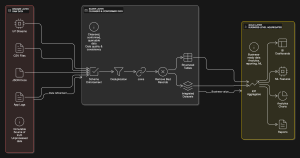
Geospatial-Ready AI Starts with Data Operations

The next phase of GeoAI is moving beyond model access. Most organizations already have access to capable models, cloud infrastructure, and enough software to build a demonstration. As those demonstrations move closer to operational use, the harder question is whether the underlying geospatial data can support real decisions.

Organizations do not get better geospatial AI by adding a model to weak data operations. They get it by making geospatial data easier to find, trust, combine, validate, and govern.

That shifts the work back to the operating discipline behind the data. Teams need to know where a dataset came from, whether it is authoritative for the decision at hand, how it can be combined with other layers, and how its quality has been checked. Those practices determine whether AI-generated spatial output can be used responsibly.

Geospatial data has always carried context that is easy to flatten. A parcel layer, elevation model, or imagery product carries the circumstances of its creation, the timing of its updates, and the purpose it was meant to support. Those details shape whether the data is suitable for a specific decision. A model may summarize, classify, infer, or recommend from that data, but the underlying constraints remain. In some cases, the speed and coherence of the output can make those constraints easier to miss.

Many organizations can already produce plausible spatial answers with AI. The next test is whether they understand the inputs, assumptions, and limitations well enough to use those answers in workflows that affect assets, services, risk, or investment.

That is where data operations become strategic. An organization that knows where its authoritative layers come from, how often they are updated, and which sources support which decisions has a stronger starting point than one that treats spatial data as a collection of files. That operating discipline changes how quickly teams can evaluate new tools, how confidently they can automate decisions, and how well they can explain the results.

The professional and standards communities are moving in the same direction. Recent guidance around responsible AI, enterprise AI governance, and AI-ready geospatial infrastructure points toward a common conclusion: operational AI depends on documented risk, accountable workflows, reusable standards, and clear stewardship of the data that feeds the system. The model sits inside that larger system.

For geospatial leaders, that creates a practical set of questions. They need to know which datasets are authoritative, where quality is checked, and which layers are ready for automated use. They also need clear ownership for updates and exceptions, along with a shared understanding of when a spatial result is strong enough to support a decision.

GeoAI makes these long-standing questions harder to postpone.

The organizations best positioned to benefit from GeoAI will treat data readiness as part of the system from the beginning. They will know which data deserves confidence, how it can be combined, where uncertainty remains, and when the result is good enough to act on.

AI-ready geospatial infrastructure starts before the model, with the operating discipline needed to make spatial data usable, explainable, and trustworthy at the point of decision.

If your organization is preparing for GeoAI, start with the data foundation. Cercana’s data engineering services help teams organize, validate, integrate, and govern geospatial data so it can support real operational decisions.

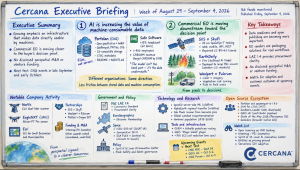
Cercana Executive Briefing — Week of May 23–29, 2026

161 feeds monitored. Published May 29, 2026.

Executive Summary

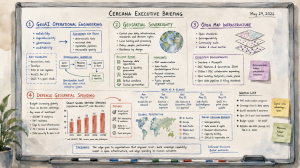
This week’s geospatial market activity centered on two related themes: the operational maturation of GeoAI and the growing importance of geospatial sovereignty. Both carry implications for procurement, vendor strategy, governance, and workforce planning.

On the AI side, reporting from the 2nd annual ESA-NASA Workshop on AI Foundation Models for Earth Observation reinforced a shift already visible across the market. The question is no longer whether GeoAI can perform useful work. The question is whether it can be trusted in operational settings. That requires engineering discipline, governance infrastructure, auditable workflows, and standardized tooling. Sparkgeo’s post-workshop analysis and Bill Dollins’ bimonthly GeoAI state-of-play survey arrived at similar conclusions from different angles: reliability, reproducibility, and governance are becoming core requirements for organizations selling or deploying spatial AI. Esri’s ArcGIS Pro 3.7 assistant beta and GeoAI Image Analyst updates also point to platform-level AI integration moving closer to routine production use.

On the sovereignty side, Geospatial World Forum 2026 produced senior-level statements that treated spatial data control as a strategic concern across Africa, the Gulf, and Europe. The announcement of the Indo-Pacific GeoIntelligence Forum, combined with a $103 million U.S. Department of Defense PNT contract award, points to continued defense investment in geospatial capability.

These two themes are connected. Sovereign AI and operational GeoAI depend on many of the same questions: who controls the data, who controls the model, what trained it, who can audit the output, and what rules govern reuse. Organizations that can answer those questions clearly will be better positioned in procurement environments where trust, provenance, and control are becoming part of the buying criteria.

Major Market Developments

GeoAI Has Entered Its Operational Engineering Phase

The 2nd ESA-NASA Workshop on AI Foundation Models for Earth Observation reflected a more mature industry conversation. Reporting from Sparkgeo’s James Banting described a shift from capability exploration toward operational readiness. In 2025, much of the discussion centered on whether foundation models could perform useful geospatial work. In 2026, the emphasis has moved toward reliability, latency, governance, and production deployment.

Several operating principles are gaining traction. LLMs are being positioned as orchestrators of deterministic tools rather than as generators of final analytical answers. Outputs need to be grounded in SQL, APIs, and auditable pipelines. Prompts should remain simple while technical complexity is embedded in tools and workflows. Generated analysis code should be retained for reproducibility.

Bill Dollins’ GeoAI survey for April and May 2026 documented a similar transition, with additional attention to regulation and procurement. RICS professional standards now require documented AI risk registers for surveyors. NATO has called for common governance standards at GEOINT. Proposed U.S. federal procurement clauses are moving toward requirements for American-developed AI components, government ownership of model outputs, and restrictions on using contract work to improve commercial models.

For vendors, this changes the sales conversation. Demonstrations still matter, but compliance documentation, auditability, reproducibility, and operating controls are becoming part of the evaluation process.

Geospatial Sovereignty Is Becoming a Multi-Region Strategic Concern

Geospatial World Forum 2026 produced a concentrated set of discussions on sovereignty. Sessions covered space access as a national right, sovereign GIS and digital twins, spatial justice and Africa’s geospatial future, and data sovereignty as an executive theme. The Indo-Pacific GeoIntelligence Forum 2026 was also announced as a dedicated forum for network-centric warfare and defense geospatial capabilities.

Taken alongside U.S. federal AI procurement clauses, Colorado’s AI Act, Virginia’s geolocation restrictions, and Canada’s sovereign AI discussion, sovereignty has moved beyond a narrow European regulatory context. It is appearing across regions as a strategic posture tied to national infrastructure, defense, land administration, precision navigation, and data control.

The practical implication is straightforward. Geospatial products and services that touch sensitive public functions will increasingly need to address provenance, jurisdiction, model governance, data rights, and operational control before procurement decisions are made.

Open Map Infrastructure Is Moving Into Enterprise Production

Overture Maps Foundation published a case study describing Microsoft’s adoption of Overture data for its internal building footprint and address layers. Microsoft replaced custom internal datasets, retired parts of its pipeline infrastructure, and reduced development cycles from months to weeks. The case study cites address accuracy improvements in South America, Mexico, and Japan, a full data layer transition completed in July 2024, and a hackathon team integrating Overture into Azure Maps SDKs in under a week.

Sparkgeo separately described its work on a self-healing Overture Places dataset. The system now monitors 9.4 million of the 15.5 million U.S. places in the dataset using real-time observations. Monthly observations grew from fewer than one million in May 2025 to more than 50 million by March 2026.

Spatialists also reported on the OGC Features and Geometries JSON standard as an evolution beyond GeoJSON. Taken together, these developments show open, collaborative map infrastructure moving from experimentation into enterprise use. Microsoft’s decision to reduce custom code and technical debt through shared infrastructure will be watched by other platform operators facing similar maintenance and data quality pressures.

Defense Geospatial Spending Is Advancing Across Regions

Apogee received a five-year, $103 million task order from the U.S. Department of Defense to support positioning, navigation, and timing modernization and sustainment planning across the international PNT enterprise.

Spain’s Ministry of Defence launched the FENIX project with UAV Navigation-Grupo Oesía and Alpha Unmanned Systems to develop heterogeneous unmanned vehicle swarms with advanced navigation and control. Australia held a military geospatial team evaluation exercise, reported by Spatial Source. GMV announced advances in secure timing and synchronization through Galileo PRS technology, aimed at defense and critical infrastructure markets.

These developments span North America, Europe, and the Indo-Pacific. They point to continued investment in resilient positioning, sovereign navigation, unmanned systems, and geospatial intelligence infrastructure.

Notable Company Activity

Product Releases

Esri launched the ArcGIS Pro 3.7 assistant beta, an AI-powered interface for automating common GIS workflows within Pro. The same release cycle included updates to GeoAI Image Analyst, ArcGIS Earth, ArcGIS StoryMaps, and cloud-enabled workflows in ArcGIS Reality Studio. The release pattern suggests continued movement toward AI-assisted platform workflows ahead of the summer user conference cycle.

Focal Point Positioning launched Precise+, a service targeting sub-meter GNSS accuracy in difficult environments such as urban canyons, dense foliage, and covered parking. The positioning market continues to segment around operating conditions, with more products designed for degraded environments.

OpenCage extended its Geosearch product to include postcode search, broadening its use in address autocomplete and geocoding integrations.

Partnerships

EarthDaily Analytics and Geospatial Intelligence announced a partnership to strengthen Earth observation capabilities in the Australian market. The partnership expands EarthDaily’s regional presence as Australian government and defense procurement continue to emphasize sovereign and allied EO capability.

Microsoft and Overture Maps Foundation represent the most detailed enterprise integration disclosed by Overture to date. Microsoft’s use of Overture data and infrastructure provides an enterprise reference case for the open collaborative model.

Funding and M&A

Octave Intelligence listed on Nasdaq New York. The company focuses on geospatial intelligence and Earth observation analytics. Its market reception will provide a reference point for other EO analytics firms considering public market activity.

Government and Policy Developments

EUSPA released a new EU Space Market Report projecting continued growth in GNSS-enabled services, with coverage of downstream market dynamics in Earth observation, satellite communications, and precision navigation. The report provides a useful benchmark for vendors positioning around European market demand.

The Indo-Pacific GeoIntelligence Forum 2026 creates a formal venue for defense geospatial standards, network-centric warfare, and capability alignment among Indo-Pacific partners. It suggests the region is developing its own geospatial intelligence architecture rather than relying only on European or North American models.

NASA’s AVIRIS-3 airborne hyperspectral campaign is opening an Expression of Interest for Australian researchers and institutions. AVIRIS-3 provides 426-band hyperspectral coverage for research applications in precision agriculture, ecosystem monitoring, and environmental compliance. Campaign participation may help indicate which organizations and workflows are moving closer to commercial use of hyperspectral data.

Bill Dollins’ GeoAI governance survey documented several overlapping regulatory developments: Colorado’s AI Act shifting toward transparency requirements for spatial decision systems, the EU’s Digital Omnibus extending AI Act compliance timelines to December 2027 while retaining high-risk treatment for land use, critical infrastructure, and emergency management GeoAI, and proposed U.S. federal procurement clauses governing AI outputs, commercial model improvement, and American-developed components. Organizations pursuing U.S. federal work should continue monitoring GSA clause development.

Technology and Research Trends

The ESA-NASA workshop showed geospatial foundation model tooling beginning to standardize around the TorchGeo ecosystem. TerraTorch and TerraKit joined TorchGeo, presenting a more unified framework for model training, evaluation, and data preparation. Standardization matters for production use because it reduces implementation variance, improves reproducibility, and supports maintainable deployment architectures.

The workshop also elevated embeddings as an infrastructure concern rather than only a performance optimization. Google’s AlphaEarth Foundation embeddings were discussed as a possible proxy for ground truth in selected research applications. One reported experiment recovered 97 percent of downstream task utility from AEF embeddings alone. This does not replace ground-truth collection, but it could affect how organizations plan and prioritize future field validation campaigns.

The Spatial Edge explored natural-language search over satellite imagery archives. This capability addresses a persistent Earth observation adoption barrier: analysts often know what they want to find but not how to express the query in catalog terms. Broader availability of natural-language archive search could make EO workflows more accessible to non-specialist users.

MappingGIS documented QGIS 4.x point cloud processing improvements, including rendering, classification, and analysis capabilities for LiDAR and photogrammetric point clouds. As point clouds become common deliverables for infrastructure inspection, urban planning, and forestry, open-source tooling quality will affect the competitiveness of workflows built around QGIS and related components.

Open Source Ecosystem Developments

FOSS4G North America 2026 is approaching, with a program covering cloud-native geospatial, AI integration, open standards, and field data collection. The conference remains a useful indicator of where open-source geospatial practitioners are putting their attention.

Bill Dollins’ GeoAI state-of-play survey raised a concern about AI coding tools and open-source maintenance. AI-assisted development may increase surface-level contributions while also adding review burden for maintainers. That can pull attention away from foundational work in projects such as GDAL, xarray, QGIS, PostGIS, and STAC. The QGIS Sustainability Initiative donated 168 hours of expert maintenance time in 2025 to address technical debt. Organizations whose production systems depend on the shared geospatial stack have a stake in whether that maintenance work is funded.

OGC is advancing the Features and Geometries JSON specification as a standardized evolution beyond GeoJSON. The specification addresses geometry type gaps and improves interoperability. Adoption is still early, but coverage from Spatialists indicates rising visibility among developers.

Watch List

Octave Intelligence Nasdaq listing: Public market reception will help establish a reference point for other EO analytics companies considering capital markets activity in 2026 and 2027.

Leaf Space TreeNet: Leaf Space introduced TreeNet as a space connectivity architecture for the “Internet of Space.” Satellite-to-satellite and multi-orbit connectivity infrastructure may become an important complement to ground station networks as small satellite operators evaluate uplink dependencies.

MainPro remote sensing products: MainPro announced online availability of a commercial remote sensing analysis product platform. New entrants continue to target vertical use cases such as precision agriculture and environmental monitoring, even as the EO analytics market faces consolidation pressure.

FME vs. AI: A Spatialists post raised a practical question for data integration teams: when does AI-powered spatial ETL begin to displace purpose-built integration platforms such as FME? The question remains early, but it is appearing in practitioner discussions and may become part of renewal and expansion decisions.

Erin Brockovich data center mapping campaign: The environmental activist launched a crowdsourced geographic mapping effort to document data center locations and environmental impacts. The combination of citizen geospatial collection, infrastructure scrutiny, and high-profile advocacy is relevant for vendors working in environmental monitoring, infrastructure planning, and public-facing geospatial applications.

Top Posts of the Week

  1. Reliability Is GeoAI’s New Metric, Sparkgeo
    Firsthand reporting from the ESA-NASA AI Foundation Models workshop, with a focus on what operational GeoAI requires beyond model performance.
  2. Geospatial AI State of Play, April–May 2026, geoMusings
    A synthesis of GeoAI governance, procurement, regulatory, and technical trends across NATO, RICS, Colorado, the EU, and the open-source ecosystem.
  3. Powering Microsoft Maps with Overture: Faster Releases, Better Data, Overture Maps Foundation
    A detailed enterprise case study showing Microsoft’s use of Overture data and shared infrastructure to improve data quality and reduce custom pipeline burden.
  4. Space for All: Why Geospatial Sovereignty is Every Nation’s Right, Geospatial World
    UNOOSA’s discussion of space access and geospatial sovereignty at Geospatial World Forum 2026.
  5. Twenty Years, Part Three, geoMusings
    A reflection on geospatial capability, decision-making, and the risk that AI accelerates familiar technology cycles without addressing the harder institutional questions.

Cercana Executive Briefing is generated from 161 feeds aggregated by geofeeds.me.
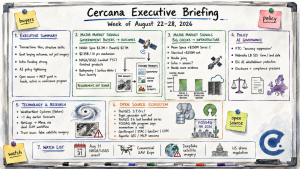
Cercana Executive Briefing — Week of May 2–8, 2026

160 feeds monitored. Published May 8, 2026.


Executive Summary

The defining story of this week is EarthDaily’s one-two punch: a full six-satellite constellation declared operational, followed within 48 hours by a National Reconnaissance Office contract award under the Strategic Commercial Enhancements (SCE) Commercial Solutions Opening. Either event would be notable on its own. Together, they mark a milestone in commercial Earth observation’s integration into national security infrastructure. The NRO’s SCE-CSO vehicle is designed for rapid commercial capability evaluation, and EarthDaily winning a slot in that framework, with 22-band, daily global multispectral data, confirms that science-grade commercial Earth observation has cleared an intelligence-community bar. For the broader commercial Earth observation sector, the message is clear: government customers remain committed to sourcing broad-area multispectral coverage from commercial constellations, and EarthDaily has established itself as an early mover at the quality tier that national security workflows require.

That supply-side validation landed during the same week the software side of the geospatial market was openly questioning whether purpose-built platforms are still necessary. A widely circulated podcast asked whether AI foundation models could replace geospatial platforms entirely; a product launch demonstrated AI-front-ended Earth observation workflows in production; and a detailed technical post from a 25-year Esri partner identified the unsolved identity and permissions problem that enterprise agentic GIS workflows must resolve before they can scale. These are not separate conversations. They are the same market interrogating the same inflection point from different vantage points.

At the same time, MapLibre and QGIS each executed major architectural transitions this week, suggesting that the open-source geospatial stack is rationalizing for the next decade of tooling. Leaders should track the identity and governance layer for agentic GIS, the NRO’s SCE-CSO vehicle for further commercial Earth observation contract awards, and Pixxel’s on-orbit processing announcement as a potential inflection point in where Earth observation analytics value is generated.


Major Market Signals

EarthDaily’s Double Strike: Constellation Complete, NRO Contract Won

This was EarthDaily’s week. The Vancouver-based Earth observation company achieved two significant milestones in 48 hours: the May 4 announcement that its full six-satellite constellation is on orbit and delivering daily global multispectral coverage, followed by a May 5 award from the National Reconnaissance Office for a $1.2 million commercial Earth observation contract. The contract, issued under the Strategic Commercial Enhancements Commercial Solutions Opening, calls for multispectral imagery delivery, end-to-end tasking, collection, product dissemination, and modeling and simulation for NRO and its mission partners. EarthDaily’s Chief Revenue Officer described the award as “an important step in establishing a scalable contracting framework for future U.S. government demand,” framing it as a bridgehead contract rather than a one-off engagement.

The constellation delivers 22 spectral bands at daily global coverage and is purpose-built for broad-area change detection. EarthDaily also published a blog post this week making the analytical case for “trusted measurement” as the basis of GEOINT advantage, a positioning move timed with the NRO announcement. With full operational capability expected later in 2026, the company is executing a deliberate dual-track strategy: demonstrate technical readiness with hardware delivery, then monetize it through federal contract vehicles that create a path to recurring government revenue.

Geospatial Platforms Under Pressure From AI Agents

Multiple independent voices converged this week on a shared question: what role do purpose-built geospatial platforms play when AI agents can increasingly assemble workflows from raw data and foundation models? The Applied Geospatial podcast put the question bluntly, “Are Geospatial Platforms Dead?”, and explicitly named Claude as a potential replacement for traditional platform architecture, exploring the economics of platform value versus custom AI-driven development. GeoAlert launched MapflowAgent, a natural-language chat interface to its geospatial AI engine, demonstrating that AI-front-ended Earth observation workflows have crossed from concept to commercial product.

GEO Jobe, a 25-year Esri Platinum Partner, published the week’s most substantive technical argument: agentic GIS workflows built on service accounts silently bypass every permission boundary an organization has set up, and the only viable path at enterprise scale is session-based identity that reflects each user’s actual ArcGIS permissions. The company will demonstrate a full session-aware solution at the Esri User Conference in July. Taken together, the week’s conversation reflects a genuine market inflection point. AI agents are capable enough to challenge geospatial platform assumptions, but the governance, identity, and security architecture required to operate them inside organizations has not been solved. The vendors who solve it are well positioned. Those who layer chat on top of existing platforms without addressing identity may find the value proposition harder to defend.

MapLibre Executing Its Most Significant Architectural Transition in Years

MapLibre’s April 2026 newsletter, published at the start of this window, reveals the project in the middle of a coordinated architectural pivot. MapLibre GL JS v6 pre-releases are underway with two major breaking changes: dropping WebGL1 support and transitioning from CommonJS to ESM. The project is deliberately shedding legacy constraints inherited from its origins. At the same time, MapLibre React Native v11, now exclusively supporting React Native’s new architecture, overhauled its API to align with MapLibre GL JS, creating a unified development surface across web and native for the first time.

The Flutter plugin received rebuilt offline regions with pause/resume support and production-ready WASM on Flutter Web. A new experimental C API opens MapLibre Native to platforms, including potential Rust, Kotlin, and Swift integrations, that could not previously use it as a dependency. This is a coordinated multi-platform transition rather than routine maintenance. For organizations running production maps on MapLibre, migration work lies ahead, but the project is delivering a substantially cleaner and more modern stack on the other side. The timing, coinciding with QGIS 4.x gaining momentum, suggests the open-source geospatial stack is broadly modernizing around current web and native primitives.


QGIS 4.x Adoption Moving Beyond Early Adopters

QGIS 4.0.2 “Norrköping” shipped on May 8 alongside LTR 3.44.10 “Solothurn,” with plugin ecosystem activity running in parallel: a geoscience plugins webinar specifically targeting QGIS 4, a new GeoPackage Exporter plugin, and expanded GeoBasis_Loader tooling adding 55 new data themes for German-speaking users. Three months into QGIS 4’s release, the simultaneous maintenance of both LTR and 4.x branches is running smoothly, and vertical-specific tooling is beginning to appear.

The geoscience sector is producing dedicated QGIS 4 plugins; the German geodata community is expanding data access tooling; and Spanish-language community resources for serverless QGIS web publishing are emerging. These are signals of a project moving beyond early adopter territory and into broader professional deployment. That is the point at which ecosystem depth compounds. The OGC Canada Forum at GeoIgnite 2026, convening this week, was already positioning QGIS 4 within national mapping strategy conversations.


Notable Company Activity

Product Releases

  • GeoAlert: Launched MapflowAgent, a conversational AI interface to its geospatial AI engine for satellite imagery analysis. Users can query and process imagery through natural language rather than manual platform workflows, representing the company’s move from tool to agent-accessible service.

Partnerships

  • Geoforce × AT&T Business: Launched the GT1c, a rugged LTE asset tracker designed for challenging industrial environments, using AT&T’s commercial network for connectivity. The product targets asset tracking in sectors such as oil and gas, construction, and logistics.

Government Contracts

  • EarthDaily × NRO: $1.2 million commercial Earth observation contract via the Strategic Commercial Enhancements Commercial Solutions Opening, covering multispectral imagery delivery, tasking, and product dissemination for intelligence community use.

Government and Policy Developments

The federal Earth observation market moved meaningfully this week, anchored by the NRO’s selection of EarthDaily under its Strategic Commercial Enhancements vehicle. The SCE-CSO mechanism is designed for rapid integration of commercial capabilities into national security workflows, and the EarthDaily award, coinciding with the company’s completed constellation, signals that the intelligence community is increasingly comfortable sourcing broad-area multispectral data commercially rather than relying solely on government-owned assets. This is consistent with a multi-year pattern of NRO and NGA accelerating commercial Earth observation integration, but EarthDaily’s science-grade calibration positioning appears to be a differentiating factor.

FedGeoDay 2026 post-event coverage surfaced USACE’s U-SMART program and the Census Bureau’s LEHD data infrastructure as examples of federal geospatial programs actively building toward AI-compatible data architecture. The underlying theme, AI readiness as a federal data stewardship priority, is emerging as a throughline in federal geospatial policy, separate from any specific application.

In Canada, the OGC Canada Forum at GeoIgnite 2026 advanced conversations around a collaborative national geospatial strategy. GeoIgnite, Canada’s national geospatial conference, attracted OGC as a formal convening partner this year, signaling that Canada is moving from informal geospatial coordination to a standards-aligned national framework.

New Zealand’s LINZ announced it is actively exploring present and future AI applications within its national spatial data mandate, joining Australia and Canada among English-speaking national mapping agencies beginning to formalize AI positions. On the regulatory side, a new U.S. rule targeting drone threats to critical infrastructure advanced this week, and AirData UAV joined the Commercial Drone Alliance ahead of expected FAA Part 108 adoption, the framework that will govern commercial drone remote ID and airspace access at scale. ESA declared Sentinel-1D fully operational, adding reliable C-band SAR coverage to the European Earth observation infrastructure portfolio.


Technology and Research Trends

The most structurally significant technical development this week is Pixxel’s announcement that it plans to implement on-orbit Earth observation imagery processing. By moving computation to the satellite rather than the ground station, Pixxel is betting that the commercial Earth observation value chain will shift from data delivery to inference delivery, with customers receiving analytics rather than raw spectral bands. If this works at scale for hyperspectral imaging, it changes what “Earth observation data product” means, reduces ground station bandwidth requirements, and potentially shifts the competitive moat from constellation access to on-board model quality. This is an architecture decision worth watching closely.

At the same time, GeoSpatial ML published ThroughputBench, a benchmarking framework for deep learning geospatial models that quantifies how fast models can map the Earth at scale. As foundation models for Earth observation mature from research artifacts to production tools, quantitative benchmarks of this kind become procurement vocabulary. The Medium post “GeoFMs in 5 Minutes: From Earth Observations to Embeddings” continued a trend of practitioner-level foundation model primers reaching an audience that is only now approaching these tools. The throughput question and the embedding quality question are related: organizations evaluating GeoFM adoption need both benchmarks.

Natural language as the geospatial interface surfaced in multiple forms this week: MapflowAgent for Earth observation workflows, the “etter” natural-language location tool from the Swiss Spatialists community for geocoding, and the broader platform replacement debate. The direction of travel is consistent. Natural language is becoming the front end to geospatial computation across multiple workflow types. The technical constraint is the identity and authorization layer in between, which GEO Jobe identified as the unsolved problem this week.


Open Source Ecosystem Signals

QGIS 4.0.2 and 3.44.10 LTR shipping on the same day reflects a healthy dual-track release process. More revealing is what is happening in the plugin and tooling ecosystem: a geoscience plugins webinar coordinated specifically around QGIS 4 capabilities, a new GeoPackage Exporter plugin, GeoBasis_Loader expanding to 55 data themes, and Spanish-language tutorials for serverless QGIS web publishing all indicate the community is actively building production tooling around the 4.x branch rather than simply maintaining 3.x compatibility. QGIS 4 ecosystem depth is compounding.

MapLibre’s April newsletter may represent the most architecturally significant month in the project’s recent history. The v6 transition, dropping WebGL1 and CommonJS, removes two long-standing legacy constraints inherited from MapLibre’s origins as a Mapbox fork. The explicit acknowledgment that migration will require effort, paired with a commitment to thorough migration documentation, is a sign of mature project governance. The new experimental C API for MapLibre Native is an underappreciated development. It opens the possibility of MapLibre bindings for systems languages that could not previously integrate it, which could expand the project’s reach into embedded, server-side, and edge deployments.

FOSS4G North America 2026 opened its Call for Proposals this week, confirming the conference is on track. FOSS4G NA CFP activity is a useful leading indicator because presentations accepted now tend to represent capabilities that reach broader adoption six to twelve months later.

Fuzzifying PostGIS, covered by Spatialists, brings fuzzy matching capabilities to PostGIS queries, reducing the need for separate similarity-matching infrastructure outside the database. For organizations doing address resolution, entity matching, or feature deduplication on spatial data, this kind of native database capability is operationally significant.


Watch List

  • Agentic GIS Identity as a Product Category: GEO Jobe’s analysis is an early warning signal that enterprise agentic GIS will generate security and compliance requirements around identity-aware tooling. Expect session-scoped MCP servers and permission-aware agent frameworks to emerge as a product category in the next 12–18 months.
  • Pixxel On-Orbit Processing: If Pixxel delivers on-orbit analytics at commercial scale, it redefines what “Earth observation data product” means for the hyperspectral segment. Watch for announcements about processing depth, latency performance, and early customer validation.
  • Taylor Geospatial World-First Global Map: Taylor Geospatial Institute claimed a “world-first global map” this week. The nature and methodology of the claim were not fully detailed in available coverage, but novel global-scale geospatial datasets are worth verifying if they hold up. This could become a significant reference dataset.
  • Natural Language Location (etter): A natural-language location interpretation tool surfaced in the Swiss Spatialists community. It is early-stage, but if natural-language location understanding scales, it has implications for address data markets, GIS data entry interfaces, and the geocoding industry.
  • GeoAI Legal Frameworks Forming: A dedicated newsletter tracking the legal dimensions of geospatial AI continued publishing this week. As GeoAI becomes commercially embedded, legal and regulatory frameworks will develop, likely faster than much of the industry anticipates.

Top Posts of the Week

  1. EarthDaily Selected by National Reconnaissance Office for Commercial Optical Earth Observation ContractEarthDaily Blog — The $1.2 million NRO award is the most consequential contract disclosure of the week, confirming EarthDaily’s constellation is production-ready for intelligence community use and establishing a government contracting path for future awards.
  2. EarthDaily Advancing Daily Global Measurement of Planetary Change with Six Satellites LaunchedEarthDaily Blog — Full constellation on orbit: daily global multispectral coverage across 22 bands is now operational, completing the foundational infrastructure for EarthDaily’s government and commercial ambitions.
  3. ArcGIS Agentic Workflows Have an Identity ProblemGEO Jobe — The week’s most substantive technical argument: service-account-based agentic GIS workflows silently bypass every organizational permission boundary, and session-based user identity is the only viable path at enterprise scale.
  4. MapLibre Newsletter April 2026MapLibre — v6 pre-releases underway, React Native v11 API overhauled, new C API launched: the open-source mapping stack’s most significant architectural transition in years, executed in parallel across all platforms.
  5. Live from New York: Are Geospatial Platforms Dead?Applied Geospatial (Christopher Ren) — A pointed podcast conversation that explicitly questions whether AI foundation models can replace purpose-built geospatial platforms, the sharpest framing yet of a question the whole industry is circling.

Cercana Executive Briefing is generated from 160 feeds aggregated by GeoFeeds.

A Novice Takes a Stab at GIS – Part 3

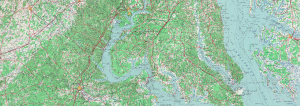
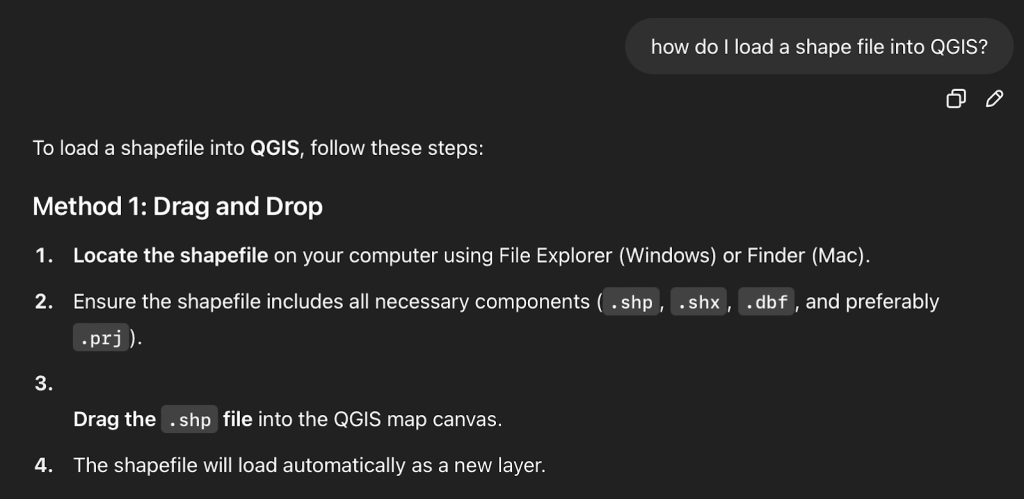
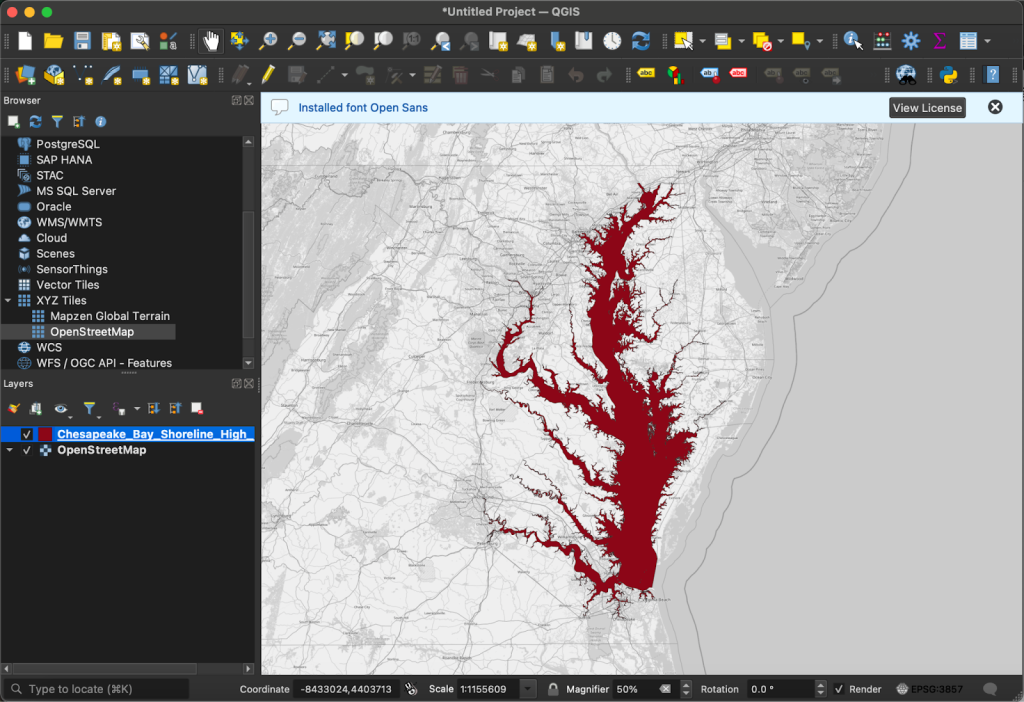
At this point in my entry-level upskilling project, the ground work has been done. I have a polygon of the Chesapeake Bay laid over an OpenStreetMap layer and I know how to change the color of it. Going back to the initial post, my hope with this project is to show change over time in the crab population of the Bay. As a complete novice, I don’t even know if there’s a way for me to do that in QGIS, or if I’m going to make 15 different maps with the 15 years of data and turn images of them into a .gif. So, I went back to ChatGPT for guidance. 

It also told me I could use style changes by time attribute, the TimeManager Plugin, or the manual process I had considered doing with turning a series of images into a .gif. 

I’ll be using the Temporal Controller since it was the first option. I asked ChatGPT for a step-by-step guide of how to do this.

Before getting bogged down in the process of creating the visualization, it’s important to have my data prepped and ready to go. I asked ChatGPT how it needed to be set up in order to use the temporal controller function.

In this case, I’ve decided to not do the thing that ChatGPT says is easier. The “Join External Time Data to Polygon” option seems to involve more data preparation work and be a better process to know for future projects. I began by taking a screen capture of the data table from the Maryland DNR’s Winter Dredge Survey history, uploaded it into ChatGPT, and had it use its OCR capabilities to make a table that I could paste into Excel and save as a .csv.

Step 1. 

Step 2. 

Step 3. 

After looking back at some of the steps in the process of using the temporal controller (Step 2 above), the final product ended up looking like this. I went into the attribute table of the polygon and saw that it already had an assigned ID of “2250”, so I added that column. Additionally, the geometry type is a polygon so that was added, as well.

With that, data preparation was complete and now I’m ready to move on to joining the data table to the polygon and creating the visualization. 

A Novice Takes a Stab at GIS – Part Two

Last week, I was able to settle on what the map I was creating would illustrate and find trustworthy data to use. This week, the focus is on actually creating the map itself. To do this, I need shapefiles of the Chesapeake Bay Watershed. 

I was able to source one from the Chesapeake Bay Program at data-chesbay.opendata.argis.com. This took me a handful of tries as most of the publicly available shape files of the Bay are a polygon of all the land and water considered to be within the Chesapeake Bay watershed. For the purposes of this map, I was looking for just the water itself. 

As a reminder, this is a self-guided process where I’m using ChatGPT to guide me through learning how to use QGIS. I’ve never loaded a shapefile before and ChatGPT gave me clear instructions.

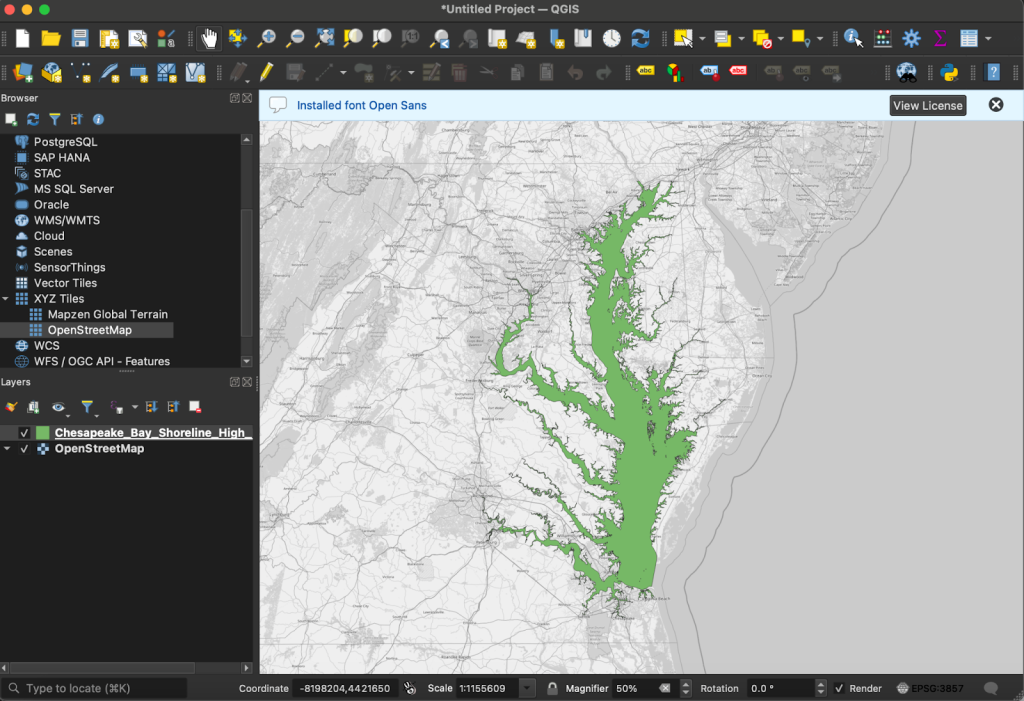
In order to load the shapefile into QGIS, I dragged the downloaded folder, which included .shp, .xml, .shx, .prj, .dbf, and .cpg files, into a blank new project. I felt a brief moment of triumph before realizing that getting the land surrounding the Bay into the project would likely not be as simple, but it was actually even easier. 

QGIS has an OpenStreetMap layer built into the “XYZ Tiles” tab on the left side of the window. I turned it on, reordered the layers so that my shapefile of the water was over top of OSM, and that was all that needed to be done. The program had already lined up the shapefile of the Bay itself perfectly with where OSM had the Bay. 

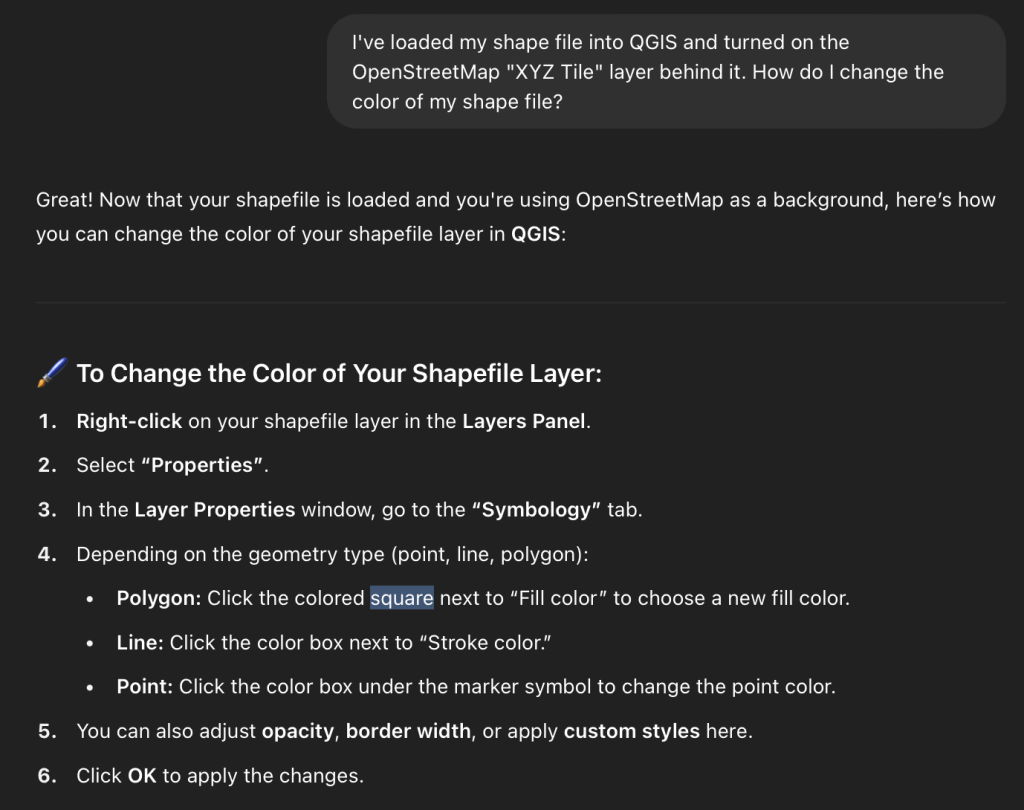
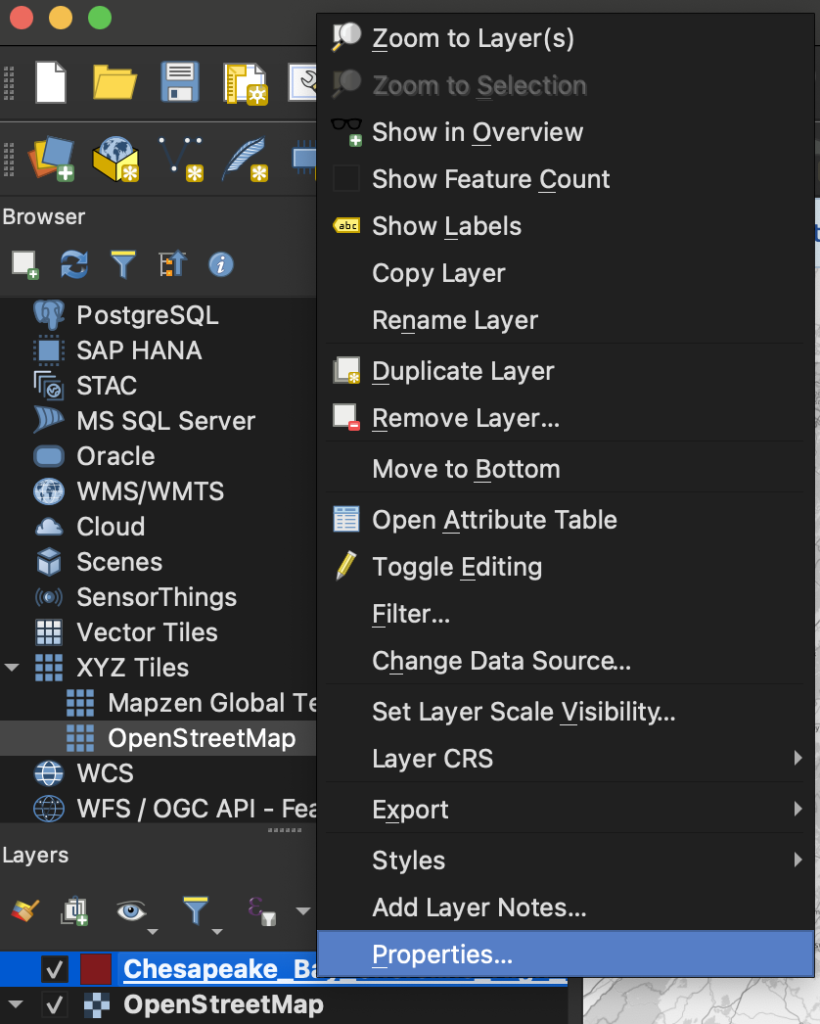
Now it’s time to go back to Professor ChatGPT. I need to know how to change the color of the shapefile before I can even worry about assigning different colors to different levels of crab population, finding out how to automatically change the color based on data in a table, or anything else. 

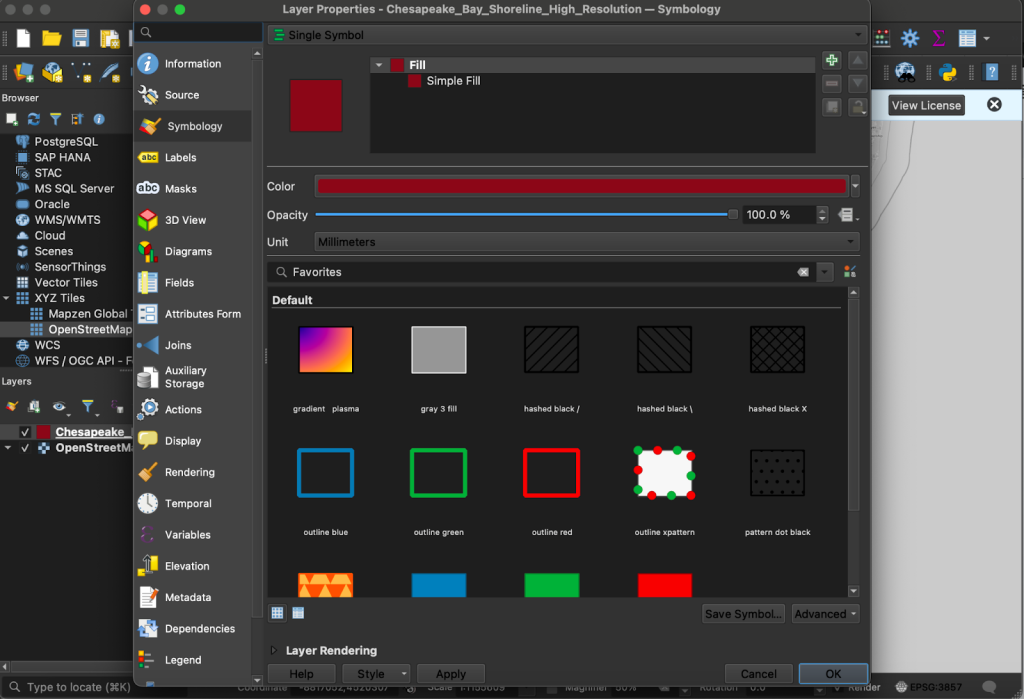
Just to practice, I made the Bay crimson. 

Step 1. 

Step 2.

Step 3.

In my next post, I’ll be going back to ChatGPT to learn how I can set up a table of data and instruct QGIS to change the color of the water based on the data in said table. I’m not sure how that will work or look yet, but that’s part of the learning. 

A Novice Takes a Stab at GIS

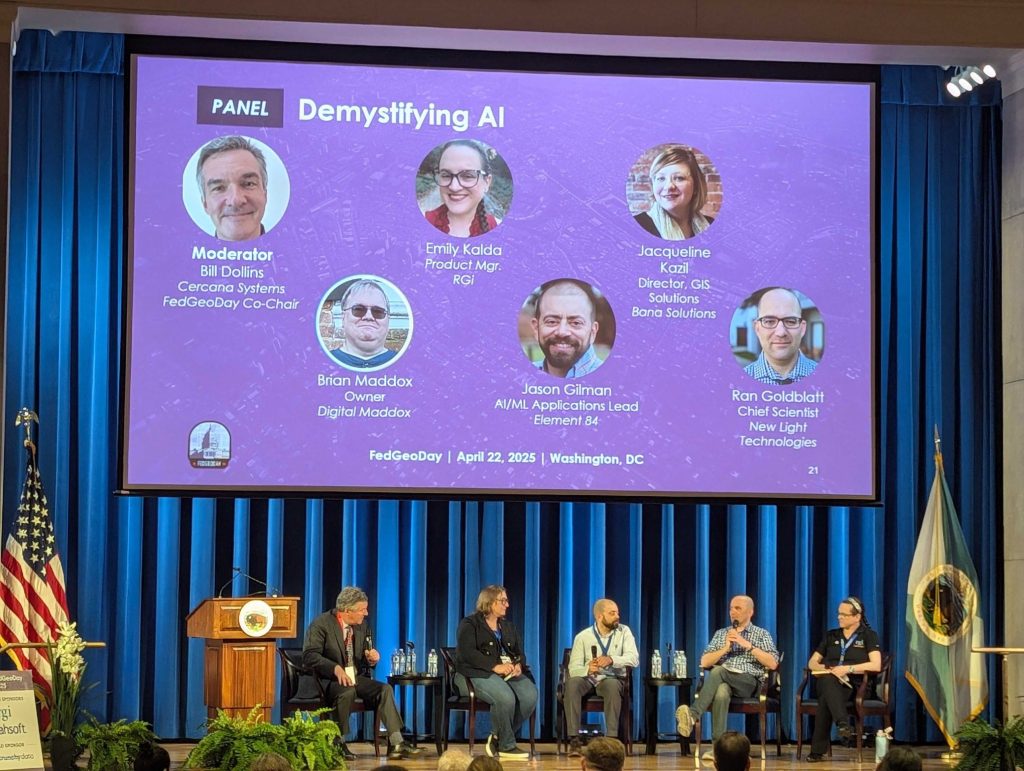
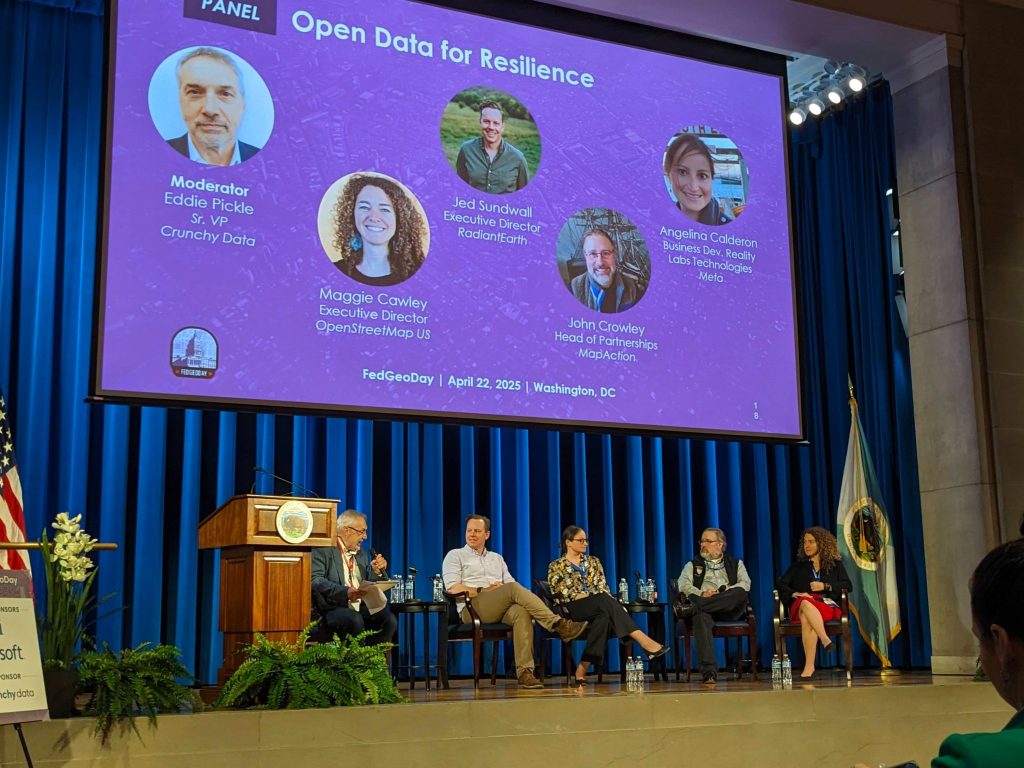
For the last handful of months, I’ve been working with my father’s company, Cercana Systems, to assist with content marketing and business development. In college, I finished most of a public relations degree at The University of Alabama before the first of my two daughters graced us with her presence and we decided to move back home to Maryland in order for her to actually have her extended family in her life. Since that time, I’ve found myself wanting more and more to find a way to help build things that provide a more tangible contribution to the world around me. Then, two weeks ago, I had the opportunity to attend FedGeoDay 2025 and decided it was time to start teaching myself some novice-level GIS skills. 

This year’s FedGeoDay theme of “open resilience” brought out a host of presenters that were using open geospatial ecosystems to do highly critical work in disaster prediction, preparation, and response. Everyone there was doing work that was well worth doing.

That brings us to the purpose of this blog post. It is the first in a series of undetermined length about me teaching myself how to use QGIS as a first foray into learning GIS skills. I am a complete novice with no coding or technical background of any kind. My hope is that documenting the process of attempting to make my first data-visualization in a commonly used tool may help others that want to delve into the field get past any apprehension they have about getting off the starting block. 

Step 1 – Pick a topic and find data

Initially, I had wanted to create a handful of heat maps that showed the change in the number of youth lacrosse programs in the mid-atlantic over the last 15 years. I turned to Chat GPT to source the data, but the engine was unable to find historical records for me to use.

“I want to build a heat map showing change over time in the concentration of youth lacrosse programs in the states of Maryland, Virginia, Delaware, New Jersey, Pennsylvania, North Carolina, West Virginia, and the District of Columbia. Could you scour the internet for data that I can use for this and put the data in a spreadsheet? The spread sheet should have three columns. The first column will indicate the year, the second will indicate the county, and the third should indicate the number of youth teams in that county. Let’s look at Spring teams only, not Fall, Winter, or Summer. Data should go back 15 years (2010-2025). Let’s consider “youth lacrosse” to be teams for children as old as 8th grade or 14 years of age. Some teams will use the “under X” age categorization, some will use the projected year of high school graduation, and some will just indicate a standard age range or grade level for the children it caters to, so be sure to look out for all of those. Can you do this?”

Compiling a comprehensive dataset detailing the number of youth lacrosse teams by county from 2010 to 2025 across Maryland, Virginia, Delaware, New Jersey, Pennsylvania, North Carolina, West Virginia, and the District of Columbia presents significant challenges. The primary hurdle is the lack of publicly available, granular historical data spanning this 15-year period. While some organizations provide current information, historical records at the county level are scarce.

### Available Data and Resources

* **Maryland Youth Lacrosse Association (MYLA)**: Oversees youth lacrosse in Maryland, offering current season details and age groupings. However, historical data by county is not readily accessible on their website. ([mylalax.com][1])

* **Western Maryland Youth Lacrosse Conference (WMYLC)**: Covers counties in Western Maryland and parts of neighboring states, with a focus on promoting youth lacrosse. Specific team counts by county and year are not provided online. 

* **Anne Arundel County Recreation and Parks**: Provides detailed information on current boys’ lacrosse leagues, including age divisions and game schedules. Historical data is not available on their platform. ([Anne Arundel County Government][2])

* **Inside Lacrosse Articles**: Discuss trends in lacrosse participation, noting shifts in player demographics and regional growth. These articles offer insights but lack specific county-level data over the desired time frame. ([Inside Lacrosse][3])

### Challenges in Data Compilation

* **Data Availability**: Most organizations do not maintain or publicly share historical team counts by county.

In the real world, sourcing and compiling accurate data can often be the bulk of the work done on a GIS project. However the point of this pursuit is to learn how to use QGIS, not spend countless hours calling up the Parks and Rec department of every county in the Mid-Atlantic, so I decided to pivot to something else.

So now, I’m looking for historical data over the last 15 years on the blue crab population in various sections of the Chesapeake Bay estuary. My new goal will be to create one map that shows the places where the population has increased the most, increased the least, and even decreased since 2010. 

This information was readily available from Maryland’s Department of Natural Resources, with one caveat. 

There was plenty of data on blue crab population available, but I wasn’t finding any that was split up into certain regions of the bay. Nonetheless, creating the map and shading the entire Bay based on percent change in population density from the median of the data year-to-year is a good beginner project to learn anything about QGIS at all, so we’re rolling with it. 

Step 2 – Installing QGIS

While it may seem like a silly step to document, this is supposed to be a properly novice guide to making a map in QGIS, and it’s a touch difficult to do that without installing the program. The machine I’m using is a 2020 M1 Macbook Air running Sonoma 14.6.1. I downloaded the installer for the “long term” version of QGIS from qgis.org, went through the install process, and attempted to open it. 

Naturally, my Macbook was less than thrilled that I was attempting to run a program that I hadn’t downloaded from the app store. It was completely blocking me from running the software when I opened it from the main application navigation screen. This issue was resolved by going to the “Applications” folder in Finder and using the control+left click method. A warning popped up about not being able to verify that the application contained no malware, I ran it anyway, and I have not had any issues opening the application since then. 

The next step will be to actually crack QGIS open and begin creating a map of the Chesapeake Bay. 

Geospatial Without Maps

When most people hear “geospatial,” they immediately think of maps. But in many advanced applications, maps never enter the picture at all. Instead, geospatial data becomes a powerful input to machine learning workflows, unlocking insights and automation in ways that don’t require a single visual.

At its core, geospatial data is structured around location—coordinates, areas, movements, or relationships in space. Machine learning models can harness this spatial logic to solve complex problems without ever generating a map. For example:

  • Predictive Maintenance: Utility companies use the GPS coordinates of assets (like transformers or pipelines) to predict failures based on environmental variables like elevation, soil type, or proximity to vegetation (AltexSoft, 2020). No map is needed—only spatially enriched feature sets for training the model.
  • Crop Classification and Yield Prediction: Satellite imagery is commonly processed into grids of numerical features (such as NDVI indices, surface temperature, soil moisture) associated with locations. Models use these purely as tabular inputs to predict crop types or estimate yields (Dash, 2023).
  • Urban Mobility Analysis: Ride-share companies model supply, demand, and surge pricing based on geographic patterns. Inputs like distance to transit hubs, density of trip starts, or average trip speeds by zone feed machine learning models that optimize logistics in real time (MIT Urban Mobility Lab, n.d.).
  • Smart Infrastructure Optimization: Photometrics AI employs geospatial AI to enhance urban lighting systems. By integrating spatial data and AI-driven analytics, it optimizes outdoor lighting to ensure appropriate illumination on streets, sidewalks, crosswalks, and bike lanes while minimizing light pollution in residential areas and natural habitats. This approach not only improves safety and energy efficiency but also supports environmental conservation efforts (EvariLABS, n.d.).

These examples show how spatial logic—such as spatial joins, proximity analysis, and zonal statistics—can drive powerful workflows even when no visualization is involved. In each case, the emphasis shifts from presenting information to enabling analysis and automation. Features are engineered based on where things are, not just what they are. However, once the spatial context is baked into the dataset, the model itself treats location-derived features just like any other numerical or categorical variable.

Using geospatial technology without maps allows organizations to focus on operational efficiency, predictive insights, and automation without the overhead of visualization. In many workflows, the spatial relationships between objects are valuable as data features rather than elements needing human interpretation. By integrating geospatial intelligence directly into machine learning models and decision systems, businesses and governments can act on spatial context faster, at scale, and with greater precision.

To capture these relationships systematically, spatial models like the Dimensionally Extended nine-Intersection Model (DE-9IM) (Clementini & Felice, 1993) provide a critical foundation. In traditional relational databases, connections between records are typically simple—one-to-one, one-to-many, or many-to-many—and must be explicitly designed and maintained. DE-9IM extends this by defining nuanced geometric interactions, such as overlapping, touching, containment, or disjointness, which are implicit in the spatial nature of geographic objects. This significantly reduces the design and maintenance overhead while allowing for much richer, more dynamic spatial relationships to be leveraged in analysis and workflows.

By embedding DE-9IM spatial predicates into machine learning workflows, organizations can extract richer, context-aware features from their data. For example, rather than merely knowing two infrastructure assets are ‘related,’ DE-9IM enables classification of whether one is physically inside a risk zone, adjacent to a hazard, or entirely separate—substantially improving the precision of classification models, risk assessments, and operational planning.

Machine learning and AI systems benefit from the DE-9IM framework by gaining access to structured, machine-readable spatial relationships without requiring manual feature engineering. Instead of inferring spatial context from raw coordinates or designing custom proximity rules, models can directly leverage DE-9IM predicates as input features. This enhances model performance in tasks such as spatial clustering, anomaly detection, and context-aware classification, where the precise nature of spatial interactions often carries critical predictive signals. Integrating DE-9IM into AI pipelines streamlines spatial feature extraction, improves model explainability, and reduces the risk of omitting important spatial dependencies.

Harnessing geospatial intelligence without relying on maps opens up powerful new pathways for innovation, operational excellence, and automation. Whether optimizing infrastructure, improving predictive maintenance, or enriching machine learning models with spatial logic, organizations can leverage these techniques to achieve better outcomes with less overhead. At Cercana Systems, we specialize in helping clients turn geospatial data into actionable insights that drive real-world results. Ready to put geospatial AI to work for you? Contact us today to learn how we can help you modernize and optimize your data-driven workflows.

References

Clementini, E., & Felice, P. D. (1993). A model for representing topological relationships between complex geometric objects. ACM Transactions on Information Systems, 11(2), 161–193. https://doi.org/10.1016/0020-0255(95)00289-8

AltexSoft. (2020). Predictive maintenance: Employing IIoT and machine learning to prevent equipment failures. AltexSoft. https://www.altexsoft.com/blog/predictive-maintenance/

Dash, S. K. (2023, May 10). Crop classification via satellite image time-series and PSETAE deep learning model. Medium. https://medium.com/geoai/crop-classification-via-satellite-image-time-series-and-psetae-deep-learning-model-c685bfb52ce

MIT Urban Mobility Lab. (n.d.). Machine learning for transportation. Massachusetts Institute of Technology. https://mobility.mit.edu/machine-learning

EvariLABS. (2025, April 14). Photometrics AI. https://www.linkedin.com/pulse/what-counts-real-roi-streetlight-owners-operators-photometricsai-vqv7c/

Reflections on the Process of Planning FedGeoDay 2025

What is FedGeoDay?

FedGeoDay is a single-track conference dedicated to federal use-cases of open geospatial ecosystems. The open ecosystems have a wide variety of uses and forms, but largely include anything designed around open data, open source software, and open standards. The main event is a one day commitment and is followed by a day of optional hands-on workshops. 

FedGeoDay has existed for roughly a decade , serving as a day of learning, networking, and collaboration in the Washington, D.C. area. Recently, Cercana Systems president Bill Dollins was invited to join the planning committee, and served as one of the co-chairs for FedGeoDay 2024 and 2025. His hope is that attendees are able to come away with practical examples of how to effectively use open geospatial ecosystems in their jobs. 

Photo courtesy of OpenStreetMap US on LinkedIn.

“Sometimes the discussion around those concepts can be highly technical and even a little esoteric, and that’s not necessarily helpful for someone who’s just got a day job that revolves around solving a problem. Events like this are very helpful in showing practical ways that open software and open data can be used.”

Dollins joined the committee for a multitude of reasons. In this post, we will explore some of his reasons for joining, as well as what he thinks he brings to the table in planning the event and things he has learned from the process. 

Why did you join the committee?

When asked for some of the reasons why he joined the planning committee for FedGeoDay, Dollins indicated that his primary purpose was to give back to a community that has been very helpful and valuable to him throughout his career in a very hands-on way. 

“In my business, I derive a lot of value from open-source software. I use it a lot in the solutions I deliver in my consulting, and when you’re using open-source software you should find a way that works for you to give back to the community that developed it. That can come in a number of ways. That can be contributing code back to the projects that you use to make them better. You can develop documentation for it, you can provide funding, or you can provide education, advocacy, and outreach. Those last three components are a big part of what FedGeoDay does.”

He also says that while being a co-chair of such an impactful event helps him maintain visibility in the community, getting the opportunity to keep his team working skills fresh was important to him, too. 

“For me, also, I’m self-employed. Essentially, I am my team,” said Dollins. “It can be really easy to sit at your desk and deliver things and sort of lose those skills.”

What do you think you brought to the committee?

Dollins has had a long career in the geospatial field and has spent the majority of his time in leadership positions, so he was confident in his ability to contribute in this new form of leadership role. Event planning is a beast of its own, but early on in the more junior roles of his career, the senior leadership around him went out of their way to teach him about project cost management, staffing, and planning agendas. He then was able to take those skills into a partner role at a small contracting firm where he wore every hat he could fit on his head for the next 15 years, including still doing a lot of technical and development work. Following his time there, he had the opportunity to join the C-suite of a private sector SaaS company and was there for six years, really rounding out his leadership experience. 

He felt one thing he was lacking in was experience in community engagement, and event planning is a great way to develop those skills. 

“Luckily, there’s a core group of people who have been planning and organizing these events for several years. They’re generally always happy to get additional help and they’re really encouraging and really patient in showing you the rules of the road, so that’s been beneficial, but my core skills around leadership were what applied most directly. It also didn’t hurt that I’ve worked with geospatial technology for over 30 years and open-source geospatial technology for almost 20, so I understood the community these events serve and the technology they are centered around,” said Dollins.

Photo courtesy of Ran Goldblatt on LinkedIn.

What were some of the hard decisions that had to be made?

Photo Courtesy of Cercana Systems on LinkedIn.

Attendees of FedGeoDay in previous years will likely remember that, in the past, the event has always been free for feds to attend. The planning committee, upon examining the revenue sheets from last year’s event, noted that the single largest unaccounted for cost was the free luncheon. A post-event survey was sent out, and federal attendees largely indicated that they would not take issue with contributing $20 to cover the cost of lunch. However, the landscape of the community changed in a manner most people did not see coming.

“We made the decision last year, and keep in mind the tickets went on sale before the change of administration, so at the time we made the decision last year it looked like a pretty low-risk thing to do,” said Dollins.

Dollins continued to say that while the landscape changes any time the administration changes, even without changing parties in power, this one has been a particularly jarring change. 

“There’s probably a case to be made that we could have bumped up the cost of some of the sponsorships and possibly the industry tickets a little bit and made an attempt to close the gap that way. We’ll have to see what the numbers look like at the end. The most obvious variable cost was the cost of lunches against the free tickets, so it made sense to do last year and we’ll just have to look and see how the numbers play out this year.”**

What have you taken away from this experience?

Dollins says one of the biggest takeaways from the process of helping to plan FedGeoDay has been learning to apply leadership in a different context. Throughout most of his career, he has served as a leader in more traditional team structures with a clearly defined hierarchy and specified roles. When working with a team of volunteers that have their own day jobs to be primarily concerned with, it requires a different approach. 

“Everyone’s got a point of view, everyone’s a professional and generally a peer of yours, and so there’s a lot more dialogue. The other aspect is that it also means everyone else has a day job, so sometimes there’s an important meeting and the one person that you needed to be there couldn’t do it because of that. You have to be able to be a lot more asynchronous in the way you do these things. That’s a good thing to give you a different approach to leadership and team work,” said Dollins on the growth opportunity. 

Dollins has even picked up some new work from his efforts on the planning committee by virtue of getting to work and network with people that weren’t necessarily in his circle beforehand. Though he’s worked in the geospatial field for 30 years and focused heavily on open-source work for 20, he says he felt hidden away from the community in a sense during his time in the private sector. 

Photo courtesy of Lane Goodman on LinkedIn.

“This has helped me get back circulating in the community and to be perceived in a different way. In my previous iterations, I was seen mainly from a technical perspective, and so this has kind of helped me let the community see me in a different capacity, which I think has been beneficial.”

FedGeoDay 2025 has concluded and was a huge success for all involved. Cercana Systems looks forward to continuing to sponsor the event going forward, and Dollins looks forward to continuing to help this impactful event bring the community together in the future. 

Photo courtesy of Cercana Systems on LinkedIn.

**This interview was conducted before FedGeoDay 2025 took place. The event exceeded the attendance levels of FedGeoDay 2024. 

FedGeoDay 2025 Highlights

The Cercana Systems team had a wonderful time attending FedGeoDay 2025 in Washington, D.C.! It was fun to catch up with long-time colleagues, make new professional connections, and learn how a wide array of new projects are contributing to the ever-evolving world of open geospatial ecosystems. 

A standout highlight was the in-depth keynote by Katie Picchione of NASA’s Disasters Program on the critical role played by open geospatial data in disaster response. Additionally, Ryan Burley of GeoSolutions moderated an excellent panel on Open-Source Geospatial Applications for Resilience, and Eddie Pickle of Crunchy Data led an energetic panel on Open Data for Resilience. 

We were especially excited about the “Demystifying AI” panel with panelists Emily Kalda of RGi, Jason Gilman of Element 84, Ran Goldblatt of New Light Technologies, and Jackie Kazil of Bana Solutions which was moderated by Cercana’s president Bill Dollins.

Location is an increasingly important component of cybersecurity and FedGeoDay featured a fireside chat on cybersecurity led by Ashley Fairman of DICE Cyber.  On either side of the lunch break, Wayne Hawkins of RGi moderated a series of informative lightning talks on a range of topics. 

FedGeoDay was a content-rich event that was upbeat from beginning to end. We are grateful to all of the presenters and panelists for taking the time to share their knowledge and to the organizing committee for their work in pulling together such a high-quality event. Cercana is proud to support FedGeoDay and looks forward to continuing to do so for years to come.

Why Young Professionals Should Get Out of the Office and Into Industry Events

In today’s fast-paced professional world, it’s easy for young professionals to assume that hard work alone will get them ahead. While grinding at the desk and delivering results matters, relying solely on your work to speak for itself may leave you overlooked in a competitive field. Getting out of the office and into local conferences, workshops, and networking events can provide invaluable opportunities that simply can’t be replicated from behind a desk.

Build Meaningful Professional Relationships

Networking remains one of the most powerful tools for career growth. According to a 2023 LinkedIn survey, 85% of job roles are filled through networking, not traditional applications. Attending local conferences puts you face-to-face with people in your industry—from potential mentors and collaborators to future employers and clients. These relationships can open doors to new opportunities that might never make it to job boards or public listings.

Stay Current With Industry Trends

Local events are also a great way to keep your knowledge sharp and up to date. Industry leaders often use conferences as platforms to discuss the latest trends, tools, and innovations. The Harvard Business Review emphasizes that staying current with changes in your field helps you remain relevant and competitive, especially in industries being rapidly transformed by technology and globalization (HBR, 2021).

Showcase Yourself Beyond the Resume

When you attend events, you get the chance to show people not just what you do—but how you do it. Your communication style, curiosity, and initiative become part of the impression you make. This visibility can lead to referrals, collaborations, or speaking invitations, all of which enhance your professional reputation in ways your LinkedIn profile alone cannot.

Gain Confidence and Soft Skills

Finally, stepping into a room full of peers and industry veterans can be intimidating—but it’s also empowering. Each interaction hones your communication skills, boosts your confidence, and teaches you how to navigate complex social dynamics in a professional context—critical soft skills that employers value highly.

Bottom Line

If you’re a young professional looking to grow, staying in your comfort zone won’t cut it. Attending local conferences and events is more than just networking—it’s about investing in your personal and professional development. Get out there, be visible, and let the right people see what you’re capable of.

Sources

Demystifying the Medallion Architecture for Geospatial Data Processing

Introduction

Geospatial data volumes and complexity are growing due to diverse sources, such as GPS, satellite imagery, and sensor data. Traditional geospatial processing methods face challenges, including scalability, handling various formats, and ensuring data consistency. The medallion architecture offers a layered approach to data management, improving data processing, reliability, and scalability. While the medallion architecture is often associated with specific implementation such as the Delta Lake, its concepts are applicable to other technical implementations. This post introduces the medallion architecture and discusses two workflows—traditional GIS-based and advanced cloud-native—to demonstrate how it can be applied to geospatial data processing.

Overview of the Medallion Architecture

The medallion architecture was developed to address the need for incremental, layered data processing, especially in big data and analytics environments. It is composed of three layers:

  • Bronze Layer: Stores raw data as-is from various sources.
  • Silver Layer: Cleans and transforms data for consistency and enrichment.
  • Gold Layer: Contains aggregated and optimized data ready for analysis and visualization.

The architecture is particularly useful in geospatial applications due to its ability to handle large datasets, maintain data lineage, and support both batch and real-time data processing. This structured approach ensures that data quality improves progressively, making downstream consumption more reliable and efficient.

Why Geospatial Data Architects Should Consider the Medallion Architecture

Geospatial data processing involves unique challenges, such as handling different formats (raster, vector), managing spatial operations (joins, buffers), and accommodating varying data sizes. Traditional methods struggle when scaling to large, real-time datasets or integrating data from multiple sources. The medallion architecture addresses these challenges through its layered approach. The bronze layer preserves the integrity of raw data, allowing for transformations to be traced easily. The silver layer handles transformations of the data, such as projections, spatial joins, and data enrichment. The gold layer provides ready-to-consume, performance optimized data ready for downstream systems. 

Example Workflow 1: Traditional GIS-Based Workflow  

For organizations that rely on established GIS tools or operate with limited cloud infrastructure, the medallion architecture provides a structured approach to data management while maintaining compatibility with traditional workflows. This method ensures efficient handling of both vector and raster data, leveraging familiar GIS technologies while optimizing data accessibility and performance.  

This workflow integrates key technologies to support data ingestion, processing, and visualization. FME serves as the primary ETL tool, streamlining data movement and transformation. Object storage solutions like AWS S3 or Azure Blob Storage store raw spatial data, ensuring scalable and cost-effective management. PostGIS enables spatial analysis and processing for vector datasets. Cloud-Optimized GeoTIFFs (COGs) facilitate efficient access to large raster datasets by allowing partial file reads, reducing storage and processing overhead. 

Bronze – Raw Data Ingestion 

The process begins with the ingestion of raw spatial data into object storage. Vector datasets, such as Shapefiles and CSVs containing spatial attributes, are uploaded alongside raster datasets like GeoTIFFs. FME plays a crucial role in automating this ingestion, ensuring that all incoming data is systematically organized and accessible for further processing.  

Silver – Data Cleaning and Processing

At this stage, vector data is loaded into PostGIS, where essential transformations take place. Operations such as spatial joins, coordinate system projections, and attribute filtering help refine the dataset for analytical use. Meanwhile, raster data undergoes optimization through conversion into COGs using FME. This transformation enhances performance by enabling GIS applications to read only the necessary portions of large imagery files, improving efficiency in spatial analysis and visualization.  

Gold – Optimized Data for Analysis and Visualization  

Once processed, the refined vector data in PostGIS and optimized raster datasets in COG format are made available for GIS tools. Analysts and decision-makers can interact with the data using platforms such as QGIS, Tableau, or Geoserver. These tools provide the necessary visualization and analytical capabilities, allowing users to generate maps, conduct spatial analyses, and derive actionable insights.  

This traditional GIS-based implementation of medallion architecture offers several advantages. It leverages established GIS tools and workflows, minimizing the need for extensive retraining or infrastructure changes. It is optimized for traditional environments yet still provides the flexibility to integrate with hybrid or cloud-based analytics platforms. Additionally, it enhances data accessibility and performance, ensuring that spatial datasets remain efficient and manageable for analysis and visualization.  

By adopting this workflow, organizations can modernize their spatial data management practices while maintaining compatibility with familiar GIS tools, resulting in a seamless transition toward more structured and optimized data handling. 

Example Workflow 2: Advanced Cloud-Native Workflow  

For organizations managing large-scale spatial datasets and requiring high-performance processing in cloud environments, a cloud-native approach to medallion architecture provides scalability, efficiency, and advanced analytics capabilities. By leveraging distributed computing and modern storage solutions, this workflow enables seamless processing of vector and raster data while maintaining cost efficiency and performance.  

This workflow is powered by cutting-edge cloud-native technologies that optimize storage, processing, and version control. 

Object Storage solutions such as AWS S3, Google Cloud Storage, or Azure Blob Storage serve as the foundation for storing raw geospatial data, ensuring scalable and cost-effective data management. Apache Spark with Apache Sedona enables large-scale spatial data processing, leveraging distributed computing to handle complex spatial joins, transformations, and aggregations. Delta Lake provides structured data management, supporting versioning and ACID transactions to ensure data integrity throughout processing. RasterFrames or Rasterio facilitate raster data transformations, including operations like mosaicking, resampling, and reprojection, while optimizing data storage and retrieval.  

Bronze – Raw Data Ingestion

The workflow begins by ingesting raw spatial data into object storage. This includes vector data such as GPS logs in CSV format and raster data like satellite imagery stored as GeoTIFFs. By leveraging cloud-based storage solutions, organizations can manage and access massive datasets without traditional on-premises limitations.  

Silver – Data Processing and Transformation

At this stage, vector data undergoes large-scale processing using Spark with Sedona. Distributed spatial operations such as filtering, joins, and projections enable efficient refinement of large datasets. Meanwhile, raster data is transformed using RasterFrames or Rasterio, which facilitate operations like mosaicking, resampling, and metadata extraction. These tools ensure that raster datasets are optimized for both analytical workloads and visualization purposes.  

Gold – Optimized Data for Analysis and Visualization

Once processed, vector data is stored in Delta Lake, where it benefits from structured storage, versioning, and enhanced querying capabilities. This ensures that analysts can access well-maintained datasets with full historical tracking. Optimized raster data is converted into Cloud-Optimized GeoTIFFs, allowing efficient cloud-based visualization and integration with GIS tools. These refined datasets can then be used in cloud analytics environments or GIS platforms for advanced spatial analysis and decision-making.  

This cloud-native implementation of medallion architecture provides several advantages for large-scale spatial data workflows. It features high scalability, enabling efficient processing of vast datasets without the constraints of traditional infrastructure, parallelized data transformations, significantly reducing processing time through distributed computing frameworks, and cloud-native optimizations, ensuring seamless integration with advanced analytics platforms, storage solutions, and visualization tools.  

By adopting this approach, organizations can harness the power of cloud computing to manage, analyze, and visualize geospatial data at an unprecedented scale, improving both efficiency and insight generation.  

Comparing the Two Workflows

AspectTraditional Workflow (FME + PostGIS)Advanced Workflow (Spark + Delta Lake)
ScalabilitySuitable for small to medium workloadsIdeal for large-scale datasets
TechnologiesFME, PostGIS, COGs, file system or object storageSpark, Sedona, Delta Lake, RasterFrames, object storage
Processing MethodSequential or batch processingParallel and distributed processing
PerformanceLimited by local infrastructure or on-premise serversOptimized for cloud-native and distributed environments
Use CasesSmall teams, traditional GIS setups, hybrid cloud setupsLarge organizations, big data environments

Key Takeaways

The medallion architecture offers much needed flexibility and scalability for geospatial data processing. It meshes well with traditional workflows using FME and PostGIS, which is effective for organizations with established GIS infrastructure. Additionally, it can be used in cloud-native workflows using Apache Spark and Delta Lake to provide scalability for large-scale processing. Both of these workflows can be adapted depending on the organization’s technological maturity and requirements. 

Conclusion

Medallion architecture provides a structured, scalable approach to geospatial data management, ensuring better data quality and streamlined processing. Whether using a traditional GIS-based workflow or an advanced cloud-native approach, this framework helps organizations refine raw spatial data into high-value insights. By assessing their infrastructure and data needs, teams can adopt the workflow that best aligns with their goals, optimizing efficiency and unlocking the full potential of their geospatial data.

Using Hstore to Analyze OSM in PostgreSQL

OpenStreetMap (OSM) is a primary authoritative source of geographic information, offering a variety of community-validated feature types. However, efficiently querying and analyzing OSM poses unique challenges. PostgreSQL, with its hstore data type, can be a powerful tool in the data analyst’s arsenal.

Understanding hstore in PostgreSQL

Before getting into the specifics of OpenStreetMap, let’s understand the hstore data type. Hstore is a key-value store within PostgreSQL, allowing data to be stored in a schema-less fashion. This flexibility makes it ideal for handling semi-structured data like OpenStreetMap.

Setting Up Your Environment

To get started, you’ll need a PostgreSQL database with PostGIS extension, which adds support for geographic objects. You will also need to add support for the hstore type. Both PostGIS and hstore are installed as extensions. The SQL to install them is:

create extension postgis;
create extension hstore;

After setting up your database, import OpenStreetMap data using tools like osm2pgsql, ensuring to import the data with the hstore option enabled. This step is crucial as it allows the key-value pairs of OSM tags to be stored in an hstore column. Be sure to install osm2pgsql using the instructions for your platform.

The syntax for importing is as follows:

osm2pgsql -c -d my_database -U my_username -W -H my_host -P my_port --hstore my_downloaded.osm

Querying OpenStreetMap Data

With your data imported, you can now unleash the power of hstore. Here’s a basic example: Let’s say you want to find all the coffee shops in a specific area. The SQL query would look something like this:

SELECT name, tags
FROM planet_osm_point
where name is not null
and tags -> 'cuisine' = 'pizza'

This query demonstrates the power of using hstore to filter data based on specific key-value pairs (finding pizza shops in this case).

Advanced Analysis Techniques

While basic queries are useful, the real power of hstore comes with its ability to facilitate complex analyses. For example, you can aggregate data based on certain criteria, such as counting the number of amenities in a given area or categorizing roads based on their condition.

Here is an example that totals the sources for each type of cuisine available in Leonardtown, Maryland:

SELECT tags -> 'cuisine' AS amenity_type, COUNT(*) AS total
FROM planet_osm_point
WHERE tags ? 'cuisine'
AND ST_Within(ST_Transform(way, 4326), ST_MakeEnvelope(-76.66779675183034, 38.285044882153485, -76.62251613561185, 38.31911201477845, 4326))
GROUP BY tags -> 'cuisine'
ORDER BY total DESC;

The above query combines hstore analysis with a PostGIS function to limit the query to a specific area. The full range of PostGIS functions can be used to perform spatial analysis in combination with hstore queries. For instance, you could analyze the spatial distribution of certain amenities, like public toilets or bus stops, within a city. You can use PostGIS functions to calculate distances, create buffers, and perform spatial joins.

Performance Considerations

Working with large datasets like OpenStreetMap can be resource-intensive. Indexing your hstore column is crucial for performance. Creating GIN (Generalized Inverted Index) indexes on hstore columns can significantly speed up query times.

Challenges and Best Practices

While hstore is powerful, it also comes with challenges. The schema-less nature of hstore can lead to inconsistencies in data, especially if the source data is not standardized. It’s important to clean and preprocess your data before analysis. OSM tends to preserve local flavor in attribution, so a good knowledge of the geographic area you are analyzing will help you be more successful when using hstore with OSM.

Conclusion

The PostgreSQL hstore data type is a potent tool for analyzing OpenStreetMap data. Its flexibility in handling semi-structured data, combined with the spatial analysis capabilities of PostGIS, makes it an compelling resource for geospatial analysts. By understanding its strengths and limitations, you can harness the power of PostgreSQL and OpenStreetMap in your work.

Remember, the key to effective data analysis is not just about choosing the right tools but also understanding the data itself. With PostgreSQL and hstore, you are well-equipped to extract meaningful insights from OpenStreetMap data.

Contact us to learn more about our services and how we can help turn your geospatial challenges into opportunities.

Do You Need a Data Pipeline?

Do you need a data pipeline? That depends on a few things. Does your organization see data as an input into its key decisions? Is data a product? Do you deal with large volumes of data or data from disparate sources? Depending on the answers to these and other questions, you may be looking at the need for a data pipeline. But what is a data pipeline and what are the considerations for implementing one, especially if your organization deals heavily with geospatial data? This post will examine those issues.

A data pipeline is a set of actions that extract, transform, and load data from one system to another. A data pipeline may be set up to run on a specific schedule (e.g., every night at midnight), or it might be event-driven, running in response to specific triggers or actions. Data pipelines are critical to data-driven organizations, as key information may need to be synthesized from various systems or sources. A data pipeline automates accepted processes, enabling data to be efficiently and reliably moved and transformed for analysis and decision-making.

A data pipeline can start small – maybe a set of shell or python scripts that run on a schedule – and it can be modified to grow along with your organization to the point where it may be driven my a full-fledged event-driven platform like AirFlow or FME (discussed later). It can be confusing, and there are a lot of commercial and open-source solutions available, so we’ll try to demystify data pipelines in this post.

Geospatial data presents unique challenges in data pipelines. Geospatial data are often large and complex, containing multiple dimensions of information (geometry, elevation, time, etc.). Processing and transforming this data can be computationally intensive and may require significant storage capacity. Managing this complexity efficiently is a major challenge. Data quality and accuracy is also a challenge. Geospatial data can come from a variety of sources (satellites, sensors, user inputs, etc.) and can be prone to errors, inconsistencies, or inaccuracies. Ensuring data quality – dealing with missing data, handling noise and outliers, verifying accuracy of coordinates – adds complexity to standard data management processes.

Standardization and interoperability challenges, while not unique to geospatial data, present additional challenges due to the nature of the data. There are many different formats, standards, and coordinate systems used in geospatial data (for example, reconciling coordinate systems between WGS84, Mercator, state plane, and various national grids). Transforming between these can be complex, due to issues such as datum transformation. Furthermore, metadata (data about the data) is crucial in geospatial datasets to understand the context, source, and reliability of the data, which adds another layer of complexity to the processing pipeline.

While these challenges make the design, implementation, and management of data pipelines for geospatial data a complex task, they can provide significant benefits to organizations that process large amounts of geospatial data:

  • Efficiency and automation: Data pipelines can automate the entire process of data extraction, transformation, and loading (ETL). Automation is particularly powerful in the transformation stage. “Transformation” is a deceptively simple term for a process that can contain many enrichment and standardization tasks. For example, as the coordinate system transformations described above are validated, they can be automated and included in the transformation stage to remove human error. Additionally, tools like Segment Anything can be called during this stage to turn imagery into actionable, analyst-ready information.
  • Data quality and consistency: The transformation phase includes steps to clean and validate data, helping to ensure data quality. This can include resolving inconsistencies, filling in missing values, normalizing data, and validating the format and accuracy of geospatial coordinates. By standardizing and automating these operations in a pipeline, an organization can ensure that the same operations are applied consistently to all data, improving overall data quality and reliability.
  • Data Integration: So far, we’ve talked a lot about the transformation phase, but the extract phase provides integration benefits. A data pipeline allows for the integration of diverse data sources, such as your CRM, ERP, or support ticketing system. It also enables extraction from a wide variety of formats (shapefile, GeoParquet, GeoJSON, GeoPackage, etc). This is crucial for organizations dealing with geospatial data, as it often comes from a variety of sources in different formats. Integration with data from business systems can provide insights into performance as relates to the use of geospatial data. 
  • Staging analyst-ready data: With good execution, a data pipeline produces clean, consistent, integrated data that enables people to conduct advanced analysis, such as predictive modeling, machine learning, or complex geospatial statistical analysis. This can provide valuable insights and support data-driven decision making.

A data pipeline is first and foremost about automating accepted data acquisition and management processes for your organization, but it is ultimately a technical architecture that will be added to your portfolio. The technology ecosystem for such tools is vast, but we will discuss a few with which we have experience.

  • Apache Airflow: Developed by Airbnb and later donated to the Apache Foundation, Airflow is a platform to programmatically author, schedule, and monitor workflows. It uses directed acyclic graphs (DAGs) to manage workflow orchestration. It supports a wide range of integrations and is highly customizable, making it a popular choice for complex data pipelines. AirFlow is capable of being your entire data pipeline.
  • GDAL/OGR: The Geospatial Data Abstraction Library (GDAL) is an open-source, translator library for raster and vector geospatial data formats. It provides a unified API for over 200 types of geospatial data formats, allowing developers to write applications that are format-agnostic. GDAL supports various operations like format conversion, data extraction, reprojection, and mosaicking. It is used in GIS software like QGIS, ArcGIS, and PostGIS. As a library it can also be used in large data processing tasks and in AirFlow workflows. Its flexibility makes it a powerful component of a data pipeline, especially where support for geospatial data is required.
  • FME: FME is a data integration platform developed by Safe Software. It allows users to connect and transform data between over 450 different formats, including geospatial, tabular, and more. With its visual interface, users can create complex data transformation workflows without coding. FME’s capabilities include data validation, transformation, integration, and distribution. FME in the geospatial information market and is the most geospatially literate commercial product in the data integration segment. In addition it supports a wide range of non-spatial sources, including proprietary platforms such as Salesforce. FME has a wide range of components, making it possible for it to scale up to support enterprise-scale data pipelines.

In addition to the tools listed above, there is a fairly crowded market segment for hosted solutions, known as “integration platform as a service” or IPaaS. These platforms all generally have ready-made connectors for various sources and destinations, but spatial awareness tends to be limited, as does customization options for adding spatial. A good data pipeline is tightly coupled to the data governance procedures of your organization, so you’ll see greater benefits from technologies that allow you customize to your needs.

Back to the original question: Do you need a data pipeline? If data-driven decisions are key to your organization, and consistent data governance is necessary to have confidence in your decisions, then you may need a data pipeline. At Cercana, we have experience implementing data pipelines and data governance procedures for organizations large and small. Contact us today to learn more about how we can help you.