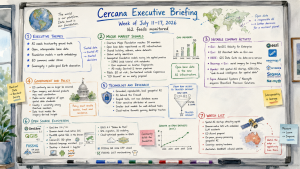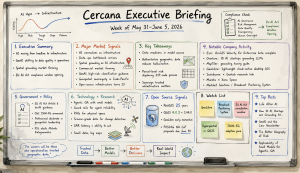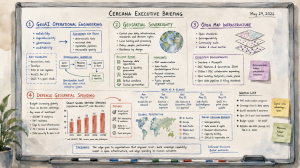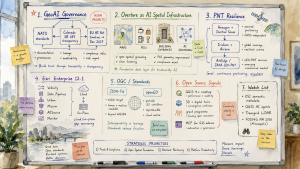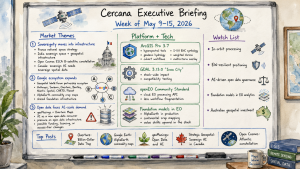

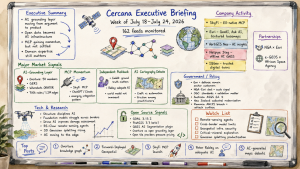
Cercana Executive Briefing: Week of May 9–15, 2026

161 feeds monitored. Published May 15, 2026.

Executive Summary

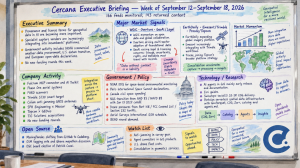
Three themes shaped this week’s geospatial activity across policy, platform strategy, and open data.

First, sovereignty is becoming a procurement and infrastructure strategy. France’s national space strategy, India’s integrated sovereign space and geospatial infrastructure program, and Open Cosmos’s final design for an eight-satellite European Atlantic constellation all appeared in the same week. Each points to governments reducing dependence on commercial supply chains they do not control. Canada’s Strategic Geospatial newsletter made the underlying logic explicit: geography determines AI advantage, and sovereign AI requires sovereign spatial data infrastructure.

Second, Google continued to define its role in the spatial intelligence market. Its Partnership of the Year award at the Geospatial World Forum recognized an ecosystem that spans Anthropic’s Claude, Sanborn, Overture Maps, Bentley, Niantic Spatial, CARTO, and Planet. Paired with Google Earth Engine’s release of annual global commodity crop maps built on its AlphaEarth foundation model, and Overture Maps’ argument that building proprietary map data is no longer economically rational, the pattern is consistent: spatial intelligence is moving toward shared foundation infrastructure, and Google is positioning itself near the center of that system.

Third, open data is under pressure from AI. Bill Dollins at geoMusings and the Overture Maps Foundation both published substantive arguments this week about AI systems becoming a new class of open data consumer at a scale that existing infrastructure was never designed to serve. This will require policy and technical responses. Leaders with dependencies on open geospatial data should be tracking the issue closely.

Esri’s ArcGIS Pro 3.7 release and GDAL 3.13.0 “Iowa City” round out a week of activity across both commercial and open-source stacks.

Market Themes

Sovereignty Moves into Infrastructure

The sovereignty theme moved from policy language into infrastructure planning this week. Open Cosmos unveiled the final design for eight Earth observation satellites destined for the European Space Constellation for the Atlantic (ESCA), a multi-nation program intended to reduce European dependence on US and commercial EO supply chains. At the Geospatial World Forum in Amsterdam, whose awards ceremony concluded this week, France’s SGDSN took the National Space Strategy of the Year award and India’s Department of Science and Technology, alongside IN-SPACe, won the Integrated Sovereign Space and Geospatial Infrastructure award.

Meanwhile, Strategic Geospatial published a long-form analysis arguing that Canada’s sovereign AI strategy is inseparable from its geospatial data infrastructure decisions. Australia’s Spatial Source reported on domestic SAR satellite technology development moving toward production. Governments across four continents are treating geospatial infrastructure as a strategic asset requiring domestic control, not a commodity service to be purchased. Vendors with deep ties to national programs, and open-source communities that provide sovereignty-compatible alternatives to commercial platforms, are positioned to benefit.

Google’s Spatial Intelligence Ecosystem Expands

Google’s receipt of the Geospatial World Forum Partnership of the Year award describes an ecosystem that extends across several parts of the spatial intelligence stack. The award citation connects Anthropic’s Claude AI, Sanborn Map Company, Overture Maps Foundation, Bentley Systems, Niantic Spatial, CARTO, and Planet. That coalition spans AI reasoning, ground-truth data, open base maps, engineering-grade 3D infrastructure, location services, analytics, and satellite imagery.

In the same week, Google Earth Engine published annual global commodity tree crop maps covering coffee, cocoa, oil palm, and rubber, built using AlphaEarth Satellite Embedding Foundation Models. The production model is the main development: a foundation model trained on petabytes of satellite imagery generating analysis-ready outputs at continental scale.

Separately, the Overture Maps Foundation published a strategic argument that the era of companies building proprietary planetary-scale map data has ended, describing shared open data infrastructure as the rational response to the AI efficiency imperative. Taken together, these moves describe an emerging architecture: Google anchors the foundation model layer, Overture provides the shared data layer, and an expanding partner ecosystem builds domain-specific applications on top.

Open Data Faces AI-Scale Demand

Two substantive analytical pieces this week tackled the same underlying problem from different angles. Bill Dollins at geoMusings wrote directly about AI systems emerging as a new category of open data consumer, one that operates at access patterns and scales that open data programs were never designed to accommodate. The Overture Maps Foundation’s “Billion-Dollar Data Trap” post argued that the AI infrastructure arms race has made it economically irrational to maintain proprietary map datasets, implicitly pushing more organizations toward open data pools.

The same AI arms race that pushes organizations toward open data also strains open data infrastructure beyond its design parameters. This dynamic will likely require new funding models for open data programs, API throttling or licensing changes, or a distinction between AI-accessible and human-accessible open data. Organizations whose workflows depend on open geospatial data at scale should be assessing their exposure now.

ArcGIS Pro 3.7 Extends Scientific and Infrastructure Workflows

ArcGIS Pro 3.7, released Thursday, adds breadth across imagery, hydrology, nautical charting, spatial analysis, and layout workflows. The release adds new hyperspectral imagery analysis tools, a geodesic flow direction algorithm for higher-accuracy hydrological modeling, improved culvert handling in drainage workflows, native S-101 ENC nautical symbology, a weighted Voronoi spatial influence tool, a multicriteria overlay tool, and a redesigned layout interface. These arrive alongside updates to Drone2Map, ArcGIS Reality, Business Analyst, and Site Scan.

The release suggests that Esri continues to push ArcGIS Pro toward scientific-grade analysis rather than positioning it purely as a data management and visualization platform. The hyperspectral and hydrological additions, in particular, show continued investment in environmental and infrastructure verticals.

Company Activity

Product Releases

Esri: ArcGIS Pro 3.7 released with significant additions in imagery analysis, hydrological modeling, BIM/CAD interoperability, and spatial analytics. Drone2Map 2026.1 and Site Scan May 2026 updates released simultaneously, indicating a coordinated platform push.

Google Earth Engine: Released annual global commodity crop maps for coffee, cocoa, oil palm, and rubber built on AlphaEarth foundation models. This is the first production-scale demonstration of Satellite Embedding Foundation Models generating analysis-ready agricultural monitoring outputs.

GDAL / OSGeo: GDAL 3.13.0 “Iowa City” released. Details appear in the Open Source section below.

Partnerships

BAE Systems GXP × Vantor: Partnership targeting electronic warfare resilience for high-accuracy drone targeting. This reflects growing integration between defense geospatial intelligence and EW-hardened positioning, a capability gap that the Ukraine conflict exposed and that NATO procurement is now actively closing.

Telit Cinterion × Swift Navigation: Skylark GNSS correction service bundled directly into Telit’s integrated IoT positioning modules, bringing centimeter-level accuracy to industrial IoT without requiring customers to manage correction service subscriptions separately.

Spiral Blue × Arlula: Australian in-orbit processing company Spiral Blue selected Arlula’s imagery distribution platform. The deal indicates that the in-orbit processing value chain is maturing. Raw satellite data is now being processed onboard and delivered via commercial marketplaces rather than requiring ground-station ingestion and post-processing.

Funding & M&A

NEC Software Solutions UK acquires Cadcorp: NECSWS, a UK public safety technology company, acquired Cadcorp, a UK-based GIS and web mapping software provider. The strategic logic is vertical integration: NECSWS gains a native geospatial stack to embed across its emergency services and law enforcement platforms rather than depending on third-party GIS licensing. This continues the pattern of non-geospatial enterprise software firms acquiring GIS capabilities rather than licensing them.

Government and Policy

The Geospatial World Forum 2026 awards, held April 29 in Amsterdam with recognition videos posted throughout this week, provided a useful snapshot of how the international community is valuing geospatial capability. France’s SGDSN winning the National Space Strategy award reflects its 2024–2030 defense space roadmap, which treats sovereign Earth observation as a strategic enabler. India’s DST and IN-SPACe joint award for Integrated Sovereign Space and Geospatial Infrastructure shows that India’s space liberalization policy has matured into operational infrastructure at a scale that peer nations are noting. Ordnance Survey’s win as National Mapping Agency of the Year reflects both its digital transformation and its growing role as a reference model for national agencies navigating the commercial-sovereign boundary.

The OGC’s publication of openEO as an official Community Standard is a significant milestone. openEO provides a standardized API for processing large-scale Earth observation data in cloud environments, reducing the fragmentation that forces customers to rewrite analysis workflows when switching between cloud EO platforms. Standardization at the API layer commoditizes undifferentiated infrastructure. That is good for users, but challenging for platforms whose value proposition depends on lock-in.

Australia continued to surface as an active geospatial investment market, with Spatial Source reporting on domestic SAR satellite development and ICEYE publishing an emergency response resilience case study.

Technology and Research

Foundation models for Earth observation are moving into production use. Google’s AlphaEarth Satellite Embedding Foundation Models produced continental-scale commodity crop maps with annual temporal resolution, a task that previously required substantial custom model development per crop type. The Spatial Edge’s analysis this week described how AlphaEarth’s latent space captures ecological structure not present in explicit training labels. This has implications for GIS platform vendors because analytical value is being extracted at the foundation model layer before data reaches traditional GIS tooling.

GeoSpatial ML published research on Gaussian Splat-based super-resolution for Sentinel-2 imagery, an early indication that computer vision techniques from autonomous vehicles and 3D reconstruction are migrating into satellite analytics.

Esri’s ArcGIS Pro 3.7 hyperspectral tools bring professional-grade spectral analysis inside the mainstream GIS platform. The geodesic flow direction and culvert-aware hydrological modeling extend its reach into environmental workflows that have historically relied on dedicated scientific tools. QGIS’s AI agent integrations continued to expand, with Open Geospatial Solutions publishing tutorials combining NASA OPERA data retrieval and satellite timelapse via natural language interfaces. That workflow template is becoming easier to reproduce.

Open Source Ecosystem

GDAL 3.13.0 “Iowa City” released on Sunday, the first major version since 3.12. GDAL underpins the entire geospatial stack, commercial and open source alike, so version increments ripple through hundreds of dependent tools. Organizations running automated pipelines should begin compatibility testing. Downstream distributions will take several months to propagate.

The OGC’s elevation of openEO to Community Standard status is both a standards milestone and an open-source ecosystem win. openEO standardizes the API for processing large-scale EO data in cloud environments, reducing workflow fragmentation across platforms. Standards compliance in procurement-driven environments will accelerate adoption, which benefits users but challenges platforms whose value proposition depends on workflow lock-in.

Oslandia published a detailed analysis of the QGIS version lifecycle covering the current LTR and Regular Release cadence. It is practically useful for organizations managing QGIS deployments at scale. FOSS4G North America’s guidance on abstract submissions shows an active call for practitioner content ahead of its 2026 conference.

Watch List

In-orbit processing: The Spiral Blue × Arlula deal is the latest indication that edge processing on satellite buses is becoming a distributable product, rather than a research-only capability. Watch for distribution platform consolidation as more in-orbit processors come to market.

EW-resilient positioning: The BAE Systems GXP × Vantor partnership suggests that GPS-denied or GPS-spoofed environments are now a baseline design assumption in defense geospatial procurement. Civilian critical infrastructure operators, including energy, transport, and utilities, may face regulatory pressure to follow.

AI-driven open data governance: The Dollins and Overture arguments this week are credible early indicators. If AI training and inference workloads continue consuming open geospatial data at scale, expect a governance debate about access tiers, rate limits, or AI licensing terms for open data, potentially within 18 months.

Foundation models in EO analytics: Google’s AlphaEarth production maps show that commodity EO analysis is moving up the stack, toward foundation model output and away from per-project model development. Firms whose revenue depends on bespoke EO model development should be tracking this closely.

Australian geospatial investment: Multiple developments this week, including SAR development, ICEYE’s resilience case study, and Spatial Information Day, suggest Australia is entering an active infrastructure investment phase. International vendors with Australian presences should be positioning.

Top Posts of the Week

  1. The Billion-Dollar Data Trap: Why Building Your Own Map is No Longer a Viable Business Strategy, Overture Maps Foundation
    A strategic argument that the AI efficiency imperative makes proprietary planetary-scale map data economically unsustainable. This is the most direct statement yet of Overture’s market thesis.
  2. Scaling Transparency: Annual, Pan-Tropical Commodity Maps Powered by AlphaEarth Foundations, Google Earth and Earth Engine
    The first production-scale demonstration of Google’s Satellite Embedding Foundation Models generating analysis-ready continental outputs. It sets a new benchmark for what foundation models can deliver in applied EO.
  3. Open Data and AI, geoMusings (Bill Dollins)
    A clear-eyed analysis of AI as a new and poorly understood class of open data consumer, raising questions that the geospatial community has not yet seriously organized around.
  4. Geography and the Future of Sovereign AI in Canada, Strategic Geospatial
    Makes the case that sovereign AI strategy is inseparable from sovereign geospatial data infrastructure. The argument is relevant well beyond Canada.
  5. Open Cosmos Builds Atlantic Satellite Constellation To Advance European Earth Observation Capability, Geoconnexion
    Final design reveal for ESCA’s eight-satellite EO constellation, the most concrete European sovereign space infrastructure announcement of the year so far.

Cercana Executive Briefing is generated from 161 feeds aggregated by geofeeds.me.
Cercana Executive Briefing — Week of May 2–8, 2026

160 feeds monitored. Published May 8, 2026.


Executive Summary

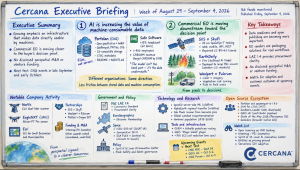
The defining story of this week is EarthDaily’s one-two punch: a full six-satellite constellation declared operational, followed within 48 hours by a National Reconnaissance Office contract award under the Strategic Commercial Enhancements (SCE) Commercial Solutions Opening. Either event would be notable on its own. Together, they mark a milestone in commercial Earth observation’s integration into national security infrastructure. The NRO’s SCE-CSO vehicle is designed for rapid commercial capability evaluation, and EarthDaily winning a slot in that framework, with 22-band, daily global multispectral data, confirms that science-grade commercial Earth observation has cleared an intelligence-community bar. For the broader commercial Earth observation sector, the message is clear: government customers remain committed to sourcing broad-area multispectral coverage from commercial constellations, and EarthDaily has established itself as an early mover at the quality tier that national security workflows require.

That supply-side validation landed during the same week the software side of the geospatial market was openly questioning whether purpose-built platforms are still necessary. A widely circulated podcast asked whether AI foundation models could replace geospatial platforms entirely; a product launch demonstrated AI-front-ended Earth observation workflows in production; and a detailed technical post from a 25-year Esri partner identified the unsolved identity and permissions problem that enterprise agentic GIS workflows must resolve before they can scale. These are not separate conversations. They are the same market interrogating the same inflection point from different vantage points.

At the same time, MapLibre and QGIS each executed major architectural transitions this week, suggesting that the open-source geospatial stack is rationalizing for the next decade of tooling. Leaders should track the identity and governance layer for agentic GIS, the NRO’s SCE-CSO vehicle for further commercial Earth observation contract awards, and Pixxel’s on-orbit processing announcement as a potential inflection point in where Earth observation analytics value is generated.


Major Market Signals

EarthDaily’s Double Strike: Constellation Complete, NRO Contract Won

This was EarthDaily’s week. The Vancouver-based Earth observation company achieved two significant milestones in 48 hours: the May 4 announcement that its full six-satellite constellation is on orbit and delivering daily global multispectral coverage, followed by a May 5 award from the National Reconnaissance Office for a $1.2 million commercial Earth observation contract. The contract, issued under the Strategic Commercial Enhancements Commercial Solutions Opening, calls for multispectral imagery delivery, end-to-end tasking, collection, product dissemination, and modeling and simulation for NRO and its mission partners. EarthDaily’s Chief Revenue Officer described the award as “an important step in establishing a scalable contracting framework for future U.S. government demand,” framing it as a bridgehead contract rather than a one-off engagement.

The constellation delivers 22 spectral bands at daily global coverage and is purpose-built for broad-area change detection. EarthDaily also published a blog post this week making the analytical case for “trusted measurement” as the basis of GEOINT advantage, a positioning move timed with the NRO announcement. With full operational capability expected later in 2026, the company is executing a deliberate dual-track strategy: demonstrate technical readiness with hardware delivery, then monetize it through federal contract vehicles that create a path to recurring government revenue.

Geospatial Platforms Under Pressure From AI Agents

Multiple independent voices converged this week on a shared question: what role do purpose-built geospatial platforms play when AI agents can increasingly assemble workflows from raw data and foundation models? The Applied Geospatial podcast put the question bluntly, “Are Geospatial Platforms Dead?”, and explicitly named Claude as a potential replacement for traditional platform architecture, exploring the economics of platform value versus custom AI-driven development. GeoAlert launched MapflowAgent, a natural-language chat interface to its geospatial AI engine, demonstrating that AI-front-ended Earth observation workflows have crossed from concept to commercial product.

GEO Jobe, a 25-year Esri Platinum Partner, published the week’s most substantive technical argument: agentic GIS workflows built on service accounts silently bypass every permission boundary an organization has set up, and the only viable path at enterprise scale is session-based identity that reflects each user’s actual ArcGIS permissions. The company will demonstrate a full session-aware solution at the Esri User Conference in July. Taken together, the week’s conversation reflects a genuine market inflection point. AI agents are capable enough to challenge geospatial platform assumptions, but the governance, identity, and security architecture required to operate them inside organizations has not been solved. The vendors who solve it are well positioned. Those who layer chat on top of existing platforms without addressing identity may find the value proposition harder to defend.

MapLibre Executing Its Most Significant Architectural Transition in Years

MapLibre’s April 2026 newsletter, published at the start of this window, reveals the project in the middle of a coordinated architectural pivot. MapLibre GL JS v6 pre-releases are underway with two major breaking changes: dropping WebGL1 support and transitioning from CommonJS to ESM. The project is deliberately shedding legacy constraints inherited from its origins. At the same time, MapLibre React Native v11, now exclusively supporting React Native’s new architecture, overhauled its API to align with MapLibre GL JS, creating a unified development surface across web and native for the first time.

The Flutter plugin received rebuilt offline regions with pause/resume support and production-ready WASM on Flutter Web. A new experimental C API opens MapLibre Native to platforms, including potential Rust, Kotlin, and Swift integrations, that could not previously use it as a dependency. This is a coordinated multi-platform transition rather than routine maintenance. For organizations running production maps on MapLibre, migration work lies ahead, but the project is delivering a substantially cleaner and more modern stack on the other side. The timing, coinciding with QGIS 4.x gaining momentum, suggests the open-source geospatial stack is broadly modernizing around current web and native primitives.

QGIS 4.x Adoption Moving Beyond Early Adopters

QGIS 4.0.2 “Norrköping” shipped on May 8 alongside LTR 3.44.10 “Solothurn,” with plugin ecosystem activity running in parallel: a geoscience plugins webinar specifically targeting QGIS 4, a new GeoPackage Exporter plugin, and expanded GeoBasis_Loader tooling adding 55 new data themes for German-speaking users. Three months into QGIS 4’s release, the simultaneous maintenance of both LTR and 4.x branches is running smoothly, and vertical-specific tooling is beginning to appear.

The geoscience sector is producing dedicated QGIS 4 plugins; the German geodata community is expanding data access tooling; and Spanish-language community resources for serverless QGIS web publishing are emerging. These are signals of a project moving beyond early adopter territory and into broader professional deployment. That is the point at which ecosystem depth compounds. The OGC Canada Forum at GeoIgnite 2026, convening this week, was already positioning QGIS 4 within national mapping strategy conversations.


Notable Company Activity

Product Releases

  • GeoAlert: Launched MapflowAgent, a conversational AI interface to its geospatial AI engine for satellite imagery analysis. Users can query and process imagery through natural language rather than manual platform workflows, representing the company’s move from tool to agent-accessible service.

Partnerships

  • Geoforce × AT&T Business: Launched the GT1c, a rugged LTE asset tracker designed for challenging industrial environments, using AT&T’s commercial network for connectivity. The product targets asset tracking in sectors such as oil and gas, construction, and logistics.

Government Contracts

  • EarthDaily × NRO: $1.2 million commercial Earth observation contract via the Strategic Commercial Enhancements Commercial Solutions Opening, covering multispectral imagery delivery, tasking, and product dissemination for intelligence community use.

Government and Policy Developments

The federal Earth observation market moved meaningfully this week, anchored by the NRO’s selection of EarthDaily under its Strategic Commercial Enhancements vehicle. The SCE-CSO mechanism is designed for rapid integration of commercial capabilities into national security workflows, and the EarthDaily award, coinciding with the company’s completed constellation, signals that the intelligence community is increasingly comfortable sourcing broad-area multispectral data commercially rather than relying solely on government-owned assets. This is consistent with a multi-year pattern of NRO and NGA accelerating commercial Earth observation integration, but EarthDaily’s science-grade calibration positioning appears to be a differentiating factor.

FedGeoDay 2026 post-event coverage surfaced USACE’s U-SMART program and the Census Bureau’s LEHD data infrastructure as examples of federal geospatial programs actively building toward AI-compatible data architecture. The underlying theme, AI readiness as a federal data stewardship priority, is emerging as a throughline in federal geospatial policy, separate from any specific application.

In Canada, the OGC Canada Forum at GeoIgnite 2026 advanced conversations around a collaborative national geospatial strategy. GeoIgnite, Canada’s national geospatial conference, attracted OGC as a formal convening partner this year, signaling that Canada is moving from informal geospatial coordination to a standards-aligned national framework.

New Zealand’s LINZ announced it is actively exploring present and future AI applications within its national spatial data mandate, joining Australia and Canada among English-speaking national mapping agencies beginning to formalize AI positions. On the regulatory side, a new U.S. rule targeting drone threats to critical infrastructure advanced this week, and AirData UAV joined the Commercial Drone Alliance ahead of expected FAA Part 108 adoption, the framework that will govern commercial drone remote ID and airspace access at scale. ESA declared Sentinel-1D fully operational, adding reliable C-band SAR coverage to the European Earth observation infrastructure portfolio.


Technology and Research Trends

The most structurally significant technical development this week is Pixxel’s announcement that it plans to implement on-orbit Earth observation imagery processing. By moving computation to the satellite rather than the ground station, Pixxel is betting that the commercial Earth observation value chain will shift from data delivery to inference delivery, with customers receiving analytics rather than raw spectral bands. If this works at scale for hyperspectral imaging, it changes what “Earth observation data product” means, reduces ground station bandwidth requirements, and potentially shifts the competitive moat from constellation access to on-board model quality. This is an architecture decision worth watching closely.

At the same time, GeoSpatial ML published ThroughputBench, a benchmarking framework for deep learning geospatial models that quantifies how fast models can map the Earth at scale. As foundation models for Earth observation mature from research artifacts to production tools, quantitative benchmarks of this kind become procurement vocabulary. The Medium post “GeoFMs in 5 Minutes: From Earth Observations to Embeddings” continued a trend of practitioner-level foundation model primers reaching an audience that is only now approaching these tools. The throughput question and the embedding quality question are related: organizations evaluating GeoFM adoption need both benchmarks.

Natural language as the geospatial interface surfaced in multiple forms this week: MapflowAgent for Earth observation workflows, the “etter” natural-language location tool from the Swiss Spatialists community for geocoding, and the broader platform replacement debate. The direction of travel is consistent. Natural language is becoming the front end to geospatial computation across multiple workflow types. The technical constraint is the identity and authorization layer in between, which GEO Jobe identified as the unsolved problem this week.


Open Source Ecosystem Signals

QGIS 4.0.2 and 3.44.10 LTR shipping on the same day reflects a healthy dual-track release process. More revealing is what is happening in the plugin and tooling ecosystem: a geoscience plugins webinar coordinated specifically around QGIS 4 capabilities, a new GeoPackage Exporter plugin, GeoBasis_Loader expanding to 55 data themes, and Spanish-language tutorials for serverless QGIS web publishing all indicate the community is actively building production tooling around the 4.x branch rather than simply maintaining 3.x compatibility. QGIS 4 ecosystem depth is compounding.

MapLibre’s April newsletter may represent the most architecturally significant month in the project’s recent history. The v6 transition, dropping WebGL1 and CommonJS, removes two long-standing legacy constraints inherited from MapLibre’s origins as a Mapbox fork. The explicit acknowledgment that migration will require effort, paired with a commitment to thorough migration documentation, is a sign of mature project governance. The new experimental C API for MapLibre Native is an underappreciated development. It opens the possibility of MapLibre bindings for systems languages that could not previously integrate it, which could expand the project’s reach into embedded, server-side, and edge deployments.

FOSS4G North America 2026 opened its Call for Proposals this week, confirming the conference is on track. FOSS4G NA CFP activity is a useful leading indicator because presentations accepted now tend to represent capabilities that reach broader adoption six to twelve months later.

Fuzzifying PostGIS, covered by Spatialists, brings fuzzy matching capabilities to PostGIS queries, reducing the need for separate similarity-matching infrastructure outside the database. For organizations doing address resolution, entity matching, or feature deduplication on spatial data, this kind of native database capability is operationally significant.


Watch List

  • Agentic GIS Identity as a Product Category: GEO Jobe’s analysis is an early warning signal that enterprise agentic GIS will generate security and compliance requirements around identity-aware tooling. Expect session-scoped MCP servers and permission-aware agent frameworks to emerge as a product category in the next 12–18 months.
  • Pixxel On-Orbit Processing: If Pixxel delivers on-orbit analytics at commercial scale, it redefines what “Earth observation data product” means for the hyperspectral segment. Watch for announcements about processing depth, latency performance, and early customer validation.
  • Taylor Geospatial World-First Global Map: Taylor Geospatial Institute claimed a “world-first global map” this week. The nature and methodology of the claim were not fully detailed in available coverage, but novel global-scale geospatial datasets are worth verifying if they hold up. This could become a significant reference dataset.
  • Natural Language Location (etter): A natural-language location interpretation tool surfaced in the Swiss Spatialists community. It is early-stage, but if natural-language location understanding scales, it has implications for address data markets, GIS data entry interfaces, and the geocoding industry.
  • GeoAI Legal Frameworks Forming: A dedicated newsletter tracking the legal dimensions of geospatial AI continued publishing this week. As GeoAI becomes commercially embedded, legal and regulatory frameworks will develop, likely faster than much of the industry anticipates.

Top Posts of the Week

  1. EarthDaily Selected by National Reconnaissance Office for Commercial Optical Earth Observation ContractEarthDaily Blog — The $1.2 million NRO award is the most consequential contract disclosure of the week, confirming EarthDaily’s constellation is production-ready for intelligence community use and establishing a government contracting path for future awards.
  2. EarthDaily Advancing Daily Global Measurement of Planetary Change with Six Satellites LaunchedEarthDaily Blog — Full constellation on orbit: daily global multispectral coverage across 22 bands is now operational, completing the foundational infrastructure for EarthDaily’s government and commercial ambitions.
  3. ArcGIS Agentic Workflows Have an Identity ProblemGEO Jobe — The week’s most substantive technical argument: service-account-based agentic GIS workflows silently bypass every organizational permission boundary, and session-based user identity is the only viable path at enterprise scale.
  4. MapLibre Newsletter April 2026MapLibre — v6 pre-releases underway, React Native v11 API overhauled, new C API launched: the open-source mapping stack’s most significant architectural transition in years, executed in parallel across all platforms.
  5. Live from New York: Are Geospatial Platforms Dead?Applied Geospatial (Christopher Ren) — A pointed podcast conversation that explicitly questions whether AI foundation models can replace purpose-built geospatial platforms, the sharpest framing yet of a question the whole industry is circling.

Cercana Executive Briefing is generated from 160 feeds aggregated by GeoFeeds.

Cercana Executive Briefing — Week of April 25–May 1, 2026

153 feeds monitored. Published May 1, 2026.

Executive Summary

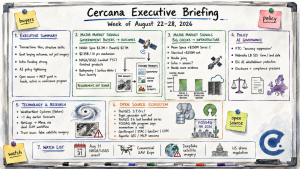
Two themes defined this week, and they reinforce each other in ways that deserve executive attention. The first is vendor consolidation. VertiGIS’s £87 million acquisition of 1Spatial marks the largest geospatial M&A event in recent months, combining enterprise data quality with location intelligence in a deal explicitly framed around the next wave of AI-powered geospatial networks. The second is the accelerating reconceptualization of geospatial from a mapping function to decision infrastructure. GoGeomatics’s interview with Nadine Alameh ahead of GeoIgnite 2026 and a Reimagining Geospatial post on “Earth models” both articulate the same thesis from different angles: the industry is moving from maps to autonomous decision loops, with geospatial foundation models as the enabling architecture.

These two threads, consolidation around data quality and the rise of AI decision infrastructure, are not coincidental. As the stakes of spatial AI outputs grow, the demand for accurate, authoritative, well-governed base data grows with it. The VertiGIS/1Spatial deal is, in part, a bet on exactly that premise.

Alongside these, FedGeoDay 2026 surfaced a distinct and important development: the U.S. federal government is treating geospatial data preservation as a national security priority, not merely an archival task. Combined with Bentley Systems achieving FedRAMP authorization for its infrastructure digital twin platforms, the government market is quietly but consistently hardening its geospatial data infrastructure. Leaders should watch this track closely because it is where procurement follows strategic intent.

Major Market Signals

Enterprise Consolidation Accelerates Around Data Quality and Location Intelligence

The VertiGIS acquisition of 1Spatial, a £87 million take-private deal announced Thursday, is the clearest indication yet that the upper tier of enterprise geospatial is consolidating around the convergence of data quality, governance, and AI-ready infrastructure. VertiGIS, best known for its GIS application platforms built on Esri and open-source stacks, is acquiring 1Spatial’s global data quality and management business. The combined entity positions itself to serve the data quality demands that AI-driven geospatial workflows expose at scale. For executives, the implication is straightforward: when AI systems ingest spatial data for automated decisions, bad data quality has operational consequences, not just analytical ones. The deal suggests that the market recognizes this and that vendors are racing to own the quality layer before their customers demand it as a commodity.

Geospatial Reframes From Mapping to Decision Infrastructure

Two independent posts this week articulate what may become the defining strategic narrative of 2026: geospatial is ceasing to be a visualization and analysis tool and becoming the substrate for autonomous decision-making. Nadine Alameh’s GeoIgnite 2026 preview interview frames natural language interfaces and GeoAI as enabling “decision loops,” or systems that act on spatial intelligence rather than merely displaying it. At the same time, Reimagining Geospatial published a structural analysis of “Earth models” that asks whether the industry will produce one comprehensive geospatial foundation model or a proliferation of vertical-specific models. These are not theoretical discussions. They define the architecture of geospatial AI investment for the next three years. The convergence of two independent voices on this idea in a single week suggests the market’s mental model is shifting.

U.S. Federal Geospatial: From Access to Resilience

FedGeoDay 2026, held at the U.S. Census Bureau in Suitland, Maryland, drew coverage from two independent observers this week. Both noted a pronounced shift in the event’s thematic focus toward data preservation and federal data stewardship. The opening keynote by Denice Ross anchored a program explicitly oriented around what happens to geospatial data assets when agencies are restructured or defunded. Separately, Bentley Systems announced FedRAMP authorization for ProjectWise and OpenGround, enabling federal agencies to deploy its infrastructure digital twin environment in compliant cloud settings. Taken together, these developments reflect a federal geospatial market that is less focused on new capability acquisition and more focused on fortifying the data and software infrastructure it already has. That posture shift has direct implications for government contract strategy.

Satellite-Based Predictive Analytics Expands Into Commodity Markets

Geospatial FM’s profile of QuantAgri, a startup using satellite data to predict USDA’s monthly WASDE agricultural supply and demand reports, illustrates a market trajectory worth tracking: the commercialization of EO analytics as a financial edge tool in commodity trading. This use case, satellite-derived crop intelligence feeding into trading models, represents a premium, high-margin vertical that bypasses traditional government or enterprise procurement cycles. It also highlights a useful counterpoint to Bill Dollins’s essay this week, discussed in the Technology section, which argues that satellite data has genuine blind spots in tracking industrial infrastructure transitions. Both point to a maturing EO market in which buyers are becoming sophisticated enough to understand where satellite analytics delivers alpha and where it does not.

Notable Company Activity

Funding and M&A

  • VertiGIS × 1Spatial: VertiGIS completed a £87 million take-private acquisition of 1Spatial, combining VertiGIS’s enterprise GIS application platform with 1Spatial’s geospatial data quality, governance, and management capabilities. The deal is framed around delivering AI-ready spatial data infrastructure for network operators, utilities, and government customers globally.
  • Spaceflux: London-based space situational awareness company Spaceflux raised a £3.5 million extension to its seed round, bringing total funding to £9 million. The capital will fund global expansion of its space intelligence platform, which tracks objects and activity in Earth orbit for commercial and government customers.

Product Releases

  • Esri, ArcGIS GeoEvent Server Deprecation: Esri announced the formal deprecation of ArcGIS GeoEvent Server, its legacy real-time event processing product. The deprecation points to Esri’s strategic migration of real-time geospatial capabilities to cloud-native and ArcGIS Velocity-based workflows. This is a meaningful architecture shift for enterprise customers running real-time IoT or sensor pipelines.
  • Bentley Systems, FedRAMP Authorization: Bentley Systems achieved FedRAMP authorization for ProjectWise, its connected data environment, and OpenGround, its subsurface data management product. The authorization clears the path for U.S. federal agencies to use Bentley’s infrastructure digital twin platform in regulated cloud environments.

Partnerships

  • HTX × ST Engineering, Singapore: Singapore’s Home Team Science & Technology Agency and ST Engineering announced a new space technology program targeting enhanced public safety operations. The partnership is an early indicator of Asia-Pacific government demand for integrated space-derived intelligence in domestic security applications.

Government and Policy Developments

FedGeoDay 2026 was the week’s most substantive government development. Two independent observers, Bill Dollins at geoMusings and the Project Geospatial team, both covered the event and noted that the program was organized around a thematic spine of data preservation and federal stewardship. The practical implication is clear: U.S. federal geospatial strategy is currently oriented around protecting and maintaining existing spatial data assets rather than expanding capabilities, a direct response to the fiscal and organizational pressures on civilian agencies. For vendors, this is a shift from sell-new to maintain-and-secure, with procurement conversations centering on data resilience and continuity rather than feature expansion.

Bentley Systems’ FedRAMP announcement is a complementary development. ProjectWise and OpenGround joining the FedRAMP authorized list removes a key procurement barrier for federal infrastructure agencies, particularly those managing the Biden-era infrastructure buildout assets now operating under the current administration’s scrutiny. Compliance certification is not glamorous, but in the federal market it is the precondition for revenue.

The ISPRS Congress announcement, with the XXV International Society for Photogrammetry and Remote Sensing Congress returning to Canada for the first time in decades and co-locating with the 47th Canadian Symposium on Remote Sensing, points to the continued elevation of Canada as a geospatial industry hub. GeoIgnite 2026 in Ottawa, scheduled for May 11–13, adds to this picture. For executives with North American government or academic portfolios, the Canadian geospatial market warrants closer attention this year.

Technology and Research Trends

The week’s most thought-provoking analytical piece came from Bill Dollins at geoMusings: “What Spatial Finance Cannot See From Orbit.” Using the premature retirement of a Maryland coal plant as a case study, Dollins argues that satellite imagery and EO-derived spatial finance tools systematically undercount the pace of industrial infrastructure transitions because the physical footprint of a plant does not change when its operations cease. This is a calibration argument, not a dismissal. EO data is a leading indicator in some contexts and a lagging one in others, and sophisticated buyers are increasingly capable of distinguishing between them. For the spatial finance market, this piece functions as a market maturation marker. The buyers are getting smarter.

The Earth models debate, articulated in Reimagining Geospatial’s “Autonomous Flying Cars and Geospatial Earth Models,” raises a structural architecture question that will have vendor strategy implications for the next 24 months. The author’s position that specialized vertical models are more likely to prevail over a single monolithic Earth model aligns with the general direction of AI development across other domains. If correct, it suggests that geospatial AI value will accrue to domain-specific applications, such as agriculture, infrastructure, and emergency management, rather than to general-purpose foundation model providers. This has direct implications for how executives should evaluate GeoAI platform investments.

ECOSTRESS land surface temperature data is emerging as a serious tool for characterizing active wildfire behavior in near real time, a trend documented this week in EarthStuff’s coverage of a new peer-reviewed application. Separately, Spatial Source reported on a multi-sensor approach combining GIS, LiDAR, and AI for high-resolution tree cover loss monitoring. Both developments show continued momentum in applied EO analytics for environmental monitoring use cases, where government and insurance market demand is growing.

Open Source Ecosystem Signals

GDAL v3.12.4 shipped this week, a maintenance release noted by the #geoObserver feed. While not a feature release, the cadence of GDAL maintenance updates matters. GDAL underpins virtually every geospatial pipeline in production, and the continued pace of patch releases reflects healthy core maintainer activity. Organizations evaluating the health of their open-source dependencies should track GDAL maintenance velocity as a baseline indicator.

Esri’s deprecation of ArcGIS GeoEvent Server has indirect open-source implications. Organizations running real-time geospatial pipelines on GeoEvent Server that are unwilling or unable to migrate to Esri’s cloud-native replacement may look to open-source alternatives, such as Apache Kafka with spatial extensions or GeoServer’s OGC API Features real-time implementations, as migration paths. Esri’s deprecation decision creates a procurement opening that open-source stack integrators should consider.

Mapscaping’s large-scale publication this week of state-by-state public data maps, including PFAS contamination, wind turbines, EV charging stations, power plants, and storm reports, is a notable content and SEO play rather than a product announcement. It also points to growing commercial appetite for localized, authoritative public-data visualizations as a discovery and lead-generation tool. The underlying data layers are open. The differentiation is in packaging and accessibility.

Watch List

  • Space Situational Awareness as a Commercial Market: Spaceflux’s £9M raise and Singapore’s HTX/ST Engineering space program both appeared in the same week. The commercial SSA market, which tracks orbital objects and activity, is attracting sustained capital and government partnership attention outside the traditional defense procurement path.
  • GeoAI Vocabulary Hardening: The phrase “decision loop” appears in the Alameh interview, while “Earth models” anchors the Reimagining Geospatial piece. When independent voices begin converging on the same vocabulary, vendor positioning language often follows. Watch for these terms in product announcements over the next 60 days.
  • Satellite-Derived Commodity Trading Intelligence: QuantAgri’s EO-to-WASDE prediction model represents a thin edge of a market, satellite analytics sold into commodity trading workflows, that is distinct from enterprise GIS and worth monitoring for funding activity.
  • Canadian Geospatial Market Elevation: GeoIgnite 2026, scheduled for May 11–13 in Ottawa, and the ISPRS Congress announcement position Canada as an unusually active geospatial hub this cycle. Executive attention and vendor investment may follow.
  • Foursquare Conversational API: Foursquare published an internal post this week on testing methodology for its conversational location API. This is a sign that production-grade natural language location interfaces may be closer to deployment than they appear in public announcements.

Top Posts of the Week

  1. VertiGIS acquires 1Spatial: Discover what this means for geospatial customers, products, and the industry, VertiGIS Blog. The definitive primary source on the week’s largest M&A transaction, framing the deal as an AI-readiness play for geospatial data quality at scale.
  2. FedGeoDay 2026: Four Talks Worth Your Attention, geoMusings by Bill Dollins. A substantive summary of FedGeoDay’s data-preservation-focused agenda and the most direct window into current U.S. federal geospatial strategy.
  3. From Maps to Decision Loops: Nadine Alameh on Rethinking Geospatial in the Age of AI, GoGeomatics. A pre-GeoIgnite interview articulating the “decision loop” framing for GeoAI that is gaining traction as the industry’s organizing narrative for 2026.
  4. What Spatial Finance Cannot See From Orbit, geoMusings by Bill Dollins. A rigorous critical analysis of EO data’s blind spots in spatial finance applications, essential reading for anyone pricing or purchasing satellite-derived analytics.
  5. Autonomous Flying Cars and Geospatial Earth Models, Reimagining Geospatial. A structural analysis of the monolithic-versus-specialized Earth model debate, with direct implications for how executives should evaluate geospatial AI platform bets over the next two years.

Cercana Executive Briefing is generated from 153 feeds aggregated by geofeeds.me.
Cercana Executive Briefing — Week of March 14–20, 2026

Executive Summary

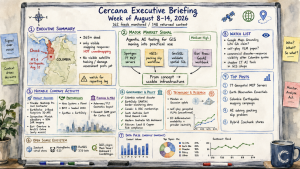
The clearest story this week is the way two separate announcements converge into a single market signal. NVIDIA introduced its first space-optimized AI computing module at GTC in San Jose. At nearly the same time, Planet Labs announced a GPU-native AI engine built on NVIDIA’s Blackwell and IGX Thor platforms. Taken together, these are more than routine product updates. They are a public indication that AI-accelerated geospatial intelligence is moving from experimentation into infrastructure.

Processing satellite imagery in seconds instead of hours, building planetary-scale vector embeddings for semantic search, and placing GPU hardware directly on satellites all point toward the same conclusion. This is becoming the new architecture of Earth observation.

That signal grew stronger this week as Google completed the global rollout of its AlphaEarth Foundations 2025 satellite embedding layer and demonstrated vector search integration across BigQuery and Earth Engine. This is a different path toward a very similar destination. When two major platforms move toward AI-native EO infrastructure at the same time, it is hard to dismiss it as coincidence. It looks much more like an inflection point.

At the same time, governments continued to build strategic distance from GNSS dependency. The United Kingdom released new funding to advance its National Timing Centre with atomic clock infrastructure as part of a broader multi-year program focused on sovereign PNT resilience. In the United States, the community-led HIFLD Next Commons launched to restore access to federal infrastructure datasets that were quietly shuttered in August.

The open-source side of the industry had its own important signal. QGIS launched one of its most coordinated sustainability pushes in recent memory, with a sustaining member campaign, a grants round, and a new flagship member all announced in the same week.

For decision-makers, the questions raised this week are fairly direct. Is your EO pipeline ready for GPU-native processing architectures? What is your exposure to GNSS dependency in critical operations? And if your work depends on U.S. public geospatial data, how much of it still rests on federal datasets that may no longer be reliably available?

Major Market Signals

GPU-Native EO Infrastructure Becomes the Production Standard

The most important structural development this week is the simultaneous move by NVIDIA and Planet Labs toward a GPU-native architecture for satellite imagery processing. NVIDIA launched its space computing platform at GTC, combining the IGX Thor and Jetson Orin modules into a system designed for size-, weight-, and power-constrained spacecraft environments. The company’s goal is explicit: bring data-center-class performance into orbit.

Jensen Huang put it simply: “intelligence must live wherever data is generated.” Planet, which operates the world’s largest Earth-observation constellation, said it will deploy NVIDIA hardware on its next-generation Pelican satellites and Owl constellation. The company also said this will reduce imagery processing from hours to seconds and allow it to apply NVIDIA’s CorrDiff generative AI diffusion model to produce physics-informed super-resolution imagery from its existing archive.

Planet also disclosed plans to convert its daily data stream into AI embeddings, making semantic search across global imagery possible at a new scale. Its stock rose by roughly 8% on the announcement, and the company also reported record Q4 revenue of $86.8 million, up 41% year over year. The market appears to be reading this not simply as a partnership announcement, but as a deeper shift in Planet’s model from imagery provider toward AI-native intelligence platform.

Other space companies, including Kepler, Aetherflux, Axiom Space, Capella, Sophia Space, and Starcloud, are also integrating NVIDIA platforms for orbital compute. That makes this look less like a one-off deal and more like an ecosystem shift.

Geospatial Foundation Models at Planetary Scale

The convergence between Planet and NVIDIA’s GPU-native processing strategy and Google’s AlphaEarth work points to a new baseline for EO analytics. Google completed its 2025 AlphaEarth Foundations satellite embedding update this week, delivering full global coverage at 10-meter resolution as a freely available dataset in Google Earth Engine and Cloud Storage.

The model compresses annual multi-sensor data, including Sentinel-2 optical, Sentinel-1 radar, Landsat thermal, GEDI LiDAR, climate models, and gravity fields, into 64-dimensional embeddings per pixel. That creates a practical foundation for similarity search, change detection, and downstream machine learning without requiring users to run their own deep learning inference stack.

Separately, a Google Earth blog post this week demonstrated embedding-based vector search across BigQuery, Earth Engine, and AlphaEarth Foundations. That is one of the clearest public signals yet of a unified semantic search pipeline for planetary data. For enterprise buyers, the significance is straightforward. A growing set of geospatial intelligence tasks, including similarity search, supply chain monitoring, and climate risk assessment, can increasingly be performed without deep remote sensing expertise or heavy infrastructure investment. That creates real pressure for traditional EO analytics vendors.

GNSS Sovereignty Investment Expands

A new funding release from the UK’s National Timing Centre program advanced construction of dedicated atomic clock infrastructure sites that will be connected through fiber and satellite to distribute a nationally assured timing signal independent of GPS or Galileo. The announcement, covered by Spatial Source this week, extends a multi-year UK investment program that now totals hundreds of millions of pounds across eLoran, atomic timing, GNSS interference monitoring, and space-based time transfer research and development.

The strategic framing is clear. Russian jamming and spoofing activity in and around conflict zones has demonstrated that GNSS-dependent critical infrastructure, including banking, telecommunications, energy, and transportation, carries an unacceptable single-point-of-failure risk. Australia is moving in a similar direction, with a reported $100 million CRC bid known as SHIELD for sovereign PNT submitted to the federal government.

The business implications extend beyond defense. Financial institutions, autonomous vehicle operators, precision agriculture vendors, and telecommunications infrastructure managers all face growing exposure to this risk category. National investment programs are also beginning to create procurement and partnership opportunities for vendors that can help address it.

US Open Infrastructure Geospatial Data Requires Alternative Sources

The launch of HIFLD Next, a community-stewarded portal built by Public Environmental Data Partners and supported by a growing coalition, marks a structured response from the geospatial community to the August 2025 shutdown of the HIFLD Open federal portal.

For more than two decades, HIFLD Open provided free and authoritative geospatial data on national infrastructure, including hospitals, schools, power plants, flood zones, and transportation networks. Emergency managers, researchers, planners, and state and local governments used it extensively. HIFLD Next preserves archived datasets in modern formats such as GeoParquet and PMTiles, and it is developing a governance model through the HIFLD Next Commons coalition.

This is a meaningful change in the U.S. geospatial data landscape. Organizations that relied on HIFLD Open data in their workflows, products, or contracts should be inventorying those dependencies now. Some datasets may need commercial replacements. Others may still exist through originating agencies, but without the unified access point that HIFLD once provided.

QGIS Coordinated Sustainability Push

In an unusually coordinated week for the QGIS ecosystem, three significant announcements landed almost together: the launch of the QGIS Sustaining Member Campaign 2026, the opening of QGIS Grants Round 11 with a call for development proposals, and the announcement that COSS has become the latest flagship sustaining member. Seen together, these moves suggest deliberate timing around a broader funding and engagement effort.

For enterprise decision-makers, the QGIS funding picture matters because it directly affects the reliability, security, and development pace of what is arguably the most widely deployed open-source GIS platform in the world. The expanding roster of sustaining members, which now includes companies, public agencies, and academic institutions, reflects the platform’s deeper role in production environments. The grants program continues to support core technical improvements that benefit the broader user base.

Notable Company Activity

Product Releases

  • Planet Labs: Announced a GPU-native AI engine in collaboration with NVIDIA, applying CorrDiff generative AI for super-resolution on PlanetScope imagery and building planetary-scale vector embeddings for semantic search. The company also reported Q4 FY2026 record revenue of $86.8 million, up 41% year over year, with full-year revenue of $307.7 million and FY2027 guidance of $415 million to $440 million.
  • Google: Completed the global rollout of AlphaEarth Foundations 2025 satellite embeddings in Earth Engine and Google Cloud Storage. The company also announced integration across BigQuery, Earth Engine, and AlphaEarth for vector search.
  • GeoSolutions: Released MapStore 2025.02, the latest version of its open-source web map composition platform.
  • Esri: Published several ArcGIS Blog posts this week covering Field Maps geospatial PDF workflows, cloud storage connectivity in ArcGIS Pro, and an AI-powered support chatbot. Together, they reflect continued incremental AI integration across the ArcGIS platform.
  • GeoCue: Launched the TrueView GO NEO LiDAR scanner, extending its airborne scanning portfolio.

Partnerships

  • NVIDIA × Planet Labs: GPU hardware integration on next-generation Pelican and Owl constellation satellites, along with CorrDiff AI and embedding architectures for ground processing. See the major signals section for more detail.
  • Trimble × Vermeer: Announced the Trimble Ready Option for Vermeer’s new SM55 Surface Miner, continuing the pattern of precision positioning integration in heavy construction equipment.
  • Q-Free × Sony Semiconductor Solutions: Announced a partnership to advance satellite-based road user charging technology, which suggests GNSS-based mobility pricing is moving closer to commercial deployment.
  • Quantum Solutions × Delmar Aerospace × Perspectum Drone: Partnered to deploy aerial hyperspectral water intelligence capabilities across North America.
  • Sanborn Geophysics: Expanded airborne electromagnetic survey services to support critical minerals exploration, positioning itself within the broader strategic minerals supply chain debate.
  • Fugro: Won a contract to map Texas river basins with LiDAR and geospatial analysis to improve flood resilience for regional water authorities.

Government and Policy Developments

The UK’s National Timing Centre advanced this week with a new funding release supporting dedicated atomic clock sites and combined fiber-and-satellite signal distribution. This forms part of a broader multi-year PNT resilience framework valued at more than £155 million and spanning eLoran terrestrial navigation, interference monitoring, and space-based time transfer research.

The framing from UK Science Minister Lord Vallance is notable. He said GNSS-based timing signals “are increasingly vulnerable to disruption” and that the government is “acting now.” That posture is becoming increasingly common across Europe and the Five Eyes community. Australia’s parallel bid for a $100 million Cooperative Research Centre for Secure, Hardened PNT, known as SHIELD, suggests this is not an isolated policy concern.

In the United States, the policy story this week is shaped as much by absence as by action. HIFLD Next represents an attempt by the community to fill the gap left by the federal retreat from open infrastructure data.

The Screening Tools post announcing HIFLD Next makes the issue plain. Authoritative and nationally consistent geospatial infrastructure data remains essential for emergency management, disaster response, and public safety planning, and the shutdown of HIFLD Open has not been matched by any federal replacement. For state and local governments, that is already an operational problem.

The Open Geospatial Consortium also published commentary this week on individual membership and influence through standards. That matters because its new individual membership tier, announced last week, lowers the barrier to formal participation in standards work. For vendors and practitioners who want to shape work around OGC API, GeoParquet, and emerging AI-related standards, that is a meaningful change.

Australia’s Digital Earth Australia also published water coverage datasets this week that reveal decades of historical water body presence. That is a significant open data release for catchment management, flood risk analysis, and agricultural planning.

Technology and Research Trends

The dominant technology story this week is the convergence of GPU compute with Earth observation pipelines. NVIDIA’s space computing platform, centered on the IGX Thor module introduced at GTC, is designed for the real constraints of spacecraft, including limited size, weight, and power, while still aiming to support data-center-class AI workloads. This is not a research concept. It is a production-oriented hardware offering aimed at satellite programs.

Combined with Planet’s CorrDiff super-resolution work and planetary vector embedding plans, the week points toward an architecture in which AI inference moves steadily closer to the sensor. The sequence is familiar now. First it moved to the ground station, then to the cloud, and now increasingly to the satellite itself. That has implications for downstream analytics vendors. If imagery arrives already processed and enriched, the value of adding analysis later in the chain may be reduced.

Google’s approach is related, though somewhat different. AlphaEarth Foundations looks backward across historical imagery, producing 64-dimensional annual embeddings for every 10-meter land pixel back to 2017. That supports similarity search, change detection, and classification with relatively little labeled data.

This week’s global 2025 update makes the current dataset broadly available, and the BigQuery integration suggests Google wants it to be usable at enterprise scale without requiring Earth Engine specialization. In practical terms, both Google and Planet are moving toward the same customer outcome from different directions. They are making geospatial intelligence more available on demand from very large EO archives, without requiring every customer to operate as a remote sensing specialist.

Elsewhere, LiDAR continues its steady expansion into new operational settings. Darling Geomatics published analysis on aerial LiDAR and photogrammetry for large-scale topographic surveys. Spatial Source covered a case study showing LiDAR helping reopen a mine after a safety event. GeoCue launched a new scanner. None of this suggests novelty. What it does suggest is a continued lowering of operational barriers and cost thresholds for proven technology.

Open Source Ecosystem Signals

QGIS’s coordinated sustainability effort this week may be the clearest sign yet of its evolution from a community-maintained tool into a strategically governed open-source platform. The Sustaining Member Campaign 2026 explicitly asks commercial users to formalize financial support. Grants Round 11 invites funded development proposals. COSS joining as a flagship sustaining member adds another institutional anchor.

This pattern is familiar from the longer history of projects such as PostgreSQL and Apache, where broad commercial dependence eventually leads to more deliberate funding structures for long-term sustainability. For enterprise QGIS users that have not yet become sustaining members, the question is becoming less philosophical and more operational. It is about supporting a dependency that already sits inside production workflows.

The PROJ coordinate transformation library turned 27 this week, as noted by geoObserver. PROJ sits underneath an enormous share of the geospatial software stack, both commercial and open source, anywhere coordinate systems and projections matter. Its continued maintenance is easy to overlook because it is so foundational. Anniversaries like this are useful reminders to ask whether organizations have any formal relationship with the open-source projects they rely on most.

OpenStreetMap US released the PWG Sidewalk Mapping Schema 1.0, a standardized schema for pedestrian infrastructure mapping. That matters for mobility planning, accessibility compliance, and autonomous navigation use cases that depend on structured and consistent sidewalk data at scale. The release marks a step forward from ad hoc community practice toward something organizations can more readily integrate into operational workflows.

GeoSolutions also released MapStore 2025.02, continuing development of an open-source web mapping platform used by national mapping agencies and public sector organizations across Europe.

Watch List

  • EO as a Public Good: Spectral Reflectance published “The Economics of Openness: Funding Earth Observation as a Public Good”, which makes an analytical case for treating EO data as public infrastructure. The argument is gaining relevance as U.S. federal open data retreats and commercial EO consolidation continues.
  • GeoAI Legal Frameworks Maturing: The GeoAI and the Law Newsletter published its latest edition, tracking regulatory and liability developments around AI applied to geospatial data. As GeoAI moves into production workflows, procurement language, liability standards, and intellectual property questions are likely to become more visible in vendor conversations.
  • Satellite-Based Road User Charging: The Q-Free and Sony partnership around satellite-based road pricing is a relatively quiet but commercially important application of GNSS-derived positioning. It also makes the UK’s GNSS sovereignty efforts more relevant for those watching mobility infrastructure.
  • Electronic Warfare and Geospatial Intelligence: Project Geospatial published an analysis of spectral techniques in modern electronic warfare. The growing use of GNSS jamming and spoofing in conflict zones is beginning to influence both defense procurement and civilian infrastructure policy.
  • Data Centre Geography: The Spatial Edge’s post “We’re running out of room for data centres” points to an emerging geographic constraint on cloud-scale geospatial processing created by the AI infrastructure boom.

Top Posts of the Week

  1. Planet to Build World’s First GPU-Native AI Engine for Planetary Intelligence with NVIDIA — Business Wire / Planet Labs — The defining story of the week: GPU-native imagery processing, CorrDiff generative super-resolution, and NVIDIA hardware on orbit marks EO’s architectural shift.
  2. Now available: Google Earth data layers go global — Google Earth and Earth Engine / Medium — AlphaEarth Foundations 2025 embeddings reach full global coverage, cementing Google’s position in the geospatial foundation model market.
  3. UK invests $340m in non-GNSS timing system — Spatial Source — The latest tranche of the UK’s National Timing Centre program signals that GNSS sovereignty investment has moved beyond planning into funded infrastructure delivery.
  4. HIFLD Next: Restoring America’s Infrastructure Datasets — Data + Screening Tools — The community-led successor to HIFLD Open takes shape, with important implications for emergency management, research, and government workflows that depended on federal open data.
  5. The Economics of Openness: Funding Earth Observation as a Public Good — Spectral Reflectance — A compelling analytical argument for public funding models for EO data, arriving precisely when the HIFLD shutdown and commercial EO consolidation have made the question urgent.

This week’s Cercana Executive Briefing is sourced from 137 feeds aggregated by geofeeds.me. Analysis by Cercana.
Reflections on the Process of Planning FedGeoDay 2025

What is FedGeoDay?

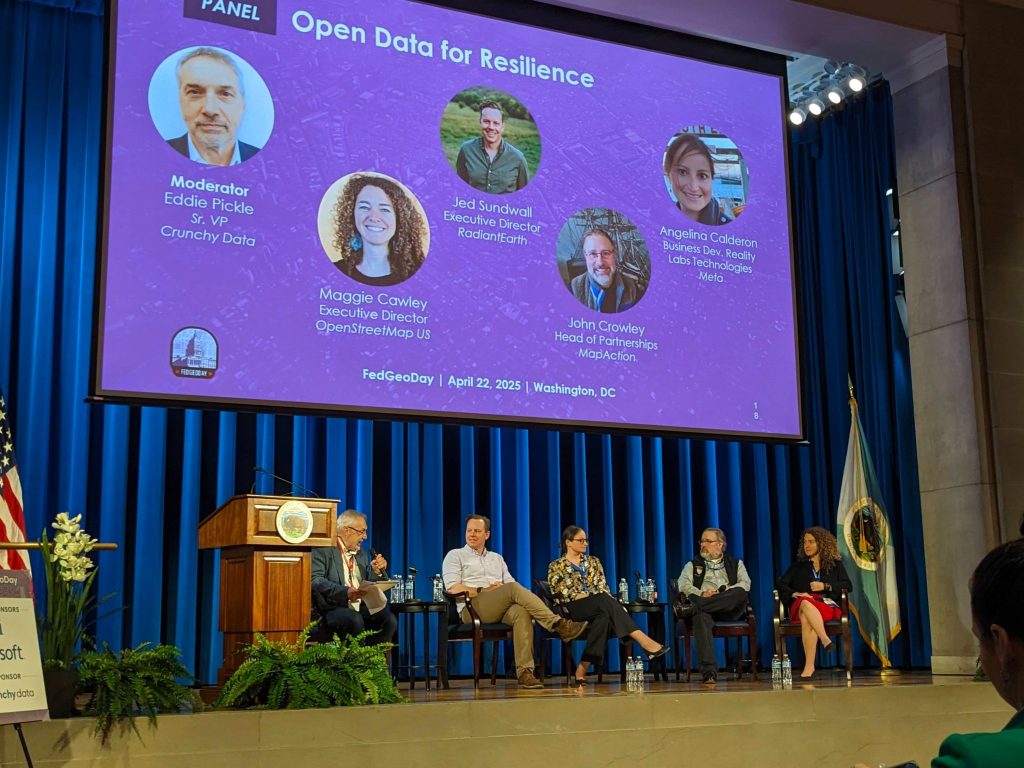
FedGeoDay is a single-track conference dedicated to federal use-cases of open geospatial ecosystems. The open ecosystems have a wide variety of uses and forms, but largely include anything designed around open data, open source software, and open standards. The main event is a one day commitment and is followed by a day of optional hands-on workshops. 

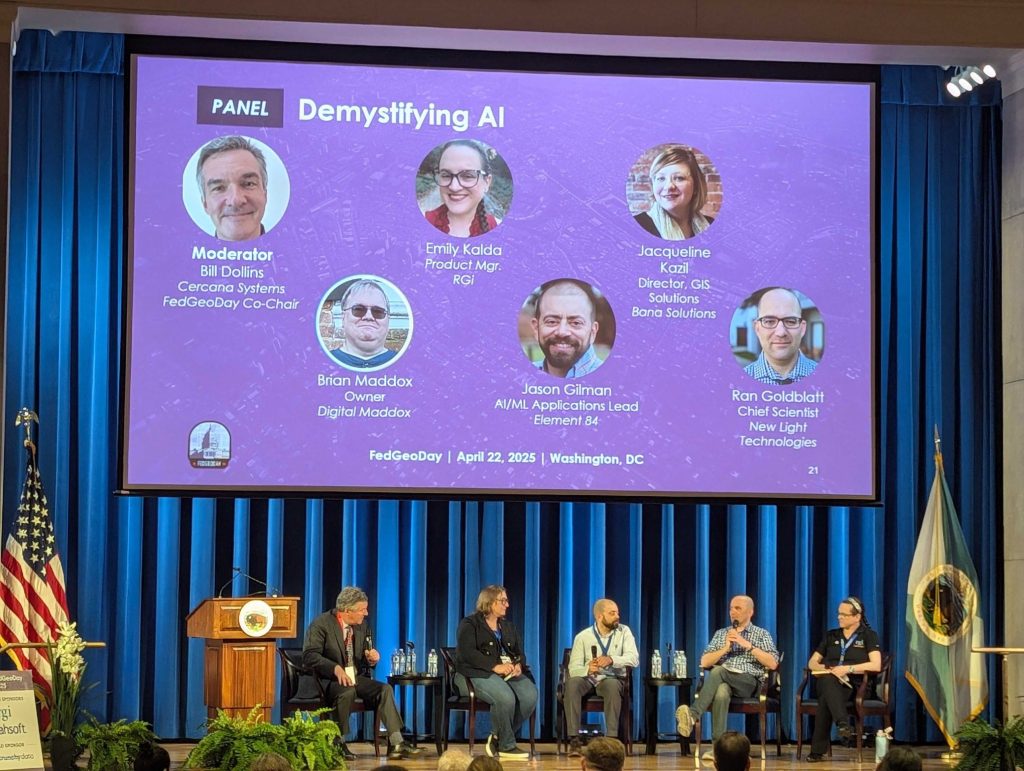
FedGeoDay has existed for roughly a decade , serving as a day of learning, networking, and collaboration in the Washington, D.C. area. Recently, Cercana Systems president Bill Dollins was invited to join the planning committee, and served as one of the co-chairs for FedGeoDay 2024 and 2025. His hope is that attendees are able to come away with practical examples of how to effectively use open geospatial ecosystems in their jobs. 

Photo courtesy of OpenStreetMap US on LinkedIn.

“Sometimes the discussion around those concepts can be highly technical and even a little esoteric, and that’s not necessarily helpful for someone who’s just got a day job that revolves around solving a problem. Events like this are very helpful in showing practical ways that open software and open data can be used.”

Dollins joined the committee for a multitude of reasons. In this post, we will explore some of his reasons for joining, as well as what he thinks he brings to the table in planning the event and things he has learned from the process. 

Why did you join the committee?

When asked for some of the reasons why he joined the planning committee for FedGeoDay, Dollins indicated that his primary purpose was to give back to a community that has been very helpful and valuable to him throughout his career in a very hands-on way. 

“In my business, I derive a lot of value from open-source software. I use it a lot in the solutions I deliver in my consulting, and when you’re using open-source software you should find a way that works for you to give back to the community that developed it. That can come in a number of ways. That can be contributing code back to the projects that you use to make them better. You can develop documentation for it, you can provide funding, or you can provide education, advocacy, and outreach. Those last three components are a big part of what FedGeoDay does.”

He also says that while being a co-chair of such an impactful event helps him maintain visibility in the community, getting the opportunity to keep his team working skills fresh was important to him, too. 

“For me, also, I’m self-employed. Essentially, I am my team,” said Dollins. “It can be really easy to sit at your desk and deliver things and sort of lose those skills.”

What do you think you brought to the committee?

Dollins has had a long career in the geospatial field and has spent the majority of his time in leadership positions, so he was confident in his ability to contribute in this new form of leadership role. Event planning is a beast of its own, but early on in the more junior roles of his career, the senior leadership around him went out of their way to teach him about project cost management, staffing, and planning agendas. He then was able to take those skills into a partner role at a small contracting firm where he wore every hat he could fit on his head for the next 15 years, including still doing a lot of technical and development work. Following his time there, he had the opportunity to join the C-suite of a private sector SaaS company and was there for six years, really rounding out his leadership experience. 

He felt one thing he was lacking in was experience in community engagement, and event planning is a great way to develop those skills. 

“Luckily, there’s a core group of people who have been planning and organizing these events for several years. They’re generally always happy to get additional help and they’re really encouraging and really patient in showing you the rules of the road, so that’s been beneficial, but my core skills around leadership were what applied most directly. It also didn’t hurt that I’ve worked with geospatial technology for over 30 years and open-source geospatial technology for almost 20, so I understood the community these events serve and the technology they are centered around,” said Dollins.

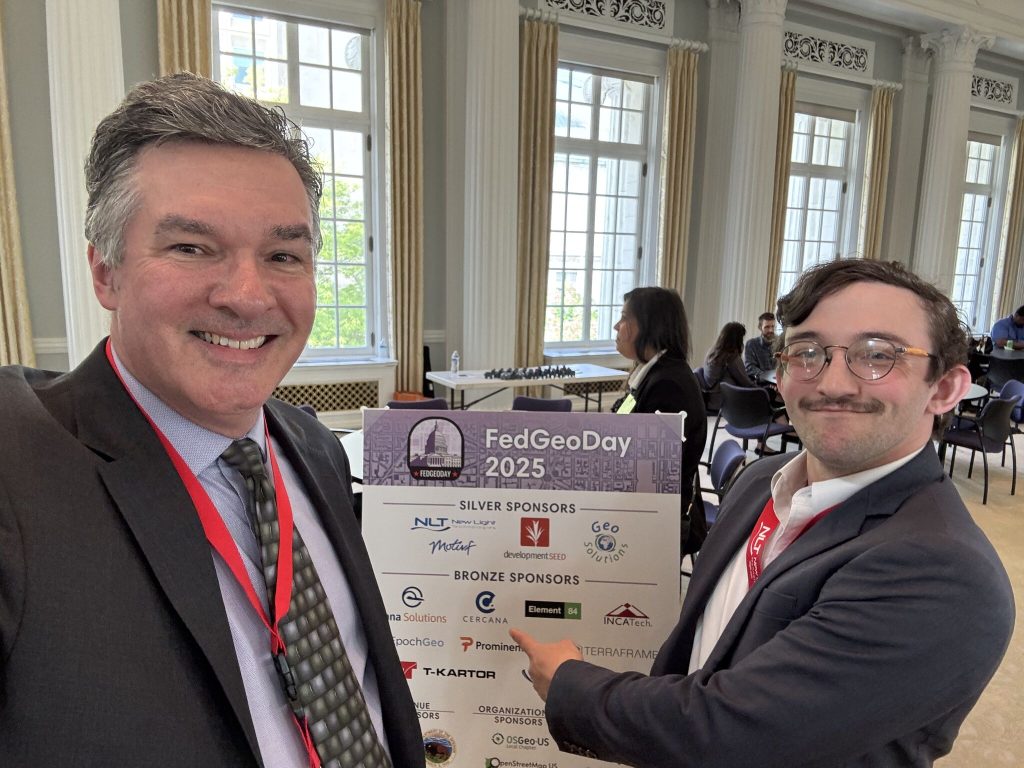
Photo courtesy of Ran Goldblatt on LinkedIn.

What were some of the hard decisions that had to be made?

Photo Courtesy of Cercana Systems on LinkedIn.

Attendees of FedGeoDay in previous years will likely remember that, in the past, the event has always been free for feds to attend. The planning committee, upon examining the revenue sheets from last year’s event, noted that the single largest unaccounted for cost was the free luncheon. A post-event survey was sent out, and federal attendees largely indicated that they would not take issue with contributing $20 to cover the cost of lunch. However, the landscape of the community changed in a manner most people did not see coming.

“We made the decision last year, and keep in mind the tickets went on sale before the change of administration, so at the time we made the decision last year it looked like a pretty low-risk thing to do,” said Dollins.

Dollins continued to say that while the landscape changes any time the administration changes, even without changing parties in power, this one has been a particularly jarring change. 

“There’s probably a case to be made that we could have bumped up the cost of some of the sponsorships and possibly the industry tickets a little bit and made an attempt to close the gap that way. We’ll have to see what the numbers look like at the end. The most obvious variable cost was the cost of lunches against the free tickets, so it made sense to do last year and we’ll just have to look and see how the numbers play out this year.”**

What have you taken away from this experience?

Dollins says one of the biggest takeaways from the process of helping to plan FedGeoDay has been learning to apply leadership in a different context. Throughout most of his career, he has served as a leader in more traditional team structures with a clearly defined hierarchy and specified roles. When working with a team of volunteers that have their own day jobs to be primarily concerned with, it requires a different approach. 

“Everyone’s got a point of view, everyone’s a professional and generally a peer of yours, and so there’s a lot more dialogue. The other aspect is that it also means everyone else has a day job, so sometimes there’s an important meeting and the one person that you needed to be there couldn’t do it because of that. You have to be able to be a lot more asynchronous in the way you do these things. That’s a good thing to give you a different approach to leadership and team work,” said Dollins on the growth opportunity. 

Dollins has even picked up some new work from his efforts on the planning committee by virtue of getting to work and network with people that weren’t necessarily in his circle beforehand. Though he’s worked in the geospatial field for 30 years and focused heavily on open-source work for 20, he says he felt hidden away from the community in a sense during his time in the private sector. 

Photo courtesy of Lane Goodman on LinkedIn.

“This has helped me get back circulating in the community and to be perceived in a different way. In my previous iterations, I was seen mainly from a technical perspective, and so this has kind of helped me let the community see me in a different capacity, which I think has been beneficial.”

FedGeoDay 2025 has concluded and was a huge success for all involved. Cercana Systems looks forward to continuing to sponsor the event going forward, and Dollins looks forward to continuing to help this impactful event bring the community together in the future. 

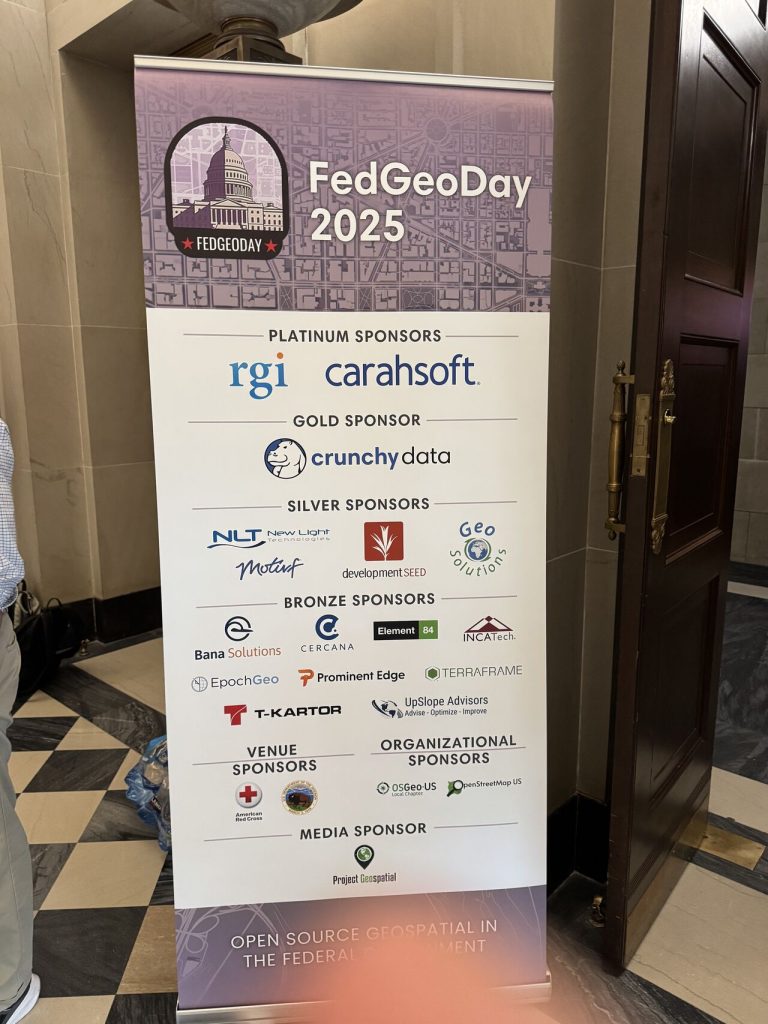
Photo courtesy of Cercana Systems on LinkedIn.

**This interview was conducted before FedGeoDay 2025 took place. The event exceeded the attendance levels of FedGeoDay 2024.