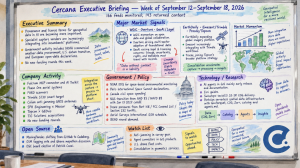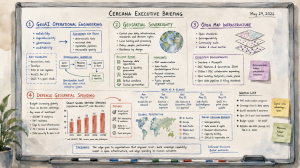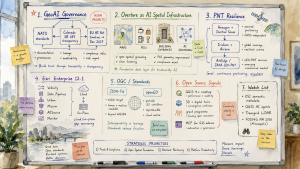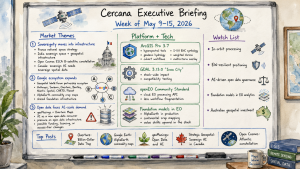
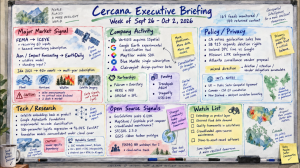
Cercana Executive Briefing: Week of April 18–24, 2026

153 feeds monitored. Published April 24, 2026.

Executive Summary

This was a week in which the geospatial industry seemed to be looking in two directions at once. On one side, companies are accelerating toward AI-native products, platforms, and data pipelines. On the other, Ed Parsons raised a harder question about whether AI world models may eventually absorb some of the value that traditional geospatial infrastructure has long claimed for itself.

That tension gives the week its shape. Parsons, one of the industry’s most credible independent voices, argued that AI “world models,” spatial representations embedded inside large neural networks, may be developing into an implicit replacement for parts of traditional geospatial data infrastructure. This is not a claim that GIS disappears tomorrow. It is more interesting, and more uncomfortable, than that. The claim is that the industry’s foundational assumption, that knowledge of the world must pass through explicit, structured, georeferenced data, may no longer be as secure as it once seemed.

The timing made the argument harder to dismiss. Google Maps Platform announced AI-powered imagery tools. L3Harris and Xoople unveiled a “next-generation spaceborne measurement system for the AI era.” EarthDaily marked a record six-satellite launch with Loft Orbital. The pattern is hard to miss: the EO and geospatial platform industries are racing to build AI-native capabilities at the same time that an emerging line of thought questions whether those investments eventually converge on terrain that AI companies absorb from below.

The rest of the week filled in the picture. Biodiversity and nature-related risk continued to look less like a niche sustainability topic and more like a forming commercial EO vertical. GeoServer 3.0 reached release candidate status. The Panoramax Foundation was formally announced. Multiple national reference frame modernization efforts advanced in parallel. Taken together, it was a week where the sector’s near-term growth story ran into its longest-horizon disruption scenario.

Major Market Signals

AI World Models and the Long-Range Platform Risk

Ed Parsons published a carefully argued piece this week positing that AI “world models,” large neural networks that learn implicit spatial representations of the physical world without relying on explicit geographic data layers, may ultimately be a deeper disruption than anything the geospatial industry has previously faced.

The important part of the argument is not technological novelty. The industry has seen plenty of that. The more important part is that world models challenge the geospatial sector’s theory of value. For decades, the working assumption has been that reliable knowledge of place requires explicit geospatial data: layers, coordinates, attributes, schemas, indexes, projections, services, and standards. That assumption has been productive. It built the modern GIS and EO industries. But if large AI systems develop useful internal representations of physical reality, some downstream users may care less about whether the system consults a conventional geospatial dataset and more about whether it produces a reliable answer.

That is why this matters for executives. The companies investing most heavily in world models, including Google, Meta, and major robotics firms, are not primarily buying geospatial data products. They are building systems that may eventually make some classes of geospatial product less visible, less differentiated, or less necessary in downstream workflows. The post landed the same week Google announced AI-powered imagery tools for Maps Platform, which reinforced rather than weakened the point. Leaders in data, platform, and analytics businesses do not need to treat this as an immediate operational threat, but they should treat it as a strategic thesis worth tracking.

EO Platforms Racing to AI-Native Architecture

The near-term story is much more straightforward: Earth observation providers are rebuilding their value chains around AI-native data delivery.

Five separate announcements this week, from different parts of the market, pointed in that direction. EarthDaily and Loft Orbital announced a record six-satellite coordinated launch, explicitly tied to EarthDaily’s AI analytics pipeline. L3Harris and Xoople announced a new spaceborne measurement system they describe as “purpose-built for the AI era.” Google expanded Maps Platform with AI-powered imagery processing. LiveEO’s Twinspector satellite duo, offering 35cm-class stereo, is aimed at infrastructure operators who need machine-parseable change detection.

The common thread is not simply better imagery. Better imagery is the familiar story. The newer story is imagery packaged, processed, and delivered so that AI systems can use it with less human mediation. That matters because procurement conversations are likely to shift. Resolution and revisit rate will still matter, but buyers are increasingly going to ask whether a data stream fits into an AI pipeline, whether it reduces preprocessing burden, and whether it can support production operations rather than isolated demonstrations.

Biodiversity and Nature-Risk Forming as a Commercial EO Vertical

Biodiversity and nature-related risk are starting to look like a real commercial EO market rather than a category held together by conference language.

Three announcements this week pointed in the same direction. CATALYST, backed by the UK Space Agency, launched a pilot with DUAL UK to develop a satellite-enabled biodiversity risk assessment tool for the insurance industry. Airbus Defence and Space was named technical partner in the Coffee Canopy Partnership with JDE Peet’s, using satellite imagery to map worldwide coffee plantations for supply chain risk monitoring. Ordnance Survey released a ready-to-use land and habitat data tool to support Biodiversity Net Gain compliance under UK planning regulations.

These are different buyers with different motivations, but the underlying need is similar. Insurers, agricultural supply chains, developers, and regulators all need auditable spatial evidence about nature-related exposure and compliance. TNFD, the Taskforce on Nature-related Financial Disclosures, is helping to create that demand, but regulation is not the only driver. Supply chain risk, underwriting discipline, and land-use policy are all pulling in the same direction. Expect more EO companies to test this vertical in the second half of 2026 as reporting expectations and compliance timelines become more concrete.

Reference Frame Modernization Advancing Simultaneously Across Multiple Countries

Reference frames rarely make for splashy market narratives, but they are one of the places where geospatial infrastructure becomes impossible to ignore.

A cluster of positioning stories this week showed that a coordinated, if unplanned, global refresh of geodetic reference systems is underway. The final GPS III satellite reached orbit, with Lockheed Martin already advancing work on the next-generation GPS IIIF. In Canada, GoGeomatics published a detailed analysis of CSRS modernization and its implications for critical infrastructure under NATRF2022. The transition affects everything from pipeline monitoring to autonomous vehicle routing. In the U.S., Esri published guidance for ArcGIS Pro users preparing for NSRS 2022, the impending American datum modernization.

These are not software updates. They are changes to the coordinate foundations on which software, data, field operations, engineering records, and compliance workflows depend. Reference frame transitions introduce systematic coordinate offsets that propagate through spatial datasets an organization already owns. For utilities, logistics providers, construction firms, autonomous systems developers, and any company with positioning-dependent operations, this is an active risk management issue. It should not be left as a background concern for the GIS team to discover late.

Open Data Matures Into a Fitness-for-Purpose Debate

The open data conversation is also maturing. That does not mean openness matters less. It means openness is no longer enough.

Two analytically aligned posts this week made that point from different directions. The Cloud Native Geo blog argued that usefulness is a better measure of data quality than openness, describing a landscape where data abundance has not translated into insight availability because the bottleneck is now integration, fitness-for-purpose, and supply chain reliability. A Medium piece made the same point from the EO side, arguing that most Earth observation projects fail not because of model quality but because no one builds the data supply chain underneath them.

This is familiar to practitioners, but it is only slowly entering the policy conversation. Open data mandates are valuable, but they do not solve deployment. A dataset can be legally open and still be operationally unusable. It can be accessible and still be poorly documented, inconsistently maintained, expensive to integrate, or misaligned with the decision it is supposed to support. That distinction matters for government open data programs and for commercial data companies that want to compete on curation, delivery, and reliability rather than raw access.

Notable Company Activity

Product Releases

  • Esri: Released ArcGIS Maps SDK 2.3 for both Unreal Engine and Unity, extending 3D geospatial capabilities for game engine-based digital twin and simulation use cases. Esri also released the April 2026 update to ArcGIS for Microsoft 365, continuing its push to embed spatial analytics in familiar enterprise productivity environments.
  • GeoSolutions Group: Released GeoServer 3.0 Release Candidate, a major milestone for the widely deployed open-source WMS/WFS server. Full coverage appears in the Open Source section below.
  • Mergin Maps: Shipped feature filtering for its QGIS-based mobile field data collection platform. Users can now filter map features by attribute values directly in the field application, addressing a common need in survey and inspection workflows.
  • Google: Added AI-powered imagery tools to Maps Platform, with possible downstream effects for geospatial workflows. Specific details on the feature set are limited in available coverage, but the announcement presents this as a developer-facing capability rather than a consumer update.

Partnerships

  • EarthDaily × Loft Orbital: Marked what both companies describe as a record coordinated launch of six EarthDaily satellites, deepening the relationship between EarthDaily’s analytics pipeline and Loft Orbital’s hosted payload infrastructure.
  • L3Harris × Xoople: Announced a next-generation spaceborne measurement capability described as designed for the AI era, combining L3Harris sensor hardware with Xoople’s software stack. Public technical detail remains limited, but the market framing suggests a defense-adjacent product targeting precision measurement at scale.
  • SSC Space × Kuva Space: Signed a Letter of Intent to strengthen Nordic space capabilities across infrastructure, mission development, and security applications. This fits a broader pattern of European space capability consolidation.
  • Point One Navigation × EuroTeleSites: Expanded high-precision location services across Southeastern Europe, using EuroTeleSites tower infrastructure as a corrections delivery network.
  • Airbus Defence and Space × JDE Peet’s: Named as technical partner in the Coffee Canopy Partnership for worldwide plantation mapping using satellite imagery and AI analytics.
  • CATALYST × DUAL UK: Launched a UK Space Agency-funded pilot to develop a satellite-enabled biodiversity risk scoring tool for insurance underwriting.

Government and Policy Developments

Geoscience Australia completed a meaningful milestone this week: the AUSTopo 1:250,000 digital map series, begun in 2023, now covers the entire Australian continent. This is not merely a cartographic update. It is the completion of a national spatial data foundation that supports emergency management, resource planning, and infrastructure investment across one of the world’s largest landmasses. The timing matters because Australia faces increasing climate-driven event frequency. A complete, current topographic base is one of the prerequisites for the next generation of risk modeling tools.

In Canada, GoGeomatics published the third installment of a detailed series on CSRS modernization, focusing on what the NATRF2022 transition means for critical infrastructure operators. The analysis identifies systematic displacement risks for pipelines, rail, and utilities whose spatial records were captured under the legacy Canadian Spatial Reference System. This is a compliance and risk management issue that has not yet received attention proportional to its potential operational consequences.

The U.S. Census Bureau’s American Community Survey released its 20th anniversary data update to 2020–2024 five-year estimates. For the first time, four comparable five-year periods spanning two decades are available simultaneously. PolicyMap covered the release in detail. For organizations using ACS data in site selection, housing analysis, community development, or equity mapping, this creates a useful longitudinal resource.

In the United Kingdom, Ordnance Survey released a land and habitat data tool designed to help developers and local authorities comply with Biodiversity Net Gain requirements under UK planning law. The tool is intended to accelerate the government’s 1.5 million homes target by reducing the time required to generate BNG assessments. That places OS in the middle of planning reform infrastructure, not merely in the background as a data provider.

Internationally, PLACE published a piece on its work with the SDG Data Alliance and a Global Data Hub supporting small island nations. The piece is a reminder that data sovereignty and spatial infrastructure gaps remain acute for some of the most climate-exposed geographies. It also shows that the donor and development community is still trying to close those gaps through trusted intermediaries rather than relying solely on commercial platforms.

Technology and Research Trends

The most analytically substantive technology piece of the week was a post on MLOps for GeoAI, specifically addressing why standard machine learning drift detection fails in Earth observation contexts. The argument is straightforward but important: landscapes change. Vegetation grows, cities expand, fields rotate, seasons shift, storms alter coastlines, and infrastructure appears or disappears. EO model inputs drift for physical reasons that have nothing to do with a broken data pipeline.

That is a real production problem, and it is often missed in ML discussions written for non-spatial contexts. Its appearance in a practitioner-oriented post suggests that GeoAI deployment maturity is advancing. The conversation is moving from “can we train a model on satellite data” to “how do we keep it working after deployment.” That is the right question. The market for MLOps tooling designed around spatial model drift is likely to become meaningful over the next two to three years.

A complementary piece addressed the architecture of automated, real-time GeoAI pipelines, describing the shift from static GIS layers to event-driven, streaming spatial systems using computer vision and edge inference. Taken together with the MLOps piece, the takeaway is that EO data science and production geospatial systems engineering are beginning to converge into a recognizable discipline. That is a healthy development. It moves the conversation away from demos and toward operational systems.

On the foundational data side, a tutorial covering machine learning cloud pixel regeneration using Sentinel-2 and Sentinel-1 SAR fusion in Google Earth Engine received meaningful attention. Techniques like this, using SAR data to reconstruct optical pixels obscured by cloud cover, have been in research for years. Their arrival in accessible practitioner-oriented tutorials suggests they are moving toward operational use by applied teams.

The Spatial Edge newsletter addressed tile optimization: reducing map tile file sizes without sacrificing visual fidelity. That may sound mundane, but it is the kind of mundane that matters at scale. For organizations operating large consumer or enterprise mapping applications, tile size is a cloud cost, performance, and user experience issue.

Open Source Ecosystem Signals

GeoServer 3.0 reached Release Candidate status this week, announced by GeoSolutions Group. GeoServer is one of the most widely deployed open-source geospatial servers in the world, underpinning a substantial share of WMS, WFS, and WCS infrastructure in enterprise and government environments. The 3.0 milestone follows an extended development cycle and represents a major modernization of the codebase.

For organizations running GeoServer 2.x, the practical message is simple: begin planning. The 3.0 release will likely carry dependencies and deployment changes that require time to test. Open-source infrastructure often disappears into the background when it works, which is one reason upgrade planning can lag. This is not a place to wait until the release is already in production elsewhere.

The QGIS project published security enhancements to its plugin repository this week, following QEP 409, published in January 2026. The changes address plugin code review practices and tighten the working processes around third-party contributions. This matters beyond the QGIS community. QGIS plugins are a meaningful attack surface for organizations that deploy QGIS in enterprise settings, and improved repository governance reduces the risk of supply chain-style compromise through malicious or poorly maintained plugins.

Panoramax, the open street-level imagery platform developed as an alternative to proprietary services like Google Street View, announced the formal creation of a Panoramax Foundation. OpenCage published an interview with founder Christian Quest covering the rationale and roadmap. The Foundation structure is notable because it mirrors the governance path of successful open geo projects, including OSGeo and the OpenStreetMap Foundation. It also signals that Panoramax is moving from promising project to stewarded infrastructure.

For organizations evaluating street-level imagery sourcing, especially in privacy-sensitive or public-sector contexts, that matters. Panoramax is now a structured, foundation-backed option rather than an interesting project to watch from the sidelines.

Watch List

  • DARPA Heavy Lift Challenge / UAV Heavy Lift: UAVOS announced it is supplying high-performance rotor blades to U.S. startup teams competing in DARPA’s Heavy Lift Challenge. If viable, heavy-lift UAV platforms create EO and logistics use cases that current fixed-wing and multirotor UAVs cannot serve. This is worth tracking as an emerging capability layer.
  • Nordic Space Infrastructure Consolidation: The SSC × Kuva Space LOI is the latest in a pattern of Nordic-region space capability agreements. Europe’s push toward strategic space autonomy is producing a quiet consolidation among smaller national players. Similar LOIs and JVs in the Baltic and Nordic regions would not be surprising through 2026.
  • Insurance Industry + EO Convergence: The CATALYST/DUAL UK biodiversity pilot and earlier ICEYE-linked parametric insurance work suggest the insurance sector is moving from experimental EO adoption to structured procurement. If major reinsurers begin requiring spatial evidence for nature-related risk assessment, EO demand could scale rapidly through the insurance value chain.
  • Panoramax Foundation: The formal Foundation announcement elevates Panoramax from a project to a governance structure. Adoption by OpenStreetMap contributors and European public-sector clients will be important to watch. Early institutional uptake would confirm Panoramax as a genuine platform-scale alternative to proprietary street-level imagery.
  • Geospatial Workforce Identity Pressure: Geospatial FM published the second chapter of a series on “moral injury” in the geospatial profession. This is an early indication of workforce sentiment around the AI transition. If the topic recurs, it could point to talent retention and role-clarity issues that affect hiring and team structure at geospatial organizations over the next 12–24 months.

Top Posts of the Week

  1. The Map of Dreams: Why AI’s “World Models” might be the Geospatial Industry’s Ultimate Disruption, Ed Parsons. The most strategically provocative post of the week, arguing that AI-embedded spatial representations could ultimately displace the need for explicit geospatial data products in key use cases.
  2. Loft and EarthDaily Mark Record Launch with Six Satellites, EarthDaily Blog. The industry’s most AI-forward EO company marked a significant constellation expansion, strengthening its argument that EO analytics should be AI-native from the ground up.
  3. Beyond Open Data: Usefulness is a better measure of quality than openness, Cloud Native Geo. A timely argument that the open data paradigm has matured to the point where fitness-for-purpose matters more than licensing, with consequences for both data policy and commercial data strategy.
  4. GeoServer 3.0-RC is here, GeoSolutions Group. A major milestone release that will affect upgrade planning for a significant share of enterprise and government geospatial infrastructure.
  5. CSRS Modernization and Critical Infrastructure: What’s at Stake for Canada, GoGeomatics. The clearest available summary of the operational risks the NATRF2022 reference frame transition poses for Canadian infrastructure operators, and a useful template for how similar transitions should be communicated in the U.S. and elsewhere.

Cercana Executive Briefing is generated from 153 feeds aggregated by geofeeds.me.
Cercana Executive Briefing — Week of April 11–17, 2026

153 feeds monitored. Published April 17, 2026.

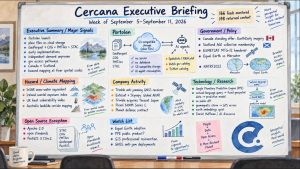
Executive Summary

The defining story of this week is a convergence that both practitioners and strategists should track closely. Multiple independent demonstrations of AI agents operating inside QGIS arrived at the same time that QGIS 4.0.1 achieved full cross-platform availability. As demonstrated this week in Germany, Spain, and by independent practitioners, LLMs connected via the Model Context Protocol can execute 28 analytical steps inside the world’s most-deployed open-source GIS from a single text prompt. That development begins to shift the skill profile required for geospatial analysis in ways that will take years to fully understand. The critical counterpoint, voiced bluntly in a widely shared Medium piece titled “AI Hasn’t Landed for the Working GIS Analyst,” is that current tools are still not reliable under production conditions. Leaders should watch this gap between demonstration and deployment carefully because it defines both the opportunity and the risk.

The AI story is also advancing from a different direction. Earth foundation model infrastructure is maturing into deployable data systems. A billion-scale SAR model, planetary-scale pixel embedding compression for real-time change detection, and on-orbit AI processing demonstrations from Planet Labs and Belgian startup EDGX all point toward the same underlying change: geospatial intelligence is moving toward an automated, machine-read pipeline and away from a purely human-supervised workflow. OGC’s completion of its Rainbow research initiative this week offers institutional acknowledgment of that reality. Its conclusion was clear: human-readable standards cannot scale to automated systems.

The week’s funding picture supports the same thesis. Capella received $48.9M for tactical space communications, Earth Blox raised £6M for EO-based climate risk, and Plume raised $3.9M for AI-driven renewable energy site intelligence. Together, those moves suggest that governments and institutional investors increasingly view geospatial data as critical infrastructure for both defense and the energy transition.

Major Market Developments

AI Agents Enter GIS Workflows at Visible Scale

Multiple independent sources this week demonstrated AI agents autonomously executing complex GIS analysis inside QGIS. A Spanish GIS blog covered QGIS MCP, which integrates the Model Context Protocol with QGIS and allows Claude AI to drive analytical workflows through natural language commands. A German community blog highlighted a video demonstration in which a single prompt generated a complete map through 28 autonomous agent steps in 15 minutes. A third post covered LandTalk.AI, which brings Gemini and ChatGPT into QGIS map interpretation. These examples do not come from a single vendor or a coordinated campaign. Instead, they reflect an organic, distributed discovery moment across the QGIS user community. The strategic implication is substantial. If agentic GIS reaches production reliability, the barrier to performing complex geospatial analysis drops, the total market for geospatial intelligence expands, and demand for traditional GIS analyst roles may compress. At the same time, a blunt critical assessment published this week argues that AI tools still fail in practice when they encounter real-world geospatial data structures. The opportunity is real, but the timeline for reliable deployment remains unclear.

Earth Foundation Models Move From Research to Infrastructure

This week’s edition of The Spatial Edge covered a billion-parameter foundation model for SAR (synthetic aperture radar) image understanding. This is a breakthrough because SAR is the all-weather, day-night workhorse of serious Earth observation, yet it is notoriously difficult to train AI on because of speckle noise and geometric distortions. In parallel, GeoSpatial ML published the third installment of a series on compressing Earth embeddings using the Clay v1.5 foundation model, demonstrating per-pixel change detection served from static object storage at planetary scale. Alpha Earth embedding behavior across stable and changing land cover classes was also analyzed independently this week. Taken together, these posts show a sector that is no longer asking only whether the technology works. The question now is how to deploy it at scale. That marks a move from research into engineering. Organizations that depend on large-area monitoring for insurance, agriculture, or defense should be asking their vendors where they stand on foundation model integration.

On-Orbit AI Processing Reaches Commercial Demonstration

Planet Labs selected Alice Springs as the test site for a demonstration of on-board satellite AI, processing imagery at 500km altitude immediately after capture to identify aircraft without downlinking to ground first. Belgian startup EDGX launched its STERNA AI edge computing system into orbit on SpaceX’s Transporter-16 mission, designed for scalable deployment across satellite constellations. Spire also deployed a dedicated satellite for continuous Earth magnetic field mapping as part of the MagQuest challenge. These simultaneous moves, across different missions and vendors, point away from the traditional “collect then process” architecture and toward edge intelligence at the point of collection. The operational implications are profound: reduced latency for time-sensitive intelligence, lower ground station bandwidth requirements, and a new performance differentiation axis for EO vendors beyond resolution and revisit frequency.

Geospatial Standards Bodies Pivot to Machine-Readable Infrastructure

The OGC published the findings of its multi-year Rainbow research initiative this week and shifted the discussion into implementation. The core finding: standards written for human readers do not scale to a world where machines must interpret and act on geospatial data directly. The implementation phase introduces machine-readable Building Blocks and Profiles as modular, traceable components. That changes how geospatial interoperability specifications are written and consumed. In parallel, Phase 1 of the S-100 maritime data framework entered into force globally, allowing the maritime community to begin implementing next-generation chart specifications. Together, these developments suggest that the geospatial standards landscape is being redesigned around machine consumption. That matters for any organization procuring or building automated geospatial pipelines.

Notable Company Activity

Product Releases

  • SimActive: Released Correlator3D Version 11 with native Gaussian splatting integration, enabling photogrammetry workflows to produce high-quality 3D splat models from imagery. This significantly expands deliverable formats for survey and construction clients.
  • Mach9: Released Digital Surveyor 2, an AI feature extraction platform designed to address the bottleneck of converting LiDAR point clouds into engineering-usable features at scale. Geo Week News assessed it as addressing a genuine and growing pain point for survey and civil engineering teams.
  • Foursquare: Published detailed use cases for FSQ Spatial Agent, positioning the product as eliminating the technical barrier between domain experts and complex geospatial analysis by pairing reasoning AI with the FSQ H3 Hub data platform, with no GIS expertise required.
  • Giro3D (Oslandia): Released Giro3D 2.0, a major update to the open-source browser-based 3D geospatial visualization library, adding GPU-side processing for HD LiDAR and 3D Tiles with support for React and Vue.js integration.
  • MapTiler: Released OpenMapTiles 3.16 with improved road connectivity and enhanced dark-mode styling.

Partnerships

  • KSAT × Kongsberg NanoAvionics: Announced a strategic partnership to streamline smallsat mission deployment, reducing operational and financial burden for satellite operators by integrating ground station services with mission management from a single provider.
  • Hexagon × Vale: Hexagon’s R-evolution unit has begun aerial 3D mapping flights under the Green Cubes Digital Reality initiative, creating digital twins to support environmental reclamation across Vale’s mining operations in Brazil. This is a notable application of digital twin technology to ESG obligations at industrial scale.

Funding & M&A

  • Capella Space: Awarded $48.9M for advanced tactical space communications in low Earth orbit. It is a defense-oriented contract that reinforces Capella’s positioning at the intersection of SAR and government intelligence.
  • Earth Blox: Raised £6M for its climate risk platform built on Earth observation data. This is institutional capital chasing the intersection of EO and climate financial risk.
  • Plume: Raised $3.9M to build AI geospatial agents for renewable energy site intelligence. This niche is directly tied to the pace of energy transition investment.

Government and Policy Developments

The OGC’s Rainbow initiative represents the most consequential standards development of the week. The multi-year project, backed by EU Horizon Europe funding and partners including ESA, NRCan, UKHO, and NGA, concluded that geospatial standards must become machine-readable to support an automated world. The move to Building Blocks and Profiles as modular, machine-parseable components will take years to propagate through procurement and compliance requirements. Organizations building automated geospatial pipelines should track this transition closely because it will eventually reshape how contracts are specified and systems are certified.

The global S-100 maritime data standard Phase 1 entering into force is a parallel marker of the same structural shift. Shipping, port management, and maritime defense organizations should begin planning for the transition from traditional ENC chart formats to the S-100 product family.

In Europe, development of EuroCoreReferenceMap — a high-value large-scale geospatial dataset for EU policymakers — is underway, highlighting continued EU investment in sovereign spatial data infrastructure. In Canada, the OGC Canada Forum and the GeoIgnite conference are both building institutional momentum around digital sovereignty and national data connectivity. K2 Geospatial’s sponsorship of GeoIgnite under an explicit digital sovereignty banner reflects how Canadian vendors are positioning themselves around the theme.

The GeoAI and the Law newsletter provided a detailed analysis of California Governor Newsom’s Executive Order N-5-26, signed March 30, which places AI safety and accountability requirements into state procurement contracts rather than creating new legislation. This procurement-driven governance model effectively reaches every vendor selling AI-enabled products or services to California state government, including geospatial AI vendors, and may become a template for other states and federal agencies.

India’s Geospatial World published a substantive interview on India’s defence geospatial transformation, presenting space and geospatial technologies as central to strategic autonomy. The interview highlights a decade of accelerating integration of geospatial capability into military decision-making, indigenization policy, and international collaboration, underscoring India’s emergence as an increasingly important geospatial market for both data and platform vendors.

Technology and Research Trends

The technical direction of travel this week centers on three converging developments: agentic GIS, foundation model operationalization, and cloud-native format adoption in production environments.

On agentic GIS, the QGIS MCP ecosystem is developing rapidly without a single vendor driving it. That is a community-level adoption pattern, which historically has been more durable than vendor-led adoption in the geospatial sector. For technology leaders, the question is not whether AI-assisted GIS workflows will become standard. The real questions are how fast that happens and what reliability threshold organizations will require before they depend on these tools for consequential decisions.

On foundation models, the week’s most technically substantive post was GeoSpatial ML’s DeltaBit piece, which demonstrated pixel-level change detection at planetary scale by compressing Clay v1.5 Earth embeddings to a density suitable for browser-based serving. The engineering ambition of making dense per-pixel embeddings available to any user at global scale would fundamentally change how change detection products are built and delivered. The Spatial Edge’s coverage of the SAR billion-parameter model adds weight to the broader pattern that foundation models designed for EO data are becoming production-grade.

On cloud-native formats, a detailed case study from Swiss consultancy EBP described integrating InSAR ground deformation data into Switzerland’s national natural hazard platform using COG, PMTiles, Parquet, and DuckDB. This is the kind of production case study that turns format advocacy into demonstrated operational value. In a government infrastructure context, the combination of those four tools is also a useful measure of the cloud-native stack’s maturity.

Open Source Ecosystem Developments

QGIS 4.0.1 resolved a Mac distribution issue and is now fully available across platforms. The 4.0 release cycle is drawing intense practitioner attention as the community works through migration and workflow adaptation.

More important over the long term was a pair of posts from OPENGIS.ch, maintainers of QField and major QGIS contributors, articulating and publishing results from their #sustainQGIS initiative. In 2025, the firm invested 168 hours in QGIS maintenance work that included bug fixes, code reviews, refactoring, and test coverage. The funding mechanism is built into their commercial support contracts. Unused hours are donated, and a portion of every multi-day contract is reserved for initiative work. This “sustainability by contract” model addresses one of open source’s most persistent vulnerabilities: maintenance work that delivers no visible features but remains essential to long-term software health. Enterprise QGIS users who depend on the platform for mission-critical workflows should understand this model and consider whether their own procurement practices support or undermine it.

Giro3D 2.0 from Oslandia is a notable open-source release. It is a browser-based 3D visualization library with GPU-accelerated LiDAR and 3D Tiles support that is now integrated into production React and Vue.js applications. PostGIS issued simultaneous security patches across versions 3.2 through 3.6.

Watch List

  • Gaussian Splatting as a Production Survey Deliverable: SimActive’s Correlator3D v11 integrates Gaussian splatting natively, and Geo Week News published a dedicated analysis. This novel 3D representation technique is entering commercial photogrammetry after emerging from research. It is a potential disruptor to traditional point cloud and mesh formats worth tracking in survey and AEC workflows.
  • California AI Procurement Model: If California’s procurement-driven AI governance approach scales, it creates a de facto compliance requirement for geospatial AI vendors selling to government. Watch for adoption in other states and potential federal influence.
  • Celeste Constellation: The first two of eleven planned Celeste testbed satellites launched this week to supplement Galileo. European sovereign positioning infrastructure is developing a second track beyond Galileo itself.
  • Plume + Renewable Energy Site Intelligence: The $3.9M raise for AI geospatial agents targeting renewable energy siting taps into the energy transition capital cycle. A small seed round, but the product thesis — AI agents replacing manual geospatial analysis for site selection — is the same thesis as FSQ Spatial Agent applied to a high-growth vertical.
  • Apple Maps and Geopolitical Cartography: Apple denied this week that it removed Lebanese towns and villages from Apple Maps in connection with the Israeli invasion — a story that generated significant social media attention. The incident reflects growing scrutiny of how commercial map providers handle politically sensitive geographic representation. This is a reputational and regulatory risk vector for any organization operating consumer-facing mapping products.

Top Posts of the Week

  1. QGIS MCP: conecta Claude AI con QGIS y automatiza tu flujo de trabajoMappingGIS — The most shared practical demonstration this week of LLM-driven GIS automation; the clearest articulation of what agentic QGIS looks like in practice for a non-technical audience.
  2. A billion-scale model for understanding radar imagesThe Spatial Edge — Covers multiple converging EO AI research developments including the SAR foundation model, global 1m forest canopy heights from Meta/WRI, and cloud-free imaging advances; the week’s best single-source EO research summary.
  3. From Research to Implementation: Building Shared Infrastructure for an Automated WorldOpen Geospatial Consortium — OGC’s formal announcement of its shift from research to implementation of machine-readable geospatial standards. This is a consequential development with long-horizon procurement implications.
  4. GeoAI and the Law NewsletterSpatial Law & Policy — Detailed analysis of California’s procurement-driven AI governance order; the most substantive policy analysis of the week for geospatial AI vendors serving government.
  5. QGIS Sustainability Initiative – Annual ReportOPENGIS.ch — A rare transparent accounting of how a commercial QGIS services firm funds open-source maintenance. It is directly relevant to any enterprise organization assessing the sustainability of its QGIS dependency.

Cercana Executive Briefing is generated from 153+ feeds aggregated by geofeeds.me.

Cercana Executive Briefing — Week of April 4 –10, 2026

152 feeds monitored. Published April 10, 2026.

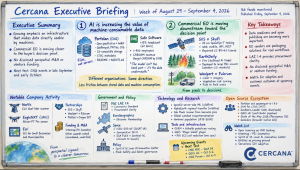
Executive Summary

The defining story of this week is the release of the White House FY 2027 budget request, which proposes a 23% cut to NASA’s overall budget and a catastrophic 47% reduction to the Science Mission Directorate. This would be the largest proposed science cut in NASA’s history. For the geospatial and Earth observation market, this is not a routine policy development. It accelerates a structural transition already underway: as the public data foundation erodes, the commercial and defense sectors are being asked to fill the gap. EarthDaily’s announcement of an eight-figure AI-ready data subscription deal with a U.S. defense and intelligence technology company, published in the same week, is not a coincidence. It is the market responding in real time.

Two threads reinforce each other this week. The budget threat to NASA and NOAA concentrates the risk of data dependency on a shrinking number of commercial providers, while simultaneously opening a procurement runway for those same providers with defense and intelligence buyers. Companies positioned at the intersection of AI-ready EO data and national security are the near-term beneficiaries. Everyone dependent on NOAA weather streams, USGS terrain data, or open NASA science missions faces a more expensive and fragmented supply chain.

Meanwhile, the AI-in-geospatial debate deepened, with serious independent analysts asking hard questions about whether large language models actually understand spatial data. That is evidence that the industry is moving beyond hype toward more disciplined evaluation. QGIS 4.0.1’s release alongside the LTR patch reinforces open-source momentum as a strategic hedge. Leaders should be paying attention to the budget, the defense data opportunity, and the growing scrutiny of AI geospatial claims.

Major Market Developments

The NASA Budget Shock Reshapes the EO Supply Chain

The White House FY 2027 budget request, released this week, proposes the largest cut to NASA’s science programs in the agency’s history. It includes a 47% reduction to the Science Mission Directorate that would bring science funding to its smallest level in decades. Project Geospatial published two separate analyses of the implications, examining both the direct market impacts and the broader ecosystem effects across the geospatial sector. The consequences are structural, not cyclical. Missions covering climate, Earth observation, and geodetic infrastructure face termination or indefinite suspension. Companies reliant on open NASA data streams in agricultural analytics, climate risk, flood modeling, and insurance will face higher data acquisition costs and supply disruption. The downstream effect on geospatial R&D pipelines through NSF and university grant programs compounds the damage. This is the single most important market development of the quarter.

Defense & Intelligence Emerge as the Anchor EO Customer

Against the backdrop of civilian budget collapse, EarthDaily announced an eight-figure AI-ready data subscription agreement with a U.S. defense and intelligence technology company. The deal is significant on multiple dimensions: it signals that defense buyers are now transacting at scale on commercially produced, AI-optimized EO data; it validates EarthDaily’s product positioning around calibrated, analytics-ready imagery; and it marks a maturation of the defense-commercial data relationship from ad hoc purchases toward structured subscriptions. This is precisely the market dynamic that emerges when public data infrastructure weakens. Commercial providers that can meet intelligence-grade consistency requirements gain strategic leverage. Expect similar announcements from other EO platforms as DoD and IC agencies accelerate commercial data integration.

AI Spatial Literacy Under Scrutiny

Two independent, high-quality voices this week focused on the same question from different angles: do AI models actually understand geography? The Spatial Edge published a rigorous examination of whether large language models can correctly interpret GPS coordinates and spatial relationships, finding significant limitations that have direct implications for any workflow deploying LLMs on geospatial tasks. Separately, Bill Dollins at geoMusings published a second installment on spatial analysis with Claude, and GoGeomatics covered NV5’s GeoAgent AI platform for agentic geospatial analysis. The convergence is meaningful: the industry is moving from enthusiasm about AI geospatial integration toward closer scrutiny of where these systems actually work and where they fail. Organizations deploying AI in spatial workflows should treat spatial literacy as a first-order evaluation criterion, not an assumption.

North American Geospatial Sovereignty Anxiety Intensifies

Canada generated two substantive policy-oriented posts this week, both pointing to the same underlying concern. GoGeomatics published an analysis arguing that Canada’s geodetic infrastructure is a hidden geospatial risk requiring immediate policy attention, noting that the country’s coordinate reference framework and positioning infrastructure lack the policy protection given to other critical infrastructure. A companion piece argued that Canada’s geospatial workforce framework is dangerously outdated and must be modernized to maintain competitiveness. These are not isolated concerns. They mirror the U.S. federal budget threat at a structural level. The issue of national geospatial sovereignty, covering both data independence and workforce capacity, is surfacing across multiple geographies at once and is becoming a credible policy agenda item.

Notable Company Activity

Product Releases

  • EarthDaily: Announced an eight-figure AI-ready data subscription agreement with a U.S. defense and intelligence technology company. It is the most commercially significant EO deal disclosed this week. The agreement underscores growing appetite for calibrated, analytics-ready imagery at defense contract scale.
  • Ecopia: Launched a self-serve platform for high-precision geospatial data downloads, lowering the barrier for enterprise and mid-market buyers to access building footprint and feature extraction data without a direct sales engagement. The move suggests Ecopia is broadening its addressable market beyond large enterprise deals.
  • NV5 / GeoAgent AI: GoGeomatics featured NV5’s GeoAgent platform, positioning it as an agentic AI system for geospatial analysis. The coverage highlights the company’s push to embed automation into traditional imagery and analysis workflows.
  • Esri: Released Q1 2026 basemap updates covering more than 200 new and updated communities, alongside new ArcGIS for Excel routing capabilities, density analysis enhancements, and an early adopter program for ArcGIS Maps for Microsoft Fabric integration.
  • geoparquet-io: A fast new GeoParquet processing tool was flagged by Spatialists, gaining attention for performance improvements in cloud-native geospatial workflows.

Partnerships & M&A

  • Blue Marble Geographics × Avenza Systems: The two companies announced a merger, combining Blue Marble’s coordinate transformation and geodetic software with Avenza’s field mapping and PDF map products into a unified field-to-office geospatial platform. This is the most structurally interesting consolidation of the week. It brings together two complementary niche players that are combining to compete at a platform level.
  • Astroscale × Exotrail: The two companies advanced France-Japan cooperation on space sustainability through a joint satellite servicing initiative. Astroscale separately announced the world’s first commercial multi-orbit satellite inspection mission, a capability with long-term implications for satellite asset management and constellation health monitoring.

Government and Policy Developments

The FY 2027 White House budget proposal dominates the policy landscape this week. If enacted, the proposed 23% overall cut to NASA, together with the 47% reduction to the Science Mission Directorate specifically, would represent the most severe contraction of U.S. civil Earth observation capability in the agency’s history. Project Geospatial’s two analyses this week frame the implications clearly: the downstream effects extend well beyond NASA itself, touching NOAA weather and climate data streams, USGS terrain and mapping programs, and the university research pipelines that generate geospatial talent and technology. The budget proposal is not yet enacted and will face congressional scrutiny, but the directional signal is unambiguous. Companies and government agencies that have built workflows on open federal data must begin contingency planning now.

FedGeoDay 2026 received a sponsorship announcement from GeoSolutions, with the event organized around “Building Ecosystems for Supporting Federal Data Stewardship,” a focus that now carries considerable urgency given the budget context. The OGC published a blog post on common challenges in geospatial integration, addressing standards interoperability issues that remain a persistent friction point across both commercial and government deployments. In Australia, Spatial Source reported on the ACT’s plans to introduce a Certificate IV in Surveying in 2027, addressing workforce pipeline gaps, while New Zealand announced grants for surveying and spatial projects — both examples of national-level investment in geospatial workforce capacity that contrasts with the U.S. federal posture.

Technology and Research Trends

The most technically interesting item this week came from GeoSpatial ML, which published the second installment of its TerraBit series on compressing earth embeddings. It explores how foundation model representations of satellite imagery can be made more efficient for downstream analytics. This work matters because the computational cost of running geospatial foundation models at scale remains a significant deployment barrier; compression approaches that preserve analytical fidelity while reducing model footprint could materially ease deployment.

The question of AI spatial literacy, meaning whether LLMs actually understand geographic coordinates and spatial relationships, received rigorous attention this week. The Spatial Edge’s analysis suggests that current models exhibit significant limitations in interpreting raw GPS coordinates. This finding has direct implications for anyone building pipelines in which an LLM is expected to reason over latitude/longitude pairs, bounding boxes, or spatial predicates without a dedicated geospatial processing layer.

SAR and optical satellite fusion continued to attract research attention, with a Medium post from Earth Observation on Medium exploring the scientific future of multi-modal fusion. SLAM LiDAR received a detailed explainer from Geo Week News, and the Artec Jet survey-grade mobile LiDAR scanner launch from Artec 3D signals continued commercialization of autonomous 3D site mapping. Sparkgeo published an analysis on the intersection of geospatial data, climate change, and financial risk, a theme gaining traction among climate-linked insurance and ESG-oriented investors.

Open Source Ecosystem Developments

QGIS had a significant release week. Both QGIS 4.0.1 “Norrköping” and the long-term release patch 3.44.9 “Solothurn” became available simultaneously for Windows, Linux, and macOS, as noted by #geoObserver. The dual-track release reflects the QGIS project’s mature release management, and the 4.0.x line is worth watching: each incremental patch strengthens the platform’s stability and makes enterprise adoption easier to consider.

Bill Dollins at geoMusings published a thoughtful essay on OGC’s RFC 1 and the long arc of technical stewardship in geospatial standards. It is a rare piece of standards governance reflection and is worth reading for anyone tracking how community-governed technical infrastructure evolves over time. The Cloud-Native Geo (CNG) community launched a mentorship pilot program, an early-stage effort to build community capacity that deserves monitoring as a potential indicator of organizational maturation. The geoparquet-io tool’s emergence as a fast GeoParquet processing option reflects continued developer interest in cloud-native geospatial formats, and the broader GeoParquet ecosystem is gaining tooling depth.

Oslandia published a client case study on QGIS deployment at LPO AuRA (a French conservation organization), illustrating how open-source geospatial tooling is reaching non-traditional enterprise users in the environmental sector. This is an underappreciated sign of adoption: QGIS’s penetration into biodiversity and conservation organizations points to a market segment that proprietary vendors have historically underserved.

Watch List

  • Earth embedding compression (TerraBit): GeoSpatial ML’s work on compressing geospatial foundation model embeddings is early-stage but directionally important. If successful at scale, it closes a meaningful deployment gap for EO AI applications. Monitor for follow-on papers and tooling.
  • Generative satellite imagery (DiffusionSat): Helios TechBlog’s practical evaluation of metadata-conditioned diffusion models for satellite imagery generation suggests that synthetic EO data pipelines are moving from theory toward tooling. Authenticity verification and provenance tracking will follow as a market need.
  • Emergency management as a latent geospatial market: Project Geospatial published an analysis arguing that emergency management is a market that geospatial vendors have repeatedly misjudged. It appears unsuitable until a disaster triggers procurement urgency. With climate event frequency rising, watch for procurement spikes.
  • Matadisco open data discovery network: MappingGIS covered Matadisco, a new open and decentralized network for geospatial data discovery. If it gains adoption, it could challenge centralized data catalogs and shift discoverability dynamics in the open data ecosystem.
  • GNSS interference as a commercial risk factor: Geo Week News ran a piece on GPS/GNSS interference as a resilience concern across geospatial and AEC industries. With interference incidents increasing in conflict zones and beyond, positioning assurance is becoming a product category, not just a military problem.

Top Posts of the Week

  1. One Large Step Back for Science, One Giant Leap Backward for Earth Observation. Geospatial Frontiers – Project Geospatial. It is the most important piece of the week: a detailed analysis of the FY 2027 NASA budget proposal’s market implications for the Earth observation and broader geospatial sector.
  2. EarthDaily Secures Eight-Figure AI-Ready Data Subscription Agreement with US Defense & Intelligence Technology Company. EarthDaily Blog. It provides defense-sector validation of commercial AI-ready EO data at subscription scale, arriving precisely as the public data foundation weakens.
  3. Do AI Models Actually Understand GPS Coordinates?. The Spatial Edge. It is a rigorous independent examination of LLM spatial literacy, with direct implications for geospatial AI pipeline design.
  4. The Ground Shifts Beneath Us: The Geospatial Ecosystem in the Shadow of the FY 2027 Budget. Geospatial Frontiers – Project Geospatial. It is the broader ecosystem analysis complementing the NASA-focused piece and examining cascading effects across NOAA, USGS, and the R&D pipeline.
  5. Canada’s Hidden Geospatial Risk: Why Geodesy Needs Policy Attention. GoGeomatics. It offers a clear-eyed argument for treating geodetic infrastructure as critical national infrastructure, with implications for any organization dependent on national coordinate reference systems.

Cercana Executive Briefing is generated from 152 feeds aggregated by geofeeds.me.
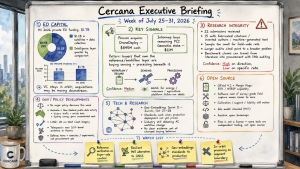
Cercana Executive Briefing — Week of March 28–April 3, 2026

152 feeds monitored. Published April 3, 2026.

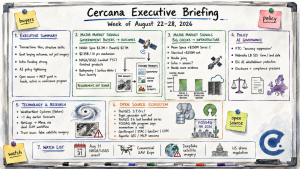
Executive Summary

The most consequential development this week was the publication of the CNG Geo-Embeddings Sprint report, which moved earth observation embeddings from an emerging research thread into the standards-drafting phase. Co-hosted by CNG, Planet, and Clark University, the March sprint produced concrete patterns for storing, cataloging, and accessing EO embeddings. This is the kind of infrastructure specification work that typically precedes commercial adoption. This matters because embeddings are one of the mechanisms through which satellite imagery can be translated into forms that AI systems can use at scale. Organizations making infrastructure decisions about their EO data pipelines should be watching this thread closely. Standards that solidify here will shape which analytics platforms interoperate and which become walled gardens.

In parallel, the defense and intelligence conversation intensified. Project Geospatial published two substantial pieces, one on GeoAI-driven military targeting ethics and another on the geopolitics of quantum gravity gradiometry, while Octave rebranded Luciad as Alto 2026.0 with explicit cyberthreat visualization capabilities for defense. Taken together, these developments suggest that the defense geospatial market is expanding its technical scope while also confronting the ethical consequences of that expansion. Meanwhile, Canada’s national geospatial strategy consultations drew critical coverage revealing a system with depth but without alignment, and Australia launched the Locus Alliance to replace its collapsed national geospatial body. The pattern across both is institutional. Countries are renegotiating how geospatial infrastructure is governed, and the outcomes will likely shape procurement structures for years.

Major Market Signals

EO Embeddings Move from Research to Standards

The CNG Geo-Embeddings Sprint brought together Planet, Clark University, and other organizations to draft best practices for storing, cataloging, and accessing Earth observation embeddings. This is not another AI capabilities announcement. It is infrastructure specification work. When the EO community starts defining how embeddings are stored and discovered, it suggests that the technology has matured enough for interoperability to matter. For platform vendors and data infrastructure buyers, this is the stage at which architectural decisions can begin to lock in compatibility or isolation. The sprint outputs are headed for community review, which means a public comment period that organizations with EO data pipelines should engage with.

Defense Geospatial Expands Scope and Confronts Ethics Simultaneously

Two distinct but convergent threads emerged this week. Octave launched Alto 2026.0, the rebranded Luciad platform, adding cyberthreat visualization for defense and extending geospatial situational awareness into the cyber domain. Simultaneously, Project Geospatial published a deeply personal account of how GeoAI-driven military targeting is eroding the oversight structures that governed intelligence operations for decades. That convergence is the real signal. The defense geospatial market is rapidly expanding what these tools can do while governance frameworks struggle to keep pace. For vendors entering the defense space, the ethics conversation is no longer peripheral. It is becoming a procurement consideration.

National Geospatial Governance Under Reconstruction

Canada’s NRCan geospatial strategy consultations drew critical analysis from GoGeomatics and EarthStuff, revealing systemic gaps in coordination, infrastructure governance, and institutional alignment. In Australia, the newly formed Locus Alliance launched to fill the void left by the collapsed Geospatial Council of Australia. These are not isolated developments. Multiple countries are simultaneously renegotiating how geospatial infrastructure is governed at the national level. For vendors and service providers, the restructuring of national geospatial bodies directly shapes procurement pipelines, standards adoption, and public-sector contract structures.

Quantum Sensing Enters the Geospatial Regulatory Conversation

Project Geospatial’s deep analysis of quantum gravity gradiometry regulation, combined with SBQuantum’s announcement of a space-bound quantum magnetometer as part of the US government’s MagQuest Challenge, marks the week when quantum sensing moved from theoretical interest to a dual regulatory and commercial question. Quantum gradiometry can reveal subsurface structures, including those with defense and resource extraction significance, at resolutions that current regulatory frameworks were not designed to address. It is still early, but this looks like a genuine market-formation signal worth tracking.

Notable Company Activity

Product Releases

  • Octave (Alto 2026.0): Rebranded its Luciad platform as Alto and launched version 2026.0 with cyberthreat visualization capabilities for defense situational awareness. The rebrand sharpens Octave’s positioning as a defense-focused geospatial intelligence platform.
  • MapTiler: Released April updates that included professional grid overlays and a major satellite imagery refresh across its basemap products.
  • USGS: Released a machine learning tool that forecasts streamflow drought conditions up to 90 days ahead nationwide. This is a significant applied AI deployment for water resource management.
  • Esri: Released the Protected Area Management solution and March 2026 ArcGIS Solutions update, alongside updates to its geocoding and world traffic services.

Partnerships

  • DroneDeploy × Cairn: Enterprise-wide aerial and ground reality capture partnership for housing development portfolio management. A useful example of reality capture moving from project-level use to portfolio-level deployment in construction.
  • Astroscale × Exotrail: Advancing France-Japan cooperation on space sustainability and on-orbit servicing, backed by a visit from Emmanuel Macron and Sanae Takaichi.

Funding & M&A

  • Xona Space Systems: Closed an oversubscribed $170M Series C to accelerate deployment of its Pulsar LEO navigation constellation. Investors include Hexagon, Craft Ventures, and Samsung Next. The round suggests strong market confidence in GPS-alternative positioning infrastructure.
  • Trimble: Signed an agreement to acquire Document Crunch, an AI-powered construction document analysis and risk management company, integrating it into the Trimble Construction One ecosystem.
  • Woolpert: Awarded a $49.9M USACE contract to support I-ATLAS coastal mapping and nautical charting efforts. It is a significant federal LiDAR and survey contract.

Government and Policy Developments

The US National Geodetic Survey’s NSRS modernization effort was the subject of a Geo Week News webinar bringing together NGS leadership and the geospatial community. The message was practical. The reference frame transition is coming, and the community should be preparing rather than worrying. For survey and mapping firms, the modernization will affect nearly every coordinate-dependent workflow in the US market, and early preparation is likely to be an advantage.

Canada’s geospatial strategy consultations drew substantive analysis revealing that while the country has depth in geospatial capabilities, it lacks consistent alignment across governance, infrastructure, and coordination. NRCan’s consultations are surfacing long-standing structural problems rather than resolving them. Sparkgeo’s piece on building a national urban forest data view illustrated both the ambition and the fragmentation of Canadian geospatial infrastructure.

In Australia, the Locus Alliance launched as a new national geospatial body to fill the gap left by the Geospatial Council of Australia’s collapse. The Alliance aims to be structurally different from its predecessor, though details of its governance are still emerging. The Ordnance Survey in the UK announced that its National Geographic Database now holds 16 data collections and 70 major enhancements, positioning Britain’s national mapping as a continuously updated digital product rather than a periodic release.

Technology and Research Trends

The technology story of the week centers on the maturation of EO data infrastructure. CNG’s Geo-Embeddings Sprint produced actionable specifications rather than aspirational roadmaps, while EarthDaily published on how real-time crop signals from its constellation are changing agricultural market decisions. It was one of the rarer posts connecting EO technology directly to commercial demand-side outcomes. TerraWatch’s “Anatomy of an Earth Observation Use Case” offered a structural critique of how the EO industry uses (and misuses) the term “use case,” pushing toward more rigorous framing of what makes an EO application commercially viable.

The Spatial Edge’s weekly digest covered satellites mapping local human development levels, LLMs estimating flood damage without training data, and foundation models for ecological mapping. Taken together, these offer a concentrated snapshot of where applied spatial data science seems to be heading. The through-line across these is the compression of traditional multi-step geospatial workflows into single-model inference. That has implications for both the skills market and the value chain.

Spatialists covered Stefan Ziegler’s work raster-enabling Apache Hop with GDAL-based transforms, demonstrating practical LiDAR-to-building-height ETL pipelines. This is exactly the kind of hands-on cloud-native geospatial tutorial content that has been persistently absent from the ecosystem. It stands out in part because material of this kind is still relatively rare.

Open Source Ecosystem Signals

The open-source ecosystem had a quieter week following the QGIS 4.0 and FOSSGIS 2026 activity of recent weeks. geoObserver noted a QGIS tip on SFCGAL functions now available as a plugin, which is better understood as a post-4.0 ecosystem refinement than a headline release. geoObserver also reflected on FOSSGIS 2026 and celebrated 44,444 downloads of the GeoBasis_Loader plugin, a milestone for the German open-data geospatial tooling community.

The Spatialists coverage of Apache Hop raster enablement is worth flagging here as well: the hop-gdal-plugin extends an open-source ETL framework with geospatial raster capabilities, bridging the gap between data engineering and geospatial processing. It represents the kind of cross-pollination between general-purpose open-source tooling and geospatial-specific capabilities that tends to strengthen the broader ecosystem.

The CNG Geo-Embeddings Sprint, covered in Market Signals above, also carries open-source ecosystem significance: the sprint’s outputs are intended for community review and adoption, meaning they will likely influence how open-source EO tooling handles embedding storage and discovery.

Watch List

  • Spiral Blue (Australia): Delivered space LiDAR hardware to a UK company as part of its strategy to build an EO space LiDAR capability. Space-based LiDAR is a nascent market with potentially transformative implications for forestry, bathymetry, and terrain mapping if costs come down.
  • Geospatial data and the EU Deforestation Regulation (EUDR): Coverage on Medium explored the geolocation data challenges and compliance implications of the EUDR. The regulation will create a distinct demand signal for geospatial verification services across commodity supply chains.
  • SBQuantum’s space quantum magnetometer: The MagQuest-funded mission could initiate a new class of GPS-independent navigation and subsurface sensing from orbit. If the technology performs, it opens regulatory and commercial questions that the geospatial industry has not yet grappled with.
  • Mainz cloud-native geospatial infrastructure: A German city implementing a fully cloud-based geospatial data infrastructure with VertiGIS and Esri. Municipal adoption of cloud-native GDI at this scale is an early but meaningful demand signal for enterprise cloud geospatial platforms in European public administration.

Top Posts of the Week

  1. Geo-Embeddings Sprint: Advancing standards for Earth observation embeddings (CNG Blog) moves EO embeddings from research into standards specification, with direct implications for data infrastructure interoperability.
  2. The New Battlespace: How Geospatial AI, Outdated Intelligence, and the Illusion of Oversight Are Reshaping Military Targeting (Project Geospatial) is a deeply informed and personal account of how GeoAI is outpacing the governance structures designed to prevent intelligence failures.
  3. The Anatomy of an Earth Observation Use Case (TerraWatch Space) offers a structural critique of how the EO industry frames commercial viability and pushes beyond “use case” as marketing shorthand.
  4. The Subsurface Geopolitics: Regulating the Commercial Use of Quantum Gravity Gradiometry (Project Geospatial) maps the emerging regulatory landscape for a technology that can reveal what lies underground at unprecedented resolution.
  5. Three Geospatial AI Myths Federal Buyers Should Not Believe (Cercana Systems) provides practical procurement-focused guidance that cuts through GeoAI marketing claims for federal decision-makers.

Cercana Executive Briefing is derived from 152 feeds aggregated by geofeeds.me.
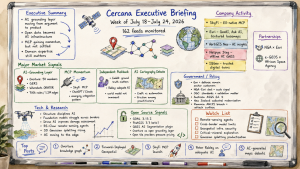
Cercana Executive Briefing — Week of March 21–27, 2026

142 feeds monitored. Published March 27, 2026.

Executive Summary

The clearest story of this week is the merging of two narratives that have been running in parallel: sovereign AI and geospatial intelligence. On Sunday, GoGeomatics published a piece authored by Will Cadell whose title states the thesis plainly: “SovereignAI is GeoAI.” Within 72 hours, Australia made three distinct institutional moves: Geoscience Australia launched a new 10-year national strategy; a new National Geospatial Advisory Committee was announced with cross-sector representation; and Geospatial World ran a feature on Australia’s Austral-Asian Space Innovation Institute discussing sovereign satellite capability and the National Digital Twin for Agriculture. This is not messaging from one company — it is institutional behavior from a government treating geospatial infrastructure as strategic national infrastructure.

That same framing is arriving in U.S. federal policy. The GeoAI and the Law Newsletter this week dissected the Artificial Intelligence Regulation and Safeguards Act and found an expanded geolocation definition that could reshape how geospatial companies collect and use location data. The GSA’s proposed AI contract clause for federal procurement is described as the most consequential shift for geospatial vendors in years.

Meanwhile, European standards are in flux. Javier de la Torre’s analysis of the INSPIRE Directive simplification argues this is not mere bureaucratic tidying but an opening to embrace analytics-native paradigms, which is a structural shift in how European geospatial infrastructure is conceived.

Across all three developments, the same question is being asked simultaneously in Washington, Brussels, Canberra, and Ottawa: what does geospatial data mean for national capability? Leaders who treat this as a technical standards conversation are reading it wrong. It is a strategic infrastructure conversation, and the answer is being written this week in policy documents, not product roadmaps.

Major Market Signals

SovereignAI and GeoAI Are Converging as a Policy Frame

GoGeomatics published “SovereignAI is GeoAI” on March 22, arguing that national AI sovereignty strategies are fundamentally geospatial challenges, asserting that understanding territory, movement, resources, and infrastructure at scale requires geospatial intelligence as a foundational layer. Within days, Australia produced three institutional signals in the same direction: a new 10-year strategy from Geoscience Australia framed around shaping “Australia’s future through geoscience insights”; a new National Geospatial Advisory Committee advising government; and a Geospatial World feature on the Austral-Asian Space Innovation Institute discussing sovereign satellite capability and the National Digital Twin for Agriculture. Canada is also in motion: the retirement of CCMEO Director General Eric Loubier after 25 years is characterized by GoGeomatics as arriving at a “critical time” for Canada’s geospatial sector. The policy frame is hardening across the middle powers, with geospatial seen as strategic infrastructure, not technical tooling.

U.S. Federal GeoAI Regulation Is Taking Shape

The Artificial Intelligence Regulation and Safeguards Act, which the GeoAI and the Law Newsletter calls the “Trump AI Act,” contains an expanded geolocation definition that could require geospatial companies to alter how they collect, store, and use location data. Separately, the GSA’s proposed AI contract clause would affect how federal agencies procure AI-enabled geospatial services. The White House push for a unified federal AI standard would supersede the patchwork of state-level rules that geospatial companies currently navigate. Taken together, these three instruments represent the most significant regulatory shift for the U.S. geospatial market since CIPSEA. Companies with federal contracts or location-data products should be conducting legal exposure assessments now, not after enactment.

Commercial EO Capacity Is Expanding Across Multiple Modalities Simultaneously

Three distinct capability additions arrived this week: Synspective successfully placed its 8th StriX SAR satellite in orbit, continuing its build toward a 30-satellite constellation by 2030; Satellogic announced its Merlin satellite will deliver daily 1-meter resolution optical imagery; and Open Cosmos launched what it describes as the largest space-based real-time data service, fusing broadband connectivity, Earth observation, and IoT in a single platform. The pattern is consistent with broader commercial EO maturation: higher revisit, higher resolution, and tighter integration with downstream data pipelines. Organizations that have been waiting for the market to stabilize before committing to EO-based workflows should note that the infrastructure is arriving whether they are ready or not.

European Geospatial Standards Infrastructure Is at a Decision Point

Javier de la Torre’s analysis in Spatialists — titled “geo beyond INSPIRE” — frames the simplification of the EU INSPIRE Directive not as a retreat but as a structural opportunity. The argument is that INSPIRE’s interoperability-first model, built for a previous era, is increasingly misaligned with how geospatial data is actually consumed. Analytics-native paradigms, where data is designed for computation from the start, not formatted for exchange, offer a better fit for the AI-era use cases now driving demand. The OGC simultaneously announced its Testbed on Trusted Data and Systems has expanded beyond Europe to include non-European NMCAs, reflecting growing global interest in how authoritative public geospatial data can be modernized and made computationally useful. These two developments together mark a transition moment for European and global geospatial standards. The question is not whether INSPIRE changes, but who shapes what replaces it.

Notable Company Activity

Product Releases

  • Esri: A coordinated spring release wave this week covered ArcGIS GeoAnalytics Engine 2.0 (cloud-scale spatial analytics), ArcGIS Urban (March 2026 update), ArcGIS StoryMaps (March 2026), ArcGIS Pro SDK updates, R-ArcGIS Bridge Spring 2026, and Lidar updates to World Elevation Layers in Living Atlas. The breadth and simultaneity of these releases signals a major platform release cycle, not incremental maintenance.
  • Satellogic: The Merlin satellite will offer daily 1-meter optical imagery, a meaningful step toward sub-daily revisit at commercial resolutions.
  • Open Cosmos: Announced what it calls the largest space-based real-time data service, combining broadband connectivity, Earth observation, and IoT telemetry in a single commercial offering.
  • Septentrio: Launched the AsteRx EB, a compact high-accuracy GNSS receiver targeting robotics, logistics, and industrial automation, extending precision positioning into non-traditional industrial sectors.
  • SBG Systems: Unveiled the Stellar-40, a modular and scalable inertial navigation system for demanding and mission-critical environments.
  • Apple: Announced that ads will come to Apple Maps in the United States and Canada beginning this summer via its new Apple Business platform.

Partnerships

  • ANELLO Photonics × Q-CTRL: A strategic collaboration combining silicon photonics inertial sensing with quantum magnetic navigation, targeting UAV operation in GPS-denied environments. The press release cites a $1 billion-per-day global cost from navigation failures, a finding that may attract defense and logistics attention.
  • Kongsberg Discovery × Fugro: A new Main Supplier framework agreement formalizing a decades-long relationship between the ocean technology and subsurface surveying firms.
  • Seabed 2030 × Greenroom Robotics: The international seabed mapping program partnered with the Australian autonomous vessel company to expand ocean floor data collection.

Funding & M&A

  • Arlula: Raised A$3.4 million to build out software workflows for automated satellite tasking and imagery analysis. This is a small-ticket award but is strategically directional in the EO automation space.
  • e-GEOS (Leonardo Group): Won a contract from Italy’s Ministry of Environment and Energy Security to conduct nationwide satellite mapping of asbestos.

Government and Policy Developments

Australia produced the most concentrated national geospatial policy activity of the week. Geoscience Australia launched a 10-year strategy framed explicitly around national capability, with ministerial endorsement. A new National Geospatial Advisory Committee was established to provide cross-sector advice to government. And the Austral-Asian Space Innovation Institute’s founding CEO used a Geospatial World platform to articulate how sovereign space capability, satellite constellation data, and the National Digital Twin for Agriculture are linked strategic assets. Three announcements in four days from one government signals that geospatial is a designated policy priority in Canberra, not a technical afterthought.

Canada’s situation is the mirror image: a leadership vacuum at CCMEO is arriving precisely when Canada needs to respond to both sovereignty pressures and a rapidly changing EO commercial market. GoGeomatics’ framing of this as a “critical time” reflects the real institutional risk that mid-cycle leadership transitions at national mapping agencies have historically been associated with delayed procurement decisions and stalled modernization programs.

In the United States, the GeoAI and the Law Newsletter’s detailed reading of the Artificial Intelligence Regulation and Safeguards Act and the GSA’s proposed AI procurement clause deserves board-level attention for any company selling geospatial AI capabilities to federal agencies. The expanded geolocation definition in the proposed legislation is not incidental and it appears to bring a wider range of location data products within the act’s scope than current law covers.

The OGC’s Testbed on Trusted Data and Systems is worth tracking as a governance model. Originally launched as Testbed Europe, its expansion reflects interest from non-European NMCAs who face the same modernization challenge: how to make authoritative public spatial data computationally useful without sacrificing trustworthiness. This is engineering work with standards implications that will matter across every market where national mapping agencies are significant data providers.

Ordnance Survey data is also anchoring a new UK multi-agency emergency communications system designed to reduce the time required to transfer incident data between control rooms, demonstrating a practical example of authoritative location data embedded in safety-critical infrastructure.

Technology and Research Trends

The Spatial Edge newsletter this week highlighted research in Nature Communications integrating seismic risk modeling, geospatial infrastructure inventory, and climate accounting that shows earthquake-related building repairs generate massive CO2 emissions. The implication for the market is directional: insurers, municipal governments, and climate-disclosure frameworks will need spatial datasets that link physical risk exposure to embodied carbon accounting. This is an early signal of a new analytical product category.

QGIS Server gained time-series (WMS-T) support for grouped layers this week, contributed by Oslandia in collaboration with Ifremer, the French oceanographic research institute. The technical significance extends beyond the feature: it enables institutional EO data providers to distribute time-varying imagery through standards-compliant web services without bespoke infrastructure. As more governments look to publish national EO datasets via QGIS-based portals, this capability removes a meaningful barrier.

Swiss cadastral survey data is now available in IFC format for BIM integration via geodienste.ch, with four cantons participating and more expected. This represents one of the first examples of authoritative cadastral data crossing the traditional boundary between GIS and building information modeling workflows. For vendors selling into the AEC sector, it is a signal that the BIM-GIS convergence is becoming a data standards reality, not just a vision document.

The “Shortening Translation Distance” essay by Bill Dollins in geoMusings this week offered a practitioner’s-eye view of how AI code generation is changing the relationship between user-centric domain knowledge and programming in geospatial work.

Open Source Ecosystem Signals

FOSSGIS 2026, the annual German open-source geospatial conference, took place this week in Göttingen. The CCC (Chaos Computer Club) published Day 1 session recordings on the same day as the presentations, which is described by geoObserver as a record turnaround that reflects both organizational maturity and the community’s commitment to accessibility. For organizations evaluating open-source geospatial tooling, FOSSGIS 2026 session recordings represent a concentrated resource: they document the current state of practice across QGIS, PostGIS, MapLibre, GeoServer, and adjacent tools, often before formal release notes appear.

Oslandia had a notable week in the European open-source ecosystem: the QGIS Server WMS-T contribution for Ifremer (technical post published), a recap of the QGIS-Fr French user days, and an announcement of GeoDataDays 2026 in Tours. Oslandia’s activity this week illustrates how open-source QGIS ecosystem contributors operate as professional services firms with direct government and research institution clients. This is model that can mitigate lifecycle concerns in procurement decisions for public sector geospatial programs.


Watch List

  • Apple Maps advertising model: If Apple’s entry into map advertising succeeds commercially, it will pressure Google to expand its own ad surface area in Maps, potentially restructuring the economics of consumer location data platforms globally. B2B geospatial vendors whose products sit downstream of consumer map data APIs should monitor closely.
  • OGC MUDDI standard: The OGC published a detailed narrative this week on the MUDDI (Model for Underground Data Definition and Integration) standard, framing it as a model for cross-system urban spatial data interoperability. Underground infrastructure mapping is a large, fragmented market and a maturing standard here could unlock significant procurement activity.
  • GPS-denied navigation commercialization: The ANELLO/Q-CTRL partnership is the most prominent announcement in a cluster of GPS-alternative navigation products reaching market. The $1B/day framing will attract defense and logistics capital. Watch for follow-on partnerships or acquisition interest from platform navigation vendors.
  • Radiant Earth governance shift: New board members this week include Cassie Ely, who played a role in bringing MethaneSAT to life, and David X. Cohen, executive producer of Futurama. The combination of climate-finance experience and science communication expertise signals that Radiant Earth is positioning itself for a higher-visibility role in the EO-climate intersection.
  • BIM-GIS cadastral convergence: Switzerland’s IFC-format cadastral data is the leading example, but the pattern of authoritative government cadastral data flowing into BIM workflows is likely to appear in other jurisdictions. AEC-sector geospatial vendors should be tracking the OGC BIM-standards working group for early signal.

Top Posts of the Week

  1. SovereignAI is GeoAIGoGeomatics — Establishes the thesis that national AI sovereignty strategies are fundamentally geospatial challenges; the most strategically significant framing piece of the week.
  1. “geo” beyond INSPIRESpatialists (Ralph Straumann / Javier de la Torre) — Frames the INSPIRE Directive simplification as an opportunity to adopt analytics-native paradigms rather than simply reducing compliance burden.
  1. GeoAI and the Law NewsletterSpatial Law & Policy — Detailed reading of the Trump AI Act’s expanded geolocation definition, the White House unified AI standard push, and the GSA AI contract clause — essential reading for any geospatial vendor with federal exposure.
  1. Contextual Location Data, Unified Foundational Maps Paramount for IndustryGeospatial World — Interview with Overture Maps Foundation Executive Director Will Mortenson on interoperability, the Global Entity Reference System, and the foundation’s AI and machine learning roadmap.
  1. Testbed on Trusted Data & SystemsOpen Geospatial Consortium — Announcement of the formerly Europe-only testbed going global, focused on practical NMCA modernization with reusable open outputs.

The Cercana Executive Briefing is sourced from 142 feeds aggregated by geofeeds.me.

Geospatial Sovereignty as a Strategic Requirement

Executive Summary

Geospatial systems are no longer peripheral tools; they underpin critical infrastructure, national security functions, and capital-intensive operations across government and industry. They support logistics, infrastructure management, environmental compliance, security operations, and strategic planning across government and industry. Yet many organizations rely on externally managed platforms for the storage, processing, and delivery of spatial intelligence.

This post discusses the concept of geospatial sovereignty, a governance and risk management discipline concerned with the degree to which an organization retains control over its geospatial data, infrastructure, and operational continuity.

As regulatory requirements expand, vendor ecosystems consolidate, positioning infrastructure faces disruption, and sovereign cloud models gain traction, executive teams must understand where they sit on the spectrum between dependency and control. The objective is informed, intentional architecture grounded in clear visibility into operational risk and long-term optionality.

Perception of Operational Control

For more than a decade, convenience has shaped enterprise technology decisions. Cloud-hosted platforms reduced infrastructure burdens. Subscription licensing simplified procurement. Managed services shifted operational responsibility outward. For many organizations, these shifts accelerated deployment and reduced internal complexity. But in the domain of geospatial operations, a different question is emerging: Who actually controls the systems that underpin your spatial intelligence?

Consider a composite scenario drawn from observable trends. A logistics provider experiences degraded positioning data during a regional GPS disruption and discovers that routing intelligence depends on upstream signals it does not control. A cloud vendor modifies pricing tiers or usage thresholds, quietly altering long-term cost projections embedded in multi‑year operating plans. A regulatory audit raises questions about data residency and physical storage location, forcing leadership to answer questions they assumed were settled at contract signature. A mission‑critical geospatial workflow is interrupted by an upstream service outage, revealing how tightly coupled internal processes have become to external infrastructure.

In each case, the organization technically “owns” its mission and its data. Yet operational continuity depends on infrastructure, policy decisions, and technical roadmaps defined elsewhere. This is not a critique of cloud providers; many are reliable, professionally managed, and appropriate for a wide range of workloads. The issue is structural. Control of infrastructure, data, and operational continuity is not the same as platform access. When those elements diverge, organizations may discover that their geospatial capabilities are more dependent than leadership intended.

From Data Sovereignty to Geospatial Sovereignty

The concept of sovereignty in digital systems is not new. Data sovereignty is commonly defined as the principle that data are subject to the laws and governance structures of the jurisdiction in which they are collected or stored.

It is important to distinguish related but separate concepts. Data residency refers to the physical location where data are stored. Data localization refers to legal requirements that certain categories of data remain within specific geographic boundaries. Data sovereignty concerns the legal authority governing that data and the jurisdiction whose laws apply. These distinctions are discussed in detail by enterprise security and cloud governance analysts (CIO, 2026).

Increasingly, major technology publications are also examining “sovereign cloud” and “geopatriation” trends, where governments and enterprises seek to re-anchor sensitive workloads within controlled jurisdictions. These discussions reinforce that sovereignty is not theoretical. It is shaping procurement, cloud architecture, and national digital strategies.

Geospatial sovereignty extends this conversation beyond legal jurisdiction. It asks whether an organization retains meaningful authority over how its spatial infrastructure is architected and governed, whether operations can continue during vendor, network, or geopolitical disruption, how systems are updated and configured, how spatial data integrates with broader enterprise platforms, and where critical skills and knowledge reside.

In this context, sovereignty is operational. It concerns who can make consequential decisions about the systems that support mission execution.

Why This Issue Is Emerging Now

Several converging pressures are elevating geospatial sovereignty from a technical concern to an executive one.

1. Geospatial Is Foundational

Spatial data now informs asset management, utilities maintenance, supply chain routing, environmental monitoring, agriculture, mining, emergency response, and national security operations. As geospatial becomes core to operations, its governance becomes a strategic concern. National Academies research has repeatedly emphasized that geospatial information infrastructure is critical to modern governance and infrastructure management (National Academies of Sciences, Engineering, and Medicine, n.d.).

2. Regulatory and Compliance Demands Are Expanding

Globally, more than one hundred privacy and data governance laws now affect how organizations collect, process, and store data. These include GDPR in the European Union and numerous national and state-level frameworks.

As data governance regimes expand, spatial datasets, which are often rich with location intelligence tied to individuals, infrastructure, or sensitive assets, fall under increasing scrutiny. European discussions around building digital sovereignty through authoritative geodata emphasize that trusted, nationally governed datasets are foundational to public policy, security, and economic competitiveness (GIM International, 2026). The implication for enterprises is clear that geospatial data is no longer merely operational. It is policy-relevant and potentially regulated. Governance expectations are rising accordingly.

Commercial perspectives are echoing this shift. Industry commentary aimed at enterprise operators has begun to frame sovereign geospatial data as a competitive and operational necessity rather than a compliance afterthought. Discussions emphasize that organizations dependent on third-party platforms for core spatial intelligence may struggle to preserve data lineage, portability, and strategic control as markets evolve (Nimbo, 2025). The argument is not ideological; it is pragmatic. When spatial data informs capital allocation, logistics optimization, and asset performance, control over that data becomes economically material.

3. Vendor Ecosystems Are Consolidating

The technology industry continues to experience consolidation through mergers and acquisitions. Platform acquisition can alter licensing terms, support models, product roadmaps, and pricing structures.

Organizations that rely exclusively on proprietary ecosystems may find their long-term cost models and integration assumptions shifting unexpectedly. Industry commentary has begun to frame geospatial sovereignty as requiring both legal alignment and architectural foresight, which highlights that compliance without architectural control can still leave organizations strategically exposed (CARTO, 2026).

In other words, sovereignty is not solved by contract language alone. It must be reflected in system design.

4. Strategic Uncertainty Is Increasing

Positioning, Navigation, and Timing (PNT) infrastructure such as the Global Positioning System (GPS) is globally relied upon and operated by national governments (U.S. Space Force, 2023). Disruptions, whether technical, environmental, or geopolitical, demonstrate that foundational spatial services are not immune to systemic risk.

Recent analysis from Australia’s spatial industry has highlighted both the economic potential and systemic vulnerability of national PNT infrastructure. Commentary in Spatial Source has warned that while modern economies are deeply dependent on satellite-based positioning, they often lack redundancy and assurance frameworks to mitigate disruption (Spatial Source, 2026a).

Further, discussion of “navwar,” or navigation warfare, underscores that PNT denial and degradation are no longer theoretical military edge cases but active considerations in contested environments (Spatial Source, 2026b). Even outside conflict scenarios, signal interference, spoofing, and systemic outages pose measurable operational risk.

In response, governments are investing in resilience and sovereign capability. Frontiersi’s launch of Australia’s first dedicated PNT Labs reflects a recognition that positioning infrastructure requires independent testing, validation, and assurance capacity (Spatial Source, 2025). Similarly, Canada’s evolving Defence Industrial Strategy explicitly acknowledges the strategic importance of domestic geospatial capability within national security and industrial planning (GoGeomatics Canada, 2026).

These developments signal a broader shift. When governments treat geospatial and PNT systems as strategic assets requiring sovereign capability, commercial enterprises should take note. If national infrastructure planners view spatial systems through a sovereignty lens, enterprises whose operations depend on those systems must evaluate their own dependency assumptions.

At the same time, analysts are emphasizing that data provenance and trust are becoming central to reliable forecasting, AI modeling, and decision support. Without clear lineage and governance, spatial analytics risk becoming less defensible and less auditable (Ready Signal, 2026).

When spatial infrastructure becomes integral to mission execution, resilience and traceability are no longer purely technical considerations. They become executive concerns tied to continuity, liability, competitive positioning, and public trust.

Costs of Dependency

Dependency is rarely visible when systems function as expected. It becomes visible when change is required. Organizations may discover that data export is limited or constrained by proprietary formats, that migration costs are materially higher than anticipated, or that integration depth is bounded by vendor APIs rather than internal design choices. Custom workflows may be constrained by externally managed roadmaps, and over time internal skills may atrophy because expertise resides primarily with the platform provider rather than within the enterprise.

These costs are often architectural rather than purely financial. They shape how quickly an organization can pivot, how confidently it can integrate acquisitions, and how effectively it can respond to regulatory change. Over time, optimizing for short-term convenience can reduce long-term flexibility. That trade-off may be acceptable for commoditized functions. It is less acceptable when spatial intelligence underpins strategic decision-making.

Sovereignty as Institutional Capability

At its most practical level, geospatial sovereignty is about institutional capability. It asks whether the organization possesses the internal knowledge required to operate and evolve its spatial systems, whether it can transition platforms without losing intellectual capital, whether its most critical spatial workflows are portable, and whether leadership has explicitly defined which components must remain under direct control.

Sovereignty exists on a spectrum, ranging from fully vendor-managed SaaS environments where infrastructure and architectural direction are externally controlled to fully self-managed systems governed internally. Most organizations operate somewhere between these poles. The leadership challenge is to ensure that dependency is intentional, understood, and aligned with mission risk tolerance. Where dependency is acceptable, it should be consciously accepted; where it is not, architectural adjustments should follow.

The Architecture Question

When organizations examine geospatial sovereignty seriously, the discussion shifts from tools to architecture. Questions emerge that are fundamentally architectural in nature. Which datasets are mission-critical versus supportive? Which workflows must remain operational during network disruption? Where does regulatory exposure exist? Which integrations define competitive advantage? How portable are spatial assets across platforms and vendors?

Answering these questions requires cross-functional engagement across technology, operations, legal, compliance, and executive leadership. The conversation moves beyond tool comparison and into enterprise design. Sovereignty is ultimately a governance and architecture exercise intersecting risk management, operational resilience, and long-term strategy.

Seeking Guidance

As geospatial systems become more deeply integrated with enterprise operations, governance cannot remain purely technical. Executive leadership increasingly needs visibility into structural dependencies, long-term total cost trajectories, regulatory exposure, continuity planning assumptions, and the sustainability of internal talent.

Organizations that evaluate sovereignty proactively retain optionality. Those that defer the conversation may discover constraints only when disruption forces action. In that moment, architectural flexibility is no longer a strategic advantage; it becomes an emergency requirement.

The role of trusted advisors in this context is not to prescribe universal solutions or advocate a single technology stack. It is to help organizations map existing dependencies, clarify strategic priorities, assess architectural alternatives, and align technology decisions with mission risk tolerance. Sovereignty decisions should reflect leadership intent rather than historical inertia.

For organizations navigating this terrain, the challenge is rarely theoretical. It is practical, architectural, and often constrained by legacy decisions. Experienced advisory support can help leadership teams translate sovereignty from an abstract principle into an actionable roadmap. That work begins with disciplined assessment, grounded risk analysis, and a clear understanding of how geospatial capabilities align with mission priorities.

A Conversation Worth Having

This discussion does not require immediate platform replacement or imply that current systems are deficient. It begins with assessment. Who controls your geospatial infrastructure? Where are your true dependencies? Which elements are strategic, and which are commoditized?

As spatial intelligence becomes central to both public and private sector operations, these questions move from theoretical to structural. They shape procurement strategy, workforce planning, compliance posture, and long-term competitiveness.

In subsequent posts, we will examine architectural models, hybrid approaches, and the role of open-source ecosystems in enabling greater geospatial independence without sacrificing innovation. We will also explore practical assessment frameworks that allow leadership teams to quantify dependency instead of debating it abstractly.

For now, the imperative is straightforward: understand your position on the sovereignty spectrum before external events force the issue. In an era of increasing complexity, control means ensuring that the systems most critical to your mission remain aligned with strategic intent.

References

CARTO. (2026, Jan 15). Geospatial sovereignty requires law and architecture. https://carto.com/blog/geospatial-sovereignty-why-it-requires-both-law-and-architecture

CIO. (2026, Feb 13). Geopatriation and sovereign cloud: How data returns to its origin. https://www.cio.com/article/4131458/geopatriacion-and-sovereign-cloud-how-data-returns-to-its-origin.html

GIM International. (2026, Feb 25). Building digital sovereignty through authoritative European geodata. https://www.gim-international.com/content/news/building-digital-sovereignty-through-authoritative-european-geodata

GoGeomatics Canada. (2026, Feb 18). What Canada’s defence industrial strategy really means for geospatial. https://gogeomatics.ca/what-canadas-defence-industrial-strategy-really-means-for-geospatial/

National Academies of Sciences, Engineering, and Medicine. (n.d.). Geospatial information infrastructure and governance. https://www.nationalacademies.org/read/28857/chapter/10

Nimbo. (2025, Dec 2). Sovereign geospatial data. https://nimbo.earth/stories/sovereign-geospatial-data/

Ready Signal. (2026, Feb 19). Data sovereignty, provenance, and trustworthy forecasts. https://www.readysignal.com/blog/data-sovereignty-provenance-trustworthy-forecasts-2026

Spatial Source. (2026, Feb 20). Australian PNT: Lots of potential, lots of danger. https://www.spatialsource.com.au/australian-pnt-lots-of-potential-lots-of-danger/

Spatial Source. (2026, Feb 10). PNT assurance in the age of navwar. https://www.spatialsource.com.au/pnt-assurance-in-the-age-of-navwar/

Spatial Source. (2025, Feb 26). Frontiersi launches Australia’s first PNT labs. https://www.spatialsource.com.au/frontiersi-launches-australias-first-pnt-labs/

U.S. Space Force. (n.d.). Global Positioning System (GPS). https://www.spaceforce.mil/About-Us/Fact-Sheets/Article/2197765/global-positioning-system/

Header image: Mhsheikholeslami, CC BY-SA 4.0 https://creativecommons.org/licenses/by-sa/4.0, via Wikimedia Commons

Strategic Teaming for Small Businesses

In federal and technically complex markets, small businesses often treat teaming as a procedural step in the pursuit lifecycle, something to evaluate during bid/no-bid discussions and formalize before proposal submission.

That framing understates its importance.

Teaming is not merely a mechanism for satisfying requirements. When approached deliberately, it becomes an institutional discipline that shapes competitive posture, delivery resilience, and long-term market positioning.

For leadership teams, the issue is not whether to team. The issue is whether teaming decisions reflect strategic intent or short-term convenience.

Executive Summary

Strong small business teaming relationships are built on four disciplines:

  1. Acknowledge capability gaps before pursuing partnerships.
  2. Build resilience through strategic capability overlap, not just gap-filling.
  3. Define workshare commitments clearly and early.
  4. Maintain professional discipline in competitive markets.

Organizations that internalize these principles strengthen both proposal credibility and long-term competitive architecture.

Why Self-Awareness Is Critical in Small Business Teaming

Organizations that consistently perform well in competitive environments share a defining trait: clarity about their capabilities — including their limitations.

No small business, regardless of technical depth, is equally strong across every domain. Attempting to project comprehensive sufficiency may satisfy internal confidence, but it can introduce structural risk into proposals and execution plans.

Strategic teaming begins with disciplined internal assessment:

  • Where does the organization create differentiated value?
  • Where does it rely on marginal capacity?
  • Where would complementary expertise materially strengthen delivery confidence?

Acknowledging capability boundaries is not weakness, it is risk management. When leadership approaches partnership from a position of institutional clarity, teaming becomes a deliberate enhancement of performance and not a reactive concession.

Should Small Businesses Avoid Overlapping Capabilities When Teaming?

A common approach to teaming is to identify narrow capability gaps and select partners who provide only those discrete functions. Overlap is often avoided in the name of efficiency.

This approach assumes static requirements and predictable execution environments. In reality, contracts evolve. Staffing markets tighten, technical requirements expand, and surge demands arise with limited notice. Under these conditions, resilience becomes more valuable than theoretical efficiency.

Strategic overlap in which partners possess adjacent or even similar capabilities provides:

  • Flexibility in resource allocation
  • Accelerated response to emergent requirements
  • Reduced dependence on extended hiring cycles
  • Continuity when individual contributors transition

Managed properly, overlapping capability is not redundancy. It is operational insurance. For leaders accountable for performance, this distinction is material.

How Should Small Businesses Structure Teaming Agreements?

Teaming agreements are often viewed as preliminary instruments necessary for proposal submission but secondary to the eventual subcontract.

In practice, they establish the psychological and operational foundation for the entire relationship. Partners who contribute proposal effort, past performance, and strategic positioning incur real opportunity cost. When post-award workshare remains ambiguous, trust erodes before execution begins.

High-functioning teams address this directly by defining:

  • Concrete areas of responsibility
  • Structured workshare commitments where feasible
  • Explicit constraints tied to funding or regulatory requirements (such as the 51% requirement in small-business set-asides)
  • Clear mechanisms for adjustment as scope evolves

Clarity does not eliminate uncertainty. It reduces avoidable friction. Trust built during formation strengthens collaboration during execution, where it matters most.

Why Professional Discipline Matters in Competitive Markets

In tightly networked technical markets, such as the geospatial technology market, roles shift frequently. Today’s teammate may be you competition tomorrow. Yesterday’s competitor may become a strategic partner.

Every organization carries an obligation to remain viable and act in the best interest of its workforce and stakeholders. Decisions about which team to join, or whether to prime independently, are strategic business judgments. Emotional reactions to competitive outcomes can introduce unnecessary long-term cost.

Professional discipline, by contrast:

  • Preserves relationships
  • Protects reputation
  • Maintains strategic optionality

In small-business ecosystems especially, credibility compounds over time.

What Makes a Strong Small Business Teaming Relationship?

A strong teaming relationship is defined less by formal structure and more by institutional alignment.

Effective teams demonstrate:

  • Clear understanding of differentiated strengths
  • Willingness to build depth rather than minimal compliance
  • Transparent workshare expectations
  • Mature responses to competitive shifts

When these elements are present, teaming strengthens not only a single proposal but the long-term capability network of the organization.

Building Competitive Architecture, Not Just Winning Contracts

Sustained growth in complex technical markets rarely comes from isolated contract awards. It comes from constructing a reliable competitive architecture grounded in disciplined execution, credible relationships, and thoughtful capability alignment. Teaming decisions are central to that architecture.

Organizations that approach partnership deliberately, with institutional self-awareness, operational foresight, and professional maturity, create networks that strengthen both pursuit and performance.

For leadership teams navigating modernization initiatives, shifting procurement priorities, evolving mission requirements, and constrained resources, the quality of partnerships is often as consequential as internal capability.

Teaming, treated as an executive-level discipline, becomes a force multiplier and a durable source of competitive strength.

Header image: G. Edward Johnson, CC BY 4.0 https://creativecommons.org/licenses/by/4.0, via Wikimedia Commons

5 Things CFOs Should Know About Open Source

You don’t have to understand open source to have an opinion on it. But here’s the thing: your company is already running on it. The question isn’t whether to engage with open source, but whether you’re being intentional about it.

Here’s what CFOs should have on their radar.

1. “Free” is a starting price, not a total cost.

Maintenance costs are baked into every software decision. The question is whether you’re paying them in engineering time or in vendor fees. Every shortcut taken today becomes tech debt tomorrow, and McKinsey warns that companies spending more than half their IT budget servicing that debt are likely paying interest only, with little left for innovation (Lamarre et al., 2020). Open source lets you redirect that spend toward work that actually differentiates your business.

2. Your vendor leverage depends on it.

When your stack is built on open source foundations, you have a credible alternative to any vendor relationship. That optionality changes contract negotiations in your favor. Companies locked into proprietary systems don’t have the same walk-away power and vendors know it.

3. It shows up in your talent numbers.

Engineers tend to follow interesting technology, making a modern open source stack is a recruiting asset, and a legacy proprietary one is a quiet repellent. A modern open source stack is a recruiting asset; a legacy proprietary one is a quiet repellent. Gallup estimates that replacing an employee in a technical role costs around 80% of their annual salary, and that figure excludes harder-to-measure losses like institutional knowledge and team morale (Gallup, 2025). Retain one engineer who would have left, and open source has already paid for itself.

4. Your open source licenses are a portfolio to manage, not a minefield to avoid.

Many open source licenses, such as Apache, MIT, or BSD are straightforwardly business-friendly. The few that carry restrictions only become a problem when nobody’s tracking them. According to Synopsys’s 2024 Open Source Security and Risk Analysis report, 53% of audited codebases contained open source license conflicts (Synopsys Cybersecurity Research Center, 2024) That number that drops sharply for organizations that treat license exposure the way they’d treat any other portfolio: with visibility and periodic review.

5. You’re more dependent on it than you think.

The infrastructure underneath your products, including databases, operating systems, security tools, and cloud platforms, is almost certainly built on open source. That’s not a problem. But it is a reason to pay attention. Synopsys’s 2024 report found that 96% of commercial codebases contain open source components, with open source accounting for 77% of the total code scanned across more than 1,000 audits (Synopsys Cybersecurity Research Center, 2024).

References

Gallup. (2025, August 22). Employee retention depends on getting recognition right. https://www.gallup.com/workplace/650174/employee-retention-depends-getting-recognition-right.aspx

Lamarre, E., Smaje, K., & Zemmel, R. (2020, October 5). Tech debt: Reclaiming tech equity. McKinsey & Company. https://www.mckinsey.com/capabilities/mckinsey-digital/our-insights/tech-debt-reclaiming-tech-equity

Synopsys Cybersecurity Research Center. (2024). Open source security and risk analysis (OSSRA) report (9th ed.). Synopsys. https://www.synopsys.com/software-integrity/resources/analyst-reports/open-source-security-risk-analysis.html

Reflections on the Process of Planning FedGeoDay 2025

What is FedGeoDay?

FedGeoDay is a single-track conference dedicated to federal use-cases of open geospatial ecosystems. The open ecosystems have a wide variety of uses and forms, but largely include anything designed around open data, open source software, and open standards. The main event is a one day commitment and is followed by a day of optional hands-on workshops. 

FedGeoDay has existed for roughly a decade , serving as a day of learning, networking, and collaboration in the Washington, D.C. area. Recently, Cercana Systems president Bill Dollins was invited to join the planning committee, and served as one of the co-chairs for FedGeoDay 2024 and 2025. His hope is that attendees are able to come away with practical examples of how to effectively use open geospatial ecosystems in their jobs. 

Photo courtesy of OpenStreetMap US on LinkedIn.

“Sometimes the discussion around those concepts can be highly technical and even a little esoteric, and that’s not necessarily helpful for someone who’s just got a day job that revolves around solving a problem. Events like this are very helpful in showing practical ways that open software and open data can be used.”

Dollins joined the committee for a multitude of reasons. In this post, we will explore some of his reasons for joining, as well as what he thinks he brings to the table in planning the event and things he has learned from the process. 

Why did you join the committee?

When asked for some of the reasons why he joined the planning committee for FedGeoDay, Dollins indicated that his primary purpose was to give back to a community that has been very helpful and valuable to him throughout his career in a very hands-on way. 

“In my business, I derive a lot of value from open-source software. I use it a lot in the solutions I deliver in my consulting, and when you’re using open-source software you should find a way that works for you to give back to the community that developed it. That can come in a number of ways. That can be contributing code back to the projects that you use to make them better. You can develop documentation for it, you can provide funding, or you can provide education, advocacy, and outreach. Those last three components are a big part of what FedGeoDay does.”

He also says that while being a co-chair of such an impactful event helps him maintain visibility in the community, getting the opportunity to keep his team working skills fresh was important to him, too. 

“For me, also, I’m self-employed. Essentially, I am my team,” said Dollins. “It can be really easy to sit at your desk and deliver things and sort of lose those skills.”

What do you think you brought to the committee?

Dollins has had a long career in the geospatial field and has spent the majority of his time in leadership positions, so he was confident in his ability to contribute in this new form of leadership role. Event planning is a beast of its own, but early on in the more junior roles of his career, the senior leadership around him went out of their way to teach him about project cost management, staffing, and planning agendas. He then was able to take those skills into a partner role at a small contracting firm where he wore every hat he could fit on his head for the next 15 years, including still doing a lot of technical and development work. Following his time there, he had the opportunity to join the C-suite of a private sector SaaS company and was there for six years, really rounding out his leadership experience. 

He felt one thing he was lacking in was experience in community engagement, and event planning is a great way to develop those skills. 

“Luckily, there’s a core group of people who have been planning and organizing these events for several years. They’re generally always happy to get additional help and they’re really encouraging and really patient in showing you the rules of the road, so that’s been beneficial, but my core skills around leadership were what applied most directly. It also didn’t hurt that I’ve worked with geospatial technology for over 30 years and open-source geospatial technology for almost 20, so I understood the community these events serve and the technology they are centered around,” said Dollins.

Photo courtesy of Ran Goldblatt on LinkedIn.

What were some of the hard decisions that had to be made?

Photo Courtesy of Cercana Systems on LinkedIn.

Attendees of FedGeoDay in previous years will likely remember that, in the past, the event has always been free for feds to attend. The planning committee, upon examining the revenue sheets from last year’s event, noted that the single largest unaccounted for cost was the free luncheon. A post-event survey was sent out, and federal attendees largely indicated that they would not take issue with contributing $20 to cover the cost of lunch. However, the landscape of the community changed in a manner most people did not see coming.

“We made the decision last year, and keep in mind the tickets went on sale before the change of administration, so at the time we made the decision last year it looked like a pretty low-risk thing to do,” said Dollins.

Dollins continued to say that while the landscape changes any time the administration changes, even without changing parties in power, this one has been a particularly jarring change. 

“There’s probably a case to be made that we could have bumped up the cost of some of the sponsorships and possibly the industry tickets a little bit and made an attempt to close the gap that way. We’ll have to see what the numbers look like at the end. The most obvious variable cost was the cost of lunches against the free tickets, so it made sense to do last year and we’ll just have to look and see how the numbers play out this year.”**

What have you taken away from this experience?

Dollins says one of the biggest takeaways from the process of helping to plan FedGeoDay has been learning to apply leadership in a different context. Throughout most of his career, he has served as a leader in more traditional team structures with a clearly defined hierarchy and specified roles. When working with a team of volunteers that have their own day jobs to be primarily concerned with, it requires a different approach. 

“Everyone’s got a point of view, everyone’s a professional and generally a peer of yours, and so there’s a lot more dialogue. The other aspect is that it also means everyone else has a day job, so sometimes there’s an important meeting and the one person that you needed to be there couldn’t do it because of that. You have to be able to be a lot more asynchronous in the way you do these things. That’s a good thing to give you a different approach to leadership and team work,” said Dollins on the growth opportunity. 

Dollins has even picked up some new work from his efforts on the planning committee by virtue of getting to work and network with people that weren’t necessarily in his circle beforehand. Though he’s worked in the geospatial field for 30 years and focused heavily on open-source work for 20, he says he felt hidden away from the community in a sense during his time in the private sector. 

Photo courtesy of Lane Goodman on LinkedIn.

“This has helped me get back circulating in the community and to be perceived in a different way. In my previous iterations, I was seen mainly from a technical perspective, and so this has kind of helped me let the community see me in a different capacity, which I think has been beneficial.”

FedGeoDay 2025 has concluded and was a huge success for all involved. Cercana Systems looks forward to continuing to sponsor the event going forward, and Dollins looks forward to continuing to help this impactful event bring the community together in the future. 

Photo courtesy of Cercana Systems on LinkedIn.

**This interview was conducted before FedGeoDay 2025 took place. The event exceeded the attendance levels of FedGeoDay 2024.