
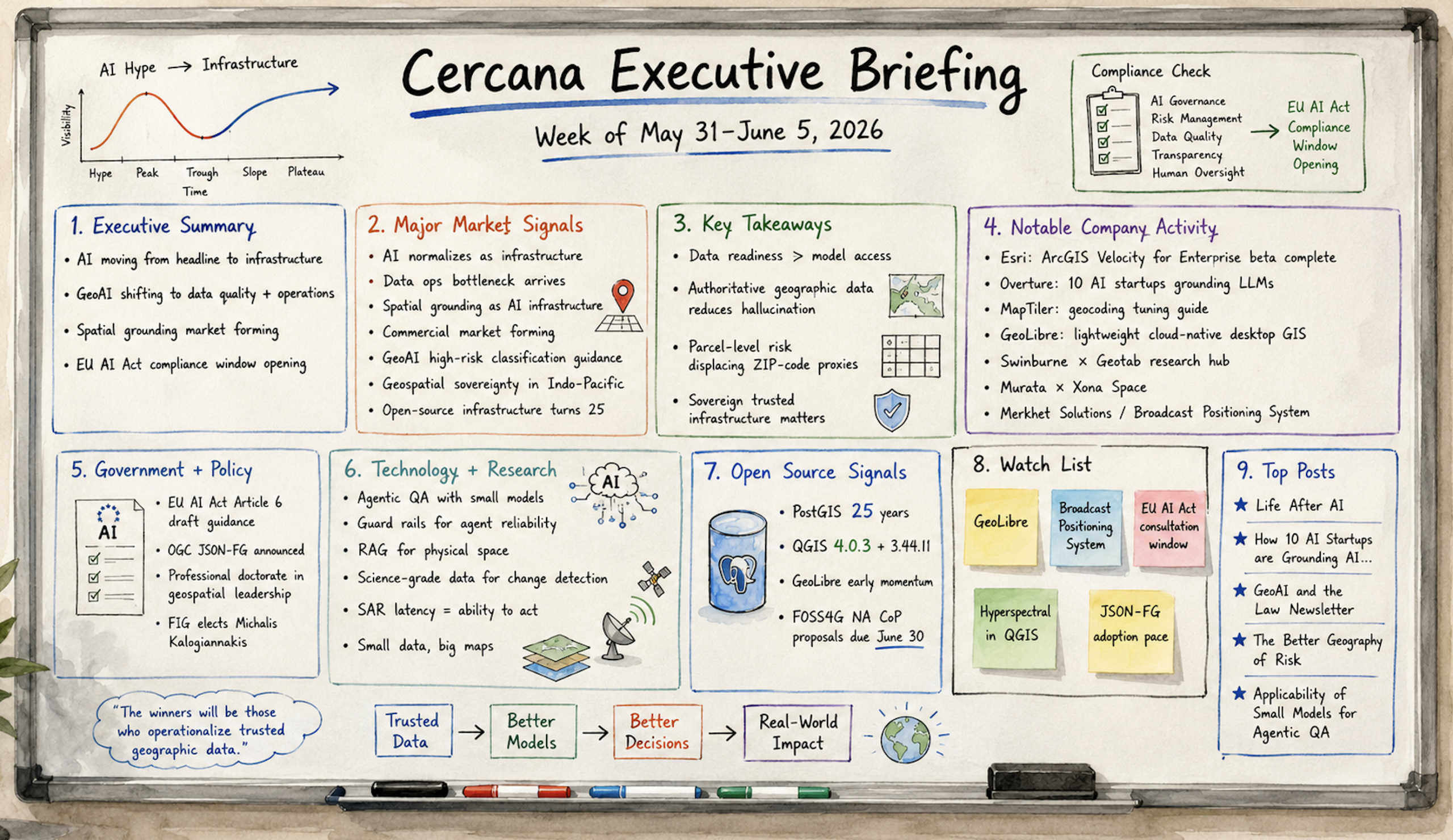
162 feeds monitored. Published June 5, 2026.
Executive Summary
This week’s clearest development is a shift in how the industry is talking about AI. In “Life After AI,” Bill Dollins argues that the technology is crossing the threshold every general-purpose platform eventually crosses, from headline to infrastructure. No one now treats “in the cloud” as the remarkable fact about a product. AI is moving toward the same invisibility. The operational consequence is straightforward: the distinguishing question is no longer which model an organization can access, but whether its geospatial data can support real decisions. The GeoAI hype cycle is not ending so much as settling into a data quality and operations question.
In parallel, Overture Maps Foundation documented how ten AI startups are using open geographic data as a grounding layer for LLMs that otherwise struggle with spatial reasoning. Clairvoyint AI published an analysis of parcel-level risk modeling displacing ZIP-code proxies in insurance. Taken together, the pattern is becoming clearer: geographic truth is turning into a critical dependency for AI systems that operate in the physical world, and the market for spatially grounded AI is beginning to form.
Leaders should also note that draft guidance on high-risk AI system classification under the EU AI Act has now been issued for stakeholder consultation. GeoAI applications sit close enough to that scope that compliance planning now belongs in the current cycle, not a later one.
Major Market Signals
AI Normalizes as Infrastructure — The Data Operations Bottleneck Arrives
Bill Dollins’ “Life After AI” (geoMusings, June 4) captures the moment well: every general-purpose technology eventually stops being the subject and becomes part of the foundation. The web did it. Cloud did it. AI is approaching the same threshold. The significance of the post lies less in novelty than in timing. Dollins has been developing the related argument across several recent pieces: once AI recedes into background infrastructure, the distinguishing capability becomes the quality of the geospatial data it operates on. Organizations that have invested in clean, well-maintained, spatially accurate data pipelines will outperform those that expect the model to compensate for weak data. For vendors, that shifts differentiation toward pipeline quality, governance, and spatial accuracy. For buyers, it shifts evaluation away from model benchmarks and toward data readiness.
Spatial Grounding as AI Infrastructure — A Commercial Market Forms
Overture Maps Foundation documented how ten AI startups are using its open geospatial dataset to anchor LLMs to physical reality (“How 10 AI Startups are Grounding AI in the Real World with Overture,” June 4). The problem they are addressing is structural. LLMs trained on static, fragmented internet text have no reliable model of physical space at inference time. They hallucinate addresses, mislocate entities, and fail at spatial reasoning tasks. Overture, and more broadly any authoritative, maintained geographic knowledge base, is becoming infrastructure for that problem rather than merely one more dataset.
Separately, Clairvoyint AI published “The Better Geography of Risk” (June 2), arguing that ZIP codes are mail-routing artifacts rather than meaningful risk proxies, and that parcel-level ground truth is now economically viable in insurance at scale. Taken together, the two pieces point to a commercial market taking shape around spatially grounded AI, enabled by higher-resolution geographic data and aimed at industries such as insurance, logistics, real estate, and emergency response that require physical-world accuracy.
EU AI Act High-Risk Classification — Compliance Window Opens for GeoAI
The GeoAI and the Law Newsletter (June 4) reported that the European Commission issued draft guidelines for stakeholder consultation on classifying high-risk AI systems under Article 6 of the EU AI Act. Applications that make consequential decisions involving physical location, including infrastructure management, environmental monitoring, land-use planning, and defense, are close enough to the core of the guidance to merit immediate attention. The consultation period is open now, which gives organizations building or deploying GeoAI systems a finite window to assess whether their applications are likely to be classified as high-risk and what that would mean for certification, documentation, and liability exposure. This is no longer a future compliance issue. Geo Week News published a parallel analysis the same week, reinforcing that regulatory pressure is beginning to consolidate from multiple directions.
Geospatial Sovereignty Reaches Strategic Doctrine in the Indo-Pacific
The inaugural session of the Indo Pacific GeoIntelligence Forum 2026 opened this week with an explicit argument: strategic sovereignty requires informational sovereignty, and geospatial intelligence sits at the center of that relationship. Lt Gen Chandele’s address emphasized the growing importance of data centricity and networked geospatial decision-making in modern military operations. The forum’s language around connected systems and data-driven decision-making mirrors themes already visible in Australian, Canadian, and European geospatial policy discourse. What is new here is the Indo-Pacific institutional setting and the direct linkage between geospatial data infrastructure and strategic national capability. For commercial vendors, that reads as a demand signal: defense and intelligence procurement in the region is likely to center on sovereign, trusted geospatial data infrastructure rather than cloud-dependent or foreign-hosted platforms.
Open-Source Infrastructure Turns 25 — And Keeps Shipping
PostGIS turned 25 years old this week. The first post to the PostGIS user list was timestamped May 31, 2001. GeoObserver marked the anniversary, and the milestone deserves attention because PostGIS remains the spatial database under a substantial share of the world’s GIS infrastructure. The same week, QGIS released patch updates for both the current stable branch, 4.0.3 “Norrköping,” and the long-term release branch, 3.44.11 “Solothurn,” across Windows, Linux, and macOS. Maintenance across two parallel release tracks reflects a mature open-source governance posture. For executives evaluating enterprise dependencies, this week served as another reminder that QGIS and PostGIS are neither fragile community projects nor legacy holdovers. They are active platforms with coordinated release management and long operating histories.
Notable Company Activity
Product Releases
- Esri: ArcGIS Velocity for ArcGIS Enterprise completed its public beta this week, suggesting the product is moving toward general availability. ArcGIS Velocity is Esri’s real-time analytics and event-driven processing capability; bringing it to Enterprise, rather than ArcGIS Online alone, extends real-time geospatial processing to organizations with on-premises or hybrid deployments. Esri also previewed ArcGIS Pro features and BIM/CAD integrations planned for announcement at the 2026 User Conference.
- Overture Maps Foundation: Published documentation of ten commercial AI startups using Overture data as a spatial grounding layer for LLMs. This is less a product release than a market-development signal: Overture is positioning its open dataset as infrastructure for AI systems that require physical-world accuracy.
- MapTiler: Released a technical guide to tuning geocoding search results, including parameter-level configuration advice. Incremental, but it points to continued investment in geocoding as a differentiated commercial service.
- Open Geospatial Solutions (YouTube): Released two videos this week introducing and updating GeoLibre, described as a lightweight, cloud-native desktop GIS. GeoLibre v0.5.0 significantly expanded geospatial data format support. This remains an early-stage open-source project and belongs on the watch list.
Partnerships
- Swinburne University × Geotab: Launched an AI-powered research hub focused on mobility and transport data. The partnership combines academic remote sensing and spatial science capabilities with Geotab’s telematics platform, pointing to growing institutional interest in vehicle-as-sensor applications for urban geospatial AI in Australia.
- Murata × Xona Space: Signed an MOU on integrating Xona’s LEO satellite navigation signals into Murata components for industrial applications, another sign of a broadening LEO PNT market.
- University of Western Australia × Seabed 2030: UWA Oceans Institute joined as a Seabed 2030 partner, extending the initiative’s research base in the Southern Hemisphere.
New Entrants
- Merkhet Solutions: The National Association of Broadcasters launched Merkhet Solutions as an independent company to commercialize the Broadcast Positioning System (BPS), a GPS-independent terrestrial timing and positioning technology that uses existing high-power broadcast infrastructure. BPS has been in development since 2021; the spinout marks a transition from R&D to deployment.
Funding & M&A
No notable funding or acquisition activity appeared in the feeds this week.
Government and Policy Developments
The EU AI Act moved this week from legal text toward draft compliance guidance. The European Commission published draft guidelines for stakeholder consultation on the classification of high-risk AI systems under Article 6 of the Act. Applications that make consequential decisions using location data, particularly in infrastructure, environmental, land management, and defense settings, sit close to the heart of what the Act treats as high-risk. The consultation window is open now, which gives organizations operating geospatial AI systems in or for European markets a limited period to assess likely classification and begin compliance planning. GeoAI and the Law Newsletter, still the most consistent legal and regulatory voice in the monitored feeds, identified this as the week’s primary regulatory watch item.
The OGC also announced an extension to GeoJSON through the newly published Features and Geometries JSON (JSON-FG) Standard. JSON-FG does not replace GeoJSON; it extends it upward by adding capabilities the original format lacked, including feature identifiers, coordinate reference system support, and geometry type extensions. For developers building on GeoJSON-based APIs, this is worth watching as JSON-FG begins to appear in OGC-compliant implementations.
The World Geospatial Industry Council and several university partners announced what they describe as the world’s first professional doctorate in geospatial leadership. The program is aimed at working professionals in senior roles rather than traditional research candidates. Whatever its eventual market traction, the announcement suggests an industry conversation that has moved beyond training GIS analysts and toward developing geospatial executives.
FIG also elected Michalis Kalogiannakis as its new president, a result that reflects a broader generational and geographic shift in global surveying and spatial data governance.
Technology and Research Trends
The agentic GIS thread advanced on two fronts this week. Dollins published “Applicability of Small Models for Agentic QA” (June 2), describing practical work on using small language models as a kind of jury pool to assess agreement across generated outputs in agentic workflows. The key point is that agentic pipelines tend to fail in specific, diagnosable ways, and agreement checking at the output stage is one practical mitigation. Geo Jobe published “Agents on Guard Rails: Making AI More Consistent and Reliable” (June 3), making the complementary argument that as agents take on more complex and repetitive tasks, reliability begins to matter more than raw capability. Together, the two pieces suggest that the agentic GIS conversation is moving away from architecture debates and toward production readiness.
Overture Maps’ documentation of spatial grounding also has a technical significance distinct from its market significance. The underlying pattern, providing a curated and authoritative geographic knowledge base at inference time to prevent spatial hallucination, is likely to recur well beyond the ten startups Overture highlighted. In effect, this is retrieval-augmented generation applied to physical space, and it is likely to become standard practice wherever AI systems need to reason about location.
EarthDaily continued its science-grade data differentiation campaign with “Why Science-Grade Data Matters for Change Detection” (June 3), showing how calibrated surface reflectance in both natural color and false color supports more reliable multi-temporal analysis than uncalibrated imagery. ICEYE published a piece that framed SAR latency not as a technical specification but as an operational capability, the ability to act, which neatly captures the defense sector’s movement from archive-oriented toward near-real-time EO procurement.
The Spatial Edge (June 4) covered research linking global trade patterns to pollution mortality through geospatial analysis of cross-border pollution flows and also noted continuing progress in EO embeddings standardization. Both point to geospatial analysis operating at macroeconomic scale rather than being confined to infrastructure or land use.
Toward Data Science published “Small Data, Big Maps: Training Geospatial ML Models When Samples Are Scarce” (June 4), addressing the persistent challenge of geospatial ML work where labeled training data is limited. Transfer learning, active learning, and semi-supervised approaches are among the techniques discussed. Accessible technical writing on this problem remains relatively scarce, so the piece stands out.
Open Source Ecosystem Signals
PostGIS reached its 25th anniversary on May 31, 2026. The original mailing list post from Dave Blasby was timestamped May 31, 2001. GeoObserver’s note on the anniversary was brief, but the milestone carries a larger implication: PostGIS has become critical infrastructure for the global geospatial industry while remaining open source throughout. It has outlasted multiple generations of commercial geospatial platforms.
QGIS released patch updates for both active release tracks this week: version 4.0.3 “Norrköping,” the current stable release, and version 3.44.11 “Solothurn,” the long-term release. Dual-track maintenance suggests that the QGIS community is managing the 3.x-to-4.x transition with a familiar level of discipline.
A newer signal came from Open Geospatial Solutions, which published two videos this week introducing GeoLibre, a lightweight, cloud-native desktop GIS. The first introduced the concept; the second documented version 0.5.0, which significantly expanded format support. The pace of communication and the explicit framing suggest an active project still in its early phase.
Oslandia also announced a webinar on creating QGIS plugins in 2026, a small but useful indicator that the plugin ecosystem is already engaging with the implications of QGIS 4.x.
FOSS4G North America issued a call for Community of Practice proposals ahead of a June 30 deadline. Even at this early stage, the call provides a view into the topics the conference community considers mature enough to organize around.
Watch List
- GeoLibre: Two videos in two days introduced and updated a new lightweight, cloud-native desktop GIS. The project appears to be moving quickly in its early stage. Watch for community uptake and contributor momentum.
- Broadcast Positioning System (Merkhet Solutions): The NAB’s commercial spinout for GPS-independent terrestrial positioning moves this technology from R&D toward deployment. If coverage develops as its broadcast infrastructure heritage suggests, it could become a meaningful resilient PNT option for industrial and critical infrastructure use.
- EU AI Act High-Risk Classification — Consultation Window: The stakeholder consultation period on high-risk AI system classification is open. Organizations with GeoAI applications in European markets should already be evaluating exposure.
- Hyperspectral in QGIS: Open Geospatial Solutions published a tutorial on working with Planet Tanager hyperspectral data, 426 bands, in QGIS using the HyperCoast plugin. This is the first tutorial-level hyperspectral item to appear in the feeds in months and may indicate the beginning of broader practitioner uptake.
- OGC JSON-FG adoption pace: The JSON-FG Standard was formally announced this week. Watch how quickly OGC-compliant implementations begin advertising support and whether developer tooling follows.
Top Posts of the Week
- Life After AI — geoMusings by Bill Dollins — AI is crossing the threshold from headline technology to foundational infrastructure, shifting attention toward data readiness and operational maturity.
- How 10 AI Startups are Grounding AI in the Real World with Overture — Overture Maps Foundation — A clear view of spatial grounding becoming a critical infrastructure layer for LLMs operating in the physical world.
- GeoAI and the Law Newsletter — GeoAI and the Law — The European Commission’s draft high-risk AI classification guidance is now in stakeholder consultation, with direct implications for GeoAI.
- The Better Geography of Risk — Clairvoyint AI — ZIP-code risk proxies are giving way to parcel-level geospatial ground truth in insurance, with implications for EO and geospatial data providers.
- Applicability of Small Models for Agentic QA — geoMusings by Bill Dollins — Practical findings on using small-model jury pools to detect disagreement and instability in agentic workflows.
Cercana Executive Briefing is generated from 162 feeds aggregated by geofeeds.me.