
Geospatial Sovereignty as a Strategic Requirement

Executive Summary

Geospatial systems are no longer peripheral tools; they underpin critical infrastructure, national security functions, and capital-intensive operations across government and industry. They support logistics, infrastructure management, environmental compliance, security operations, and strategic planning across government and industry. Yet many organizations rely on externally managed platforms for the storage, processing, and delivery of spatial intelligence.

This post discusses the concept of geospatial sovereignty, a governance and risk management discipline concerned with the degree to which an organization retains control over its geospatial data, infrastructure, and operational continuity.

As regulatory requirements expand, vendor ecosystems consolidate, positioning infrastructure faces disruption, and sovereign cloud models gain traction, executive teams must understand where they sit on the spectrum between dependency and control. The objective is informed, intentional architecture grounded in clear visibility into operational risk and long-term optionality.

Perception of Operational Control

For more than a decade, convenience has shaped enterprise technology decisions. Cloud-hosted platforms reduced infrastructure burdens. Subscription licensing simplified procurement. Managed services shifted operational responsibility outward. For many organizations, these shifts accelerated deployment and reduced internal complexity. But in the domain of geospatial operations, a different question is emerging: Who actually controls the systems that underpin your spatial intelligence?

Consider a composite scenario drawn from observable trends. A logistics provider experiences degraded positioning data during a regional GPS disruption and discovers that routing intelligence depends on upstream signals it does not control. A cloud vendor modifies pricing tiers or usage thresholds, quietly altering long-term cost projections embedded in multi‑year operating plans. A regulatory audit raises questions about data residency and physical storage location, forcing leadership to answer questions they assumed were settled at contract signature. A mission‑critical geospatial workflow is interrupted by an upstream service outage, revealing how tightly coupled internal processes have become to external infrastructure.

In each case, the organization technically “owns” its mission and its data. Yet operational continuity depends on infrastructure, policy decisions, and technical roadmaps defined elsewhere. This is not a critique of cloud providers; many are reliable, professionally managed, and appropriate for a wide range of workloads. The issue is structural. Control of infrastructure, data, and operational continuity is not the same as platform access. When those elements diverge, organizations may discover that their geospatial capabilities are more dependent than leadership intended.

From Data Sovereignty to Geospatial Sovereignty

The concept of sovereignty in digital systems is not new. Data sovereignty is commonly defined as the principle that data are subject to the laws and governance structures of the jurisdiction in which they are collected or stored.

It is important to distinguish related but separate concepts. Data residency refers to the physical location where data are stored. Data localization refers to legal requirements that certain categories of data remain within specific geographic boundaries. Data sovereignty concerns the legal authority governing that data and the jurisdiction whose laws apply. These distinctions are discussed in detail by enterprise security and cloud governance analysts (CIO, 2026).

Increasingly, major technology publications are also examining “sovereign cloud” and “geopatriation” trends, where governments and enterprises seek to re-anchor sensitive workloads within controlled jurisdictions. These discussions reinforce that sovereignty is not theoretical. It is shaping procurement, cloud architecture, and national digital strategies.

Geospatial sovereignty extends this conversation beyond legal jurisdiction. It asks whether an organization retains meaningful authority over how its spatial infrastructure is architected and governed, whether operations can continue during vendor, network, or geopolitical disruption, how systems are updated and configured, how spatial data integrates with broader enterprise platforms, and where critical skills and knowledge reside.

In this context, sovereignty is operational. It concerns who can make consequential decisions about the systems that support mission execution.

Why This Issue Is Emerging Now

Several converging pressures are elevating geospatial sovereignty from a technical concern to an executive one.

1. Geospatial Is Foundational

Spatial data now informs asset management, utilities maintenance, supply chain routing, environmental monitoring, agriculture, mining, emergency response, and national security operations. As geospatial becomes core to operations, its governance becomes a strategic concern. National Academies research has repeatedly emphasized that geospatial information infrastructure is critical to modern governance and infrastructure management (National Academies of Sciences, Engineering, and Medicine, n.d.).

2. Regulatory and Compliance Demands Are Expanding

Globally, more than one hundred privacy and data governance laws now affect how organizations collect, process, and store data. These include GDPR in the European Union and numerous national and state-level frameworks.

As data governance regimes expand, spatial datasets, which are often rich with location intelligence tied to individuals, infrastructure, or sensitive assets, fall under increasing scrutiny. European discussions around building digital sovereignty through authoritative geodata emphasize that trusted, nationally governed datasets are foundational to public policy, security, and economic competitiveness (GIM International, 2026). The implication for enterprises is clear that geospatial data is no longer merely operational. It is policy-relevant and potentially regulated. Governance expectations are rising accordingly.

Commercial perspectives are echoing this shift. Industry commentary aimed at enterprise operators has begun to frame sovereign geospatial data as a competitive and operational necessity rather than a compliance afterthought. Discussions emphasize that organizations dependent on third-party platforms for core spatial intelligence may struggle to preserve data lineage, portability, and strategic control as markets evolve (Nimbo, 2025). The argument is not ideological; it is pragmatic. When spatial data informs capital allocation, logistics optimization, and asset performance, control over that data becomes economically material.

3. Vendor Ecosystems Are Consolidating

The technology industry continues to experience consolidation through mergers and acquisitions. Platform acquisition can alter licensing terms, support models, product roadmaps, and pricing structures.

Organizations that rely exclusively on proprietary ecosystems may find their long-term cost models and integration assumptions shifting unexpectedly. Industry commentary has begun to frame geospatial sovereignty as requiring both legal alignment and architectural foresight, which highlights that compliance without architectural control can still leave organizations strategically exposed (CARTO, 2026).

In other words, sovereignty is not solved by contract language alone. It must be reflected in system design.

4. Strategic Uncertainty Is Increasing

Positioning, Navigation, and Timing (PNT) infrastructure such as the Global Positioning System (GPS) is globally relied upon and operated by national governments (U.S. Space Force, 2023). Disruptions, whether technical, environmental, or geopolitical, demonstrate that foundational spatial services are not immune to systemic risk.

Recent analysis from Australia’s spatial industry has highlighted both the economic potential and systemic vulnerability of national PNT infrastructure. Commentary in Spatial Source has warned that while modern economies are deeply dependent on satellite-based positioning, they often lack redundancy and assurance frameworks to mitigate disruption (Spatial Source, 2026a).

Further, discussion of “navwar,” or navigation warfare, underscores that PNT denial and degradation are no longer theoretical military edge cases but active considerations in contested environments (Spatial Source, 2026b). Even outside conflict scenarios, signal interference, spoofing, and systemic outages pose measurable operational risk.

In response, governments are investing in resilience and sovereign capability. Frontiersi’s launch of Australia’s first dedicated PNT Labs reflects a recognition that positioning infrastructure requires independent testing, validation, and assurance capacity (Spatial Source, 2025). Similarly, Canada’s evolving Defence Industrial Strategy explicitly acknowledges the strategic importance of domestic geospatial capability within national security and industrial planning (GoGeomatics Canada, 2026).

These developments signal a broader shift. When governments treat geospatial and PNT systems as strategic assets requiring sovereign capability, commercial enterprises should take note. If national infrastructure planners view spatial systems through a sovereignty lens, enterprises whose operations depend on those systems must evaluate their own dependency assumptions.

At the same time, analysts are emphasizing that data provenance and trust are becoming central to reliable forecasting, AI modeling, and decision support. Without clear lineage and governance, spatial analytics risk becoming less defensible and less auditable (Ready Signal, 2026).

When spatial infrastructure becomes integral to mission execution, resilience and traceability are no longer purely technical considerations. They become executive concerns tied to continuity, liability, competitive positioning, and public trust.

Costs of Dependency

Dependency is rarely visible when systems function as expected. It becomes visible when change is required. Organizations may discover that data export is limited or constrained by proprietary formats, that migration costs are materially higher than anticipated, or that integration depth is bounded by vendor APIs rather than internal design choices. Custom workflows may be constrained by externally managed roadmaps, and over time internal skills may atrophy because expertise resides primarily with the platform provider rather than within the enterprise.

These costs are often architectural rather than purely financial. They shape how quickly an organization can pivot, how confidently it can integrate acquisitions, and how effectively it can respond to regulatory change. Over time, optimizing for short-term convenience can reduce long-term flexibility. That trade-off may be acceptable for commoditized functions. It is less acceptable when spatial intelligence underpins strategic decision-making.

Sovereignty as Institutional Capability

At its most practical level, geospatial sovereignty is about institutional capability. It asks whether the organization possesses the internal knowledge required to operate and evolve its spatial systems, whether it can transition platforms without losing intellectual capital, whether its most critical spatial workflows are portable, and whether leadership has explicitly defined which components must remain under direct control.

Sovereignty exists on a spectrum, ranging from fully vendor-managed SaaS environments where infrastructure and architectural direction are externally controlled to fully self-managed systems governed internally. Most organizations operate somewhere between these poles. The leadership challenge is to ensure that dependency is intentional, understood, and aligned with mission risk tolerance. Where dependency is acceptable, it should be consciously accepted; where it is not, architectural adjustments should follow.

The Architecture Question

When organizations examine geospatial sovereignty seriously, the discussion shifts from tools to architecture. Questions emerge that are fundamentally architectural in nature. Which datasets are mission-critical versus supportive? Which workflows must remain operational during network disruption? Where does regulatory exposure exist? Which integrations define competitive advantage? How portable are spatial assets across platforms and vendors?

Answering these questions requires cross-functional engagement across technology, operations, legal, compliance, and executive leadership. The conversation moves beyond tool comparison and into enterprise design. Sovereignty is ultimately a governance and architecture exercise intersecting risk management, operational resilience, and long-term strategy.

Seeking Guidance

As geospatial systems become more deeply integrated with enterprise operations, governance cannot remain purely technical. Executive leadership increasingly needs visibility into structural dependencies, long-term total cost trajectories, regulatory exposure, continuity planning assumptions, and the sustainability of internal talent.

Organizations that evaluate sovereignty proactively retain optionality. Those that defer the conversation may discover constraints only when disruption forces action. In that moment, architectural flexibility is no longer a strategic advantage; it becomes an emergency requirement.

The role of trusted advisors in this context is not to prescribe universal solutions or advocate a single technology stack. It is to help organizations map existing dependencies, clarify strategic priorities, assess architectural alternatives, and align technology decisions with mission risk tolerance. Sovereignty decisions should reflect leadership intent rather than historical inertia.

For organizations navigating this terrain, the challenge is rarely theoretical. It is practical, architectural, and often constrained by legacy decisions. Experienced advisory support can help leadership teams translate sovereignty from an abstract principle into an actionable roadmap. That work begins with disciplined assessment, grounded risk analysis, and a clear understanding of how geospatial capabilities align with mission priorities.

A Conversation Worth Having

This discussion does not require immediate platform replacement or imply that current systems are deficient. It begins with assessment. Who controls your geospatial infrastructure? Where are your true dependencies? Which elements are strategic, and which are commoditized?

As spatial intelligence becomes central to both public and private sector operations, these questions move from theoretical to structural. They shape procurement strategy, workforce planning, compliance posture, and long-term competitiveness.

In subsequent posts, we will examine architectural models, hybrid approaches, and the role of open-source ecosystems in enabling greater geospatial independence without sacrificing innovation. We will also explore practical assessment frameworks that allow leadership teams to quantify dependency instead of debating it abstractly.

For now, the imperative is straightforward: understand your position on the sovereignty spectrum before external events force the issue. In an era of increasing complexity, control means ensuring that the systems most critical to your mission remain aligned with strategic intent.

References

CARTO. (2026, Jan 15). Geospatial sovereignty requires law and architecture. https://carto.com/blog/geospatial-sovereignty-why-it-requires-both-law-and-architecture

CIO. (2026, Feb 13). Geopatriation and sovereign cloud: How data returns to its origin. https://www.cio.com/article/4131458/geopatriacion-and-sovereign-cloud-how-data-returns-to-its-origin.html

GIM International. (2026, Feb 25). Building digital sovereignty through authoritative European geodata. https://www.gim-international.com/content/news/building-digital-sovereignty-through-authoritative-european-geodata

GoGeomatics Canada. (2026, Feb 18). What Canada’s defence industrial strategy really means for geospatial. https://gogeomatics.ca/what-canadas-defence-industrial-strategy-really-means-for-geospatial/

National Academies of Sciences, Engineering, and Medicine. (n.d.). Geospatial information infrastructure and governance. https://www.nationalacademies.org/read/28857/chapter/10

Nimbo. (2025, Dec 2). Sovereign geospatial data. https://nimbo.earth/stories/sovereign-geospatial-data/

Ready Signal. (2026, Feb 19). Data sovereignty, provenance, and trustworthy forecasts. https://www.readysignal.com/blog/data-sovereignty-provenance-trustworthy-forecasts-2026

Spatial Source. (2026, Feb 20). Australian PNT: Lots of potential, lots of danger. https://www.spatialsource.com.au/australian-pnt-lots-of-potential-lots-of-danger/

Spatial Source. (2026, Feb 10). PNT assurance in the age of navwar. https://www.spatialsource.com.au/pnt-assurance-in-the-age-of-navwar/

Spatial Source. (2025, Feb 26). Frontiersi launches Australia’s first PNT labs. https://www.spatialsource.com.au/frontiersi-launches-australias-first-pnt-labs/

U.S. Space Force. (n.d.). Global Positioning System (GPS). https://www.spaceforce.mil/About-Us/Fact-Sheets/Article/2197765/global-positioning-system/

Header image: Mhsheikholeslami, CC BY-SA 4.0 https://creativecommons.org/licenses/by-sa/4.0, via Wikimedia Commons

Strategic Teaming for Small Businesses

In federal and technically complex markets, small businesses often treat teaming as a procedural step in the pursuit lifecycle, something to evaluate during bid/no-bid discussions and formalize before proposal submission.

That framing understates its importance.

Teaming is not merely a mechanism for satisfying requirements. When approached deliberately, it becomes an institutional discipline that shapes competitive posture, delivery resilience, and long-term market positioning.

For leadership teams, the issue is not whether to team. The issue is whether teaming decisions reflect strategic intent or short-term convenience.

Executive Summary

Strong small business teaming relationships are built on four disciplines:

  1. Acknowledge capability gaps before pursuing partnerships.
  2. Build resilience through strategic capability overlap, not just gap-filling.
  3. Define workshare commitments clearly and early.
  4. Maintain professional discipline in competitive markets.

Organizations that internalize these principles strengthen both proposal credibility and long-term competitive architecture.

Why Self-Awareness Is Critical in Small Business Teaming

Organizations that consistently perform well in competitive environments share a defining trait: clarity about their capabilities — including their limitations.

No small business, regardless of technical depth, is equally strong across every domain. Attempting to project comprehensive sufficiency may satisfy internal confidence, but it can introduce structural risk into proposals and execution plans.

Strategic teaming begins with disciplined internal assessment:

  • Where does the organization create differentiated value?
  • Where does it rely on marginal capacity?
  • Where would complementary expertise materially strengthen delivery confidence?

Acknowledging capability boundaries is not weakness, it is risk management. When leadership approaches partnership from a position of institutional clarity, teaming becomes a deliberate enhancement of performance and not a reactive concession.

Should Small Businesses Avoid Overlapping Capabilities When Teaming?

A common approach to teaming is to identify narrow capability gaps and select partners who provide only those discrete functions. Overlap is often avoided in the name of efficiency.

This approach assumes static requirements and predictable execution environments. In reality, contracts evolve. Staffing markets tighten, technical requirements expand, and surge demands arise with limited notice. Under these conditions, resilience becomes more valuable than theoretical efficiency.

Strategic overlap in which partners possess adjacent or even similar capabilities provides:

  • Flexibility in resource allocation
  • Accelerated response to emergent requirements
  • Reduced dependence on extended hiring cycles
  • Continuity when individual contributors transition

Managed properly, overlapping capability is not redundancy. It is operational insurance. For leaders accountable for performance, this distinction is material.

How Should Small Businesses Structure Teaming Agreements?

Teaming agreements are often viewed as preliminary instruments necessary for proposal submission but secondary to the eventual subcontract.

In practice, they establish the psychological and operational foundation for the entire relationship. Partners who contribute proposal effort, past performance, and strategic positioning incur real opportunity cost. When post-award workshare remains ambiguous, trust erodes before execution begins.

High-functioning teams address this directly by defining:

  • Concrete areas of responsibility
  • Structured workshare commitments where feasible
  • Explicit constraints tied to funding or regulatory requirements (such as the 51% requirement in small-business set-asides)
  • Clear mechanisms for adjustment as scope evolves

Clarity does not eliminate uncertainty. It reduces avoidable friction. Trust built during formation strengthens collaboration during execution, where it matters most.

Why Professional Discipline Matters in Competitive Markets

In tightly networked technical markets, such as the geospatial technology market, roles shift frequently. Today’s teammate may be you competition tomorrow. Yesterday’s competitor may become a strategic partner.

Every organization carries an obligation to remain viable and act in the best interest of its workforce and stakeholders. Decisions about which team to join, or whether to prime independently, are strategic business judgments. Emotional reactions to competitive outcomes can introduce unnecessary long-term cost.

Professional discipline, by contrast:

  • Preserves relationships
  • Protects reputation
  • Maintains strategic optionality

In small-business ecosystems especially, credibility compounds over time.

What Makes a Strong Small Business Teaming Relationship?

A strong teaming relationship is defined less by formal structure and more by institutional alignment.

Effective teams demonstrate:

  • Clear understanding of differentiated strengths
  • Willingness to build depth rather than minimal compliance
  • Transparent workshare expectations
  • Mature responses to competitive shifts

When these elements are present, teaming strengthens not only a single proposal but the long-term capability network of the organization.

Building Competitive Architecture, Not Just Winning Contracts

Sustained growth in complex technical markets rarely comes from isolated contract awards. It comes from constructing a reliable competitive architecture grounded in disciplined execution, credible relationships, and thoughtful capability alignment. Teaming decisions are central to that architecture.

Organizations that approach partnership deliberately, with institutional self-awareness, operational foresight, and professional maturity, create networks that strengthen both pursuit and performance.

For leadership teams navigating modernization initiatives, shifting procurement priorities, evolving mission requirements, and constrained resources, the quality of partnerships is often as consequential as internal capability.

Teaming, treated as an executive-level discipline, becomes a force multiplier and a durable source of competitive strength.

Header image: G. Edward Johnson, CC BY 4.0 https://creativecommons.org/licenses/by/4.0, via Wikimedia Commons

5 Things CFOs Should Know About Open Source

You don’t have to understand open source to have an opinion on it. But here’s the thing: your company is already running on it. The question isn’t whether to engage with open source, but whether you’re being intentional about it.

Here’s what CFOs should have on their radar.

1. “Free” is a starting price, not a total cost.

Maintenance costs are baked into every software decision. The question is whether you’re paying them in engineering time or in vendor fees. Every shortcut taken today becomes tech debt tomorrow, and McKinsey warns that companies spending more than half their IT budget servicing that debt are likely paying interest only, with little left for innovation (Lamarre et al., 2020). Open source lets you redirect that spend toward work that actually differentiates your business.

2. Your vendor leverage depends on it.

When your stack is built on open source foundations, you have a credible alternative to any vendor relationship. That optionality changes contract negotiations in your favor. Companies locked into proprietary systems don’t have the same walk-away power and vendors know it.

3. It shows up in your talent numbers.

Engineers tend to follow interesting technology, making a modern open source stack is a recruiting asset, and a legacy proprietary one is a quiet repellent. A modern open source stack is a recruiting asset; a legacy proprietary one is a quiet repellent. Gallup estimates that replacing an employee in a technical role costs around 80% of their annual salary, and that figure excludes harder-to-measure losses like institutional knowledge and team morale (Gallup, 2025). Retain one engineer who would have left, and open source has already paid for itself.

4. Your open source licenses are a portfolio to manage, not a minefield to avoid.

Many open source licenses, such as Apache, MIT, or BSD are straightforwardly business-friendly. The few that carry restrictions only become a problem when nobody’s tracking them. According to Synopsys’s 2024 Open Source Security and Risk Analysis report, 53% of audited codebases contained open source license conflicts (Synopsys Cybersecurity Research Center, 2024) That number that drops sharply for organizations that treat license exposure the way they’d treat any other portfolio: with visibility and periodic review.

5. You’re more dependent on it than you think.

The infrastructure underneath your products, including databases, operating systems, security tools, and cloud platforms, is almost certainly built on open source. That’s not a problem. But it is a reason to pay attention. Synopsys’s 2024 report found that 96% of commercial codebases contain open source components, with open source accounting for 77% of the total code scanned across more than 1,000 audits (Synopsys Cybersecurity Research Center, 2024).

References

Gallup. (2025, August 22). Employee retention depends on getting recognition right. https://www.gallup.com/workplace/650174/employee-retention-depends-getting-recognition-right.aspx

Lamarre, E., Smaje, K., & Zemmel, R. (2020, October 5). Tech debt: Reclaiming tech equity. McKinsey & Company. https://www.mckinsey.com/capabilities/mckinsey-digital/our-insights/tech-debt-reclaiming-tech-equity

Synopsys Cybersecurity Research Center. (2024). Open source security and risk analysis (OSSRA) report (9th ed.). Synopsys. https://www.synopsys.com/software-integrity/resources/analyst-reports/open-source-security-risk-analysis.html

Reflections on the Process of Planning FedGeoDay 2025

What is FedGeoDay?

FedGeoDay is a single-track conference dedicated to federal use-cases of open geospatial ecosystems. The open ecosystems have a wide variety of uses and forms, but largely include anything designed around open data, open source software, and open standards. The main event is a one day commitment and is followed by a day of optional hands-on workshops. 

FedGeoDay has existed for roughly a decade , serving as a day of learning, networking, and collaboration in the Washington, D.C. area. Recently, Cercana Systems president Bill Dollins was invited to join the planning committee, and served as one of the co-chairs for FedGeoDay 2024 and 2025. His hope is that attendees are able to come away with practical examples of how to effectively use open geospatial ecosystems in their jobs. 

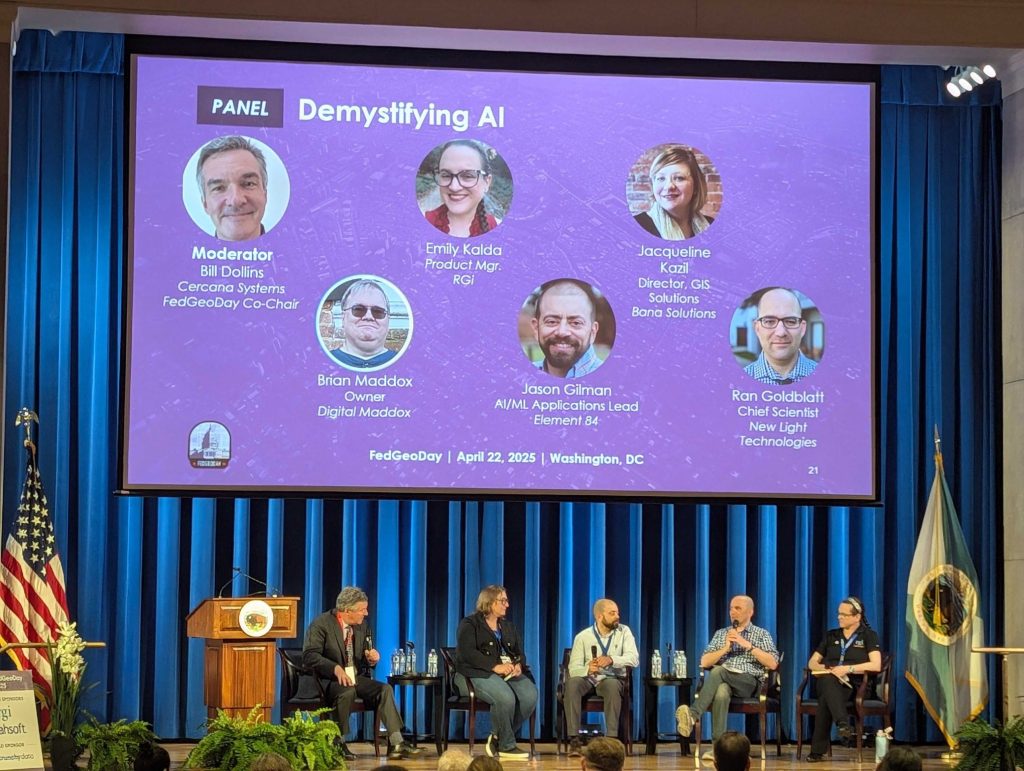
Photo courtesy of OpenStreetMap US on LinkedIn.

“Sometimes the discussion around those concepts can be highly technical and even a little esoteric, and that’s not necessarily helpful for someone who’s just got a day job that revolves around solving a problem. Events like this are very helpful in showing practical ways that open software and open data can be used.”

Dollins joined the committee for a multitude of reasons. In this post, we will explore some of his reasons for joining, as well as what he thinks he brings to the table in planning the event and things he has learned from the process. 

Why did you join the committee?

When asked for some of the reasons why he joined the planning committee for FedGeoDay, Dollins indicated that his primary purpose was to give back to a community that has been very helpful and valuable to him throughout his career in a very hands-on way. 

“In my business, I derive a lot of value from open-source software. I use it a lot in the solutions I deliver in my consulting, and when you’re using open-source software you should find a way that works for you to give back to the community that developed it. That can come in a number of ways. That can be contributing code back to the projects that you use to make them better. You can develop documentation for it, you can provide funding, or you can provide education, advocacy, and outreach. Those last three components are a big part of what FedGeoDay does.”

He also says that while being a co-chair of such an impactful event helps him maintain visibility in the community, getting the opportunity to keep his team working skills fresh was important to him, too. 

“For me, also, I’m self-employed. Essentially, I am my team,” said Dollins. “It can be really easy to sit at your desk and deliver things and sort of lose those skills.”

What do you think you brought to the committee?

Dollins has had a long career in the geospatial field and has spent the majority of his time in leadership positions, so he was confident in his ability to contribute in this new form of leadership role. Event planning is a beast of its own, but early on in the more junior roles of his career, the senior leadership around him went out of their way to teach him about project cost management, staffing, and planning agendas. He then was able to take those skills into a partner role at a small contracting firm where he wore every hat he could fit on his head for the next 15 years, including still doing a lot of technical and development work. Following his time there, he had the opportunity to join the C-suite of a private sector SaaS company and was there for six years, really rounding out his leadership experience. 

He felt one thing he was lacking in was experience in community engagement, and event planning is a great way to develop those skills. 

“Luckily, there’s a core group of people who have been planning and organizing these events for several years. They’re generally always happy to get additional help and they’re really encouraging and really patient in showing you the rules of the road, so that’s been beneficial, but my core skills around leadership were what applied most directly. It also didn’t hurt that I’ve worked with geospatial technology for over 30 years and open-source geospatial technology for almost 20, so I understood the community these events serve and the technology they are centered around,” said Dollins.

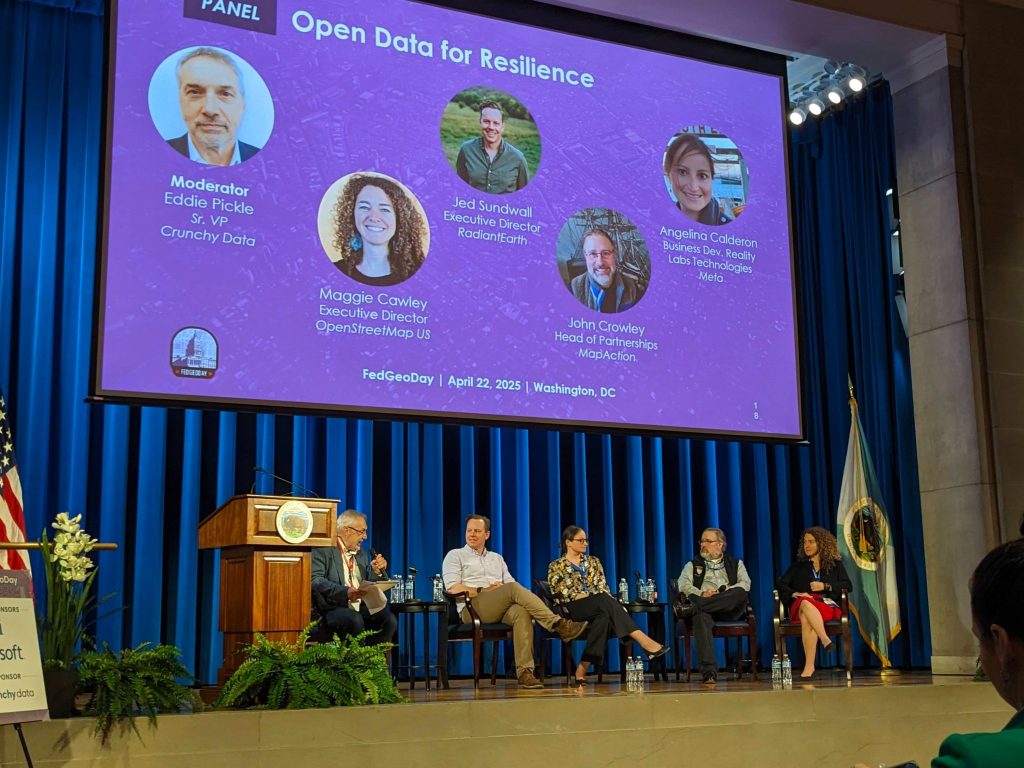
Photo courtesy of Ran Goldblatt on LinkedIn.

What were some of the hard decisions that had to be made?

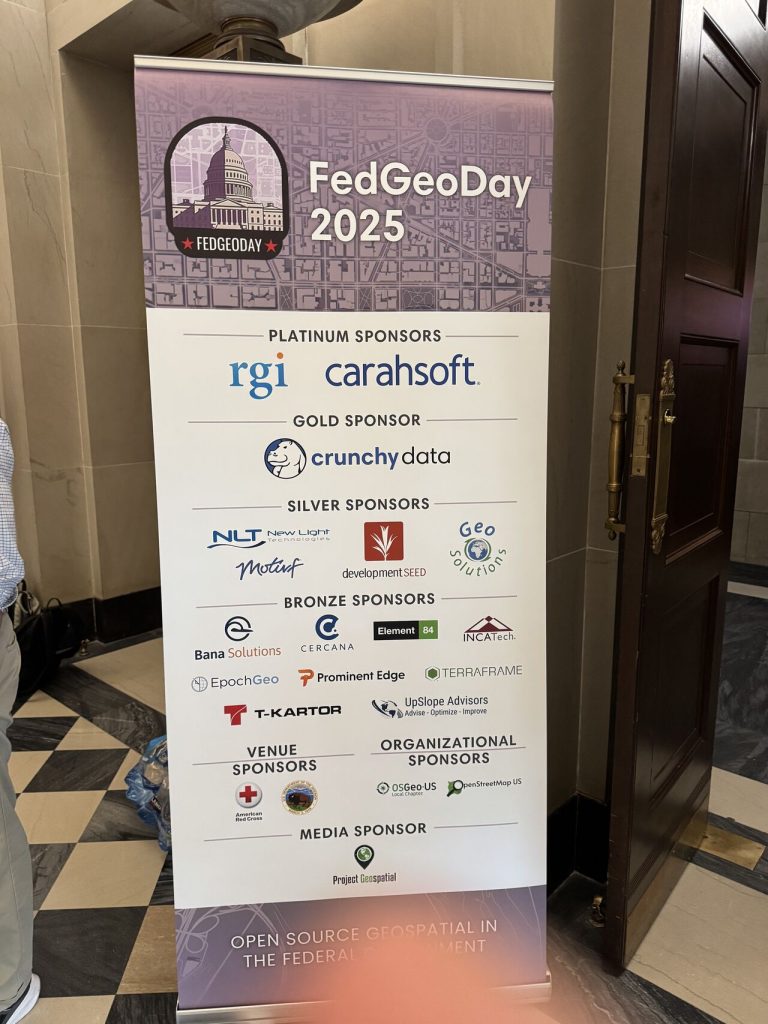
Photo Courtesy of Cercana Systems on LinkedIn.

Attendees of FedGeoDay in previous years will likely remember that, in the past, the event has always been free for feds to attend. The planning committee, upon examining the revenue sheets from last year’s event, noted that the single largest unaccounted for cost was the free luncheon. A post-event survey was sent out, and federal attendees largely indicated that they would not take issue with contributing $20 to cover the cost of lunch. However, the landscape of the community changed in a manner most people did not see coming.

“We made the decision last year, and keep in mind the tickets went on sale before the change of administration, so at the time we made the decision last year it looked like a pretty low-risk thing to do,” said Dollins.

Dollins continued to say that while the landscape changes any time the administration changes, even without changing parties in power, this one has been a particularly jarring change. 

“There’s probably a case to be made that we could have bumped up the cost of some of the sponsorships and possibly the industry tickets a little bit and made an attempt to close the gap that way. We’ll have to see what the numbers look like at the end. The most obvious variable cost was the cost of lunches against the free tickets, so it made sense to do last year and we’ll just have to look and see how the numbers play out this year.”**

What have you taken away from this experience?

Dollins says one of the biggest takeaways from the process of helping to plan FedGeoDay has been learning to apply leadership in a different context. Throughout most of his career, he has served as a leader in more traditional team structures with a clearly defined hierarchy and specified roles. When working with a team of volunteers that have their own day jobs to be primarily concerned with, it requires a different approach. 

“Everyone’s got a point of view, everyone’s a professional and generally a peer of yours, and so there’s a lot more dialogue. The other aspect is that it also means everyone else has a day job, so sometimes there’s an important meeting and the one person that you needed to be there couldn’t do it because of that. You have to be able to be a lot more asynchronous in the way you do these things. That’s a good thing to give you a different approach to leadership and team work,” said Dollins on the growth opportunity. 

Dollins has even picked up some new work from his efforts on the planning committee by virtue of getting to work and network with people that weren’t necessarily in his circle beforehand. Though he’s worked in the geospatial field for 30 years and focused heavily on open-source work for 20, he says he felt hidden away from the community in a sense during his time in the private sector. 

Photo courtesy of Lane Goodman on LinkedIn.

“This has helped me get back circulating in the community and to be perceived in a different way. In my previous iterations, I was seen mainly from a technical perspective, and so this has kind of helped me let the community see me in a different capacity, which I think has been beneficial.”

FedGeoDay 2025 has concluded and was a huge success for all involved. Cercana Systems looks forward to continuing to sponsor the event going forward, and Dollins looks forward to continuing to help this impactful event bring the community together in the future. 

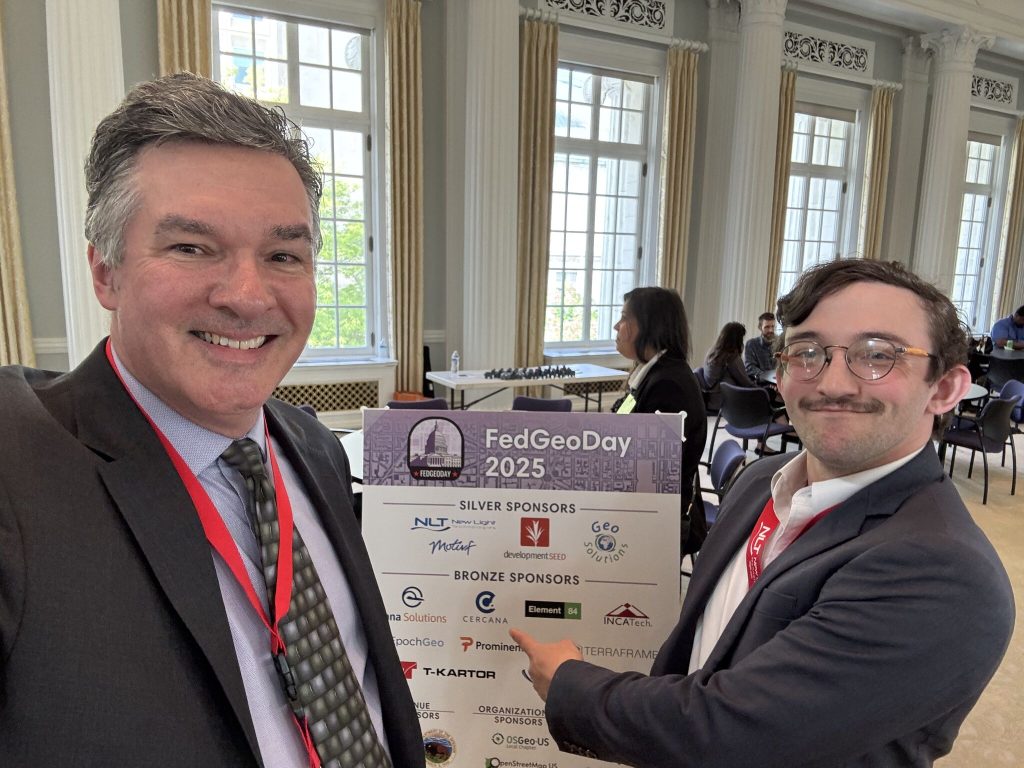
Photo courtesy of Cercana Systems on LinkedIn.

**This interview was conducted before FedGeoDay 2025 took place. The event exceeded the attendance levels of FedGeoDay 2024.