

by Bill Dollins, CEO
Back in June, I examined the potential impact of vibe coding and AI on the commercial software market in an essay on my personal blog, geoMusings. My basic argument was that AI posed a real threat to commercial software, but some companies were more vulnerable than others. Five months later, developments in both the SaaS and AI markets have me revisiting that argument.
As AI drives down the cost of software development, it could present a competitive threat to companies that derive much of their value from the software they’ve developed and an opportunity for those that derive their value from the problems they’ve learned how to solve.
The SaaS Capital Index approached seventeen times annualized revenue during the 2020–2021 period before settling into a range of six to seven times between the second quarters of 2022 and 2024, its lowest levels in nearly a decade. The correction in SaaS valuations was already underway before generative AI gained widespread adoption. That has me wondering how much of what we came to call the SaaSpocalypse was actually caused by AI.
PitchBook’s analysis of 99 publicly traded enterprise SaaS companies found that their median enterprise value, measured as a multiple of revenue over the preceding twelve months, declined from 6.2 times at the end of 2024 to 4.9 times at the end of 2025 and 3.3 times at the end of March 2026. PitchBook identifies Anthropic’s January 12 launch of Claude Cowork as the catalyst for the 2026 selloff, compounded by weak fourth-quarter earnings, economic uncertainty surrounding tariffs, and concerns about the future of per-seat licensing. AI appears to have accelerated a decline that was already underway, although it’s difficult to determine how much AI contributed to the earlier decline.
Some of that decline appears to have reflected fears about future disruption. First Analysis documented a recovery in average SaaS enterprise values, measured against projected 2026 revenue, from 3.9 times at the end of March to 6.0 times at the end of September. Its analysts found little evidence that AI was hurting revenue growth projections for the companies they track, although the median stock was still down 10.6 percent for the year through September.
Investor enthusiasm for AI has cooled in recent weeks. Between October 9 and 23, the data center infrastructure and semiconductor stocks tracked by Sherlund Partners declined 18.2 percent and 11.9 percent, respectively, while its group of software application stocks gained 4.6 percent, suggesting that investors were shifting toward software companies. According to Reuters’ coverage of Bank of America’s November Global Fund Manager Survey, the net percentage of fund managers holding more technology stocks than their benchmarks fell from 37 percent to 12 percent, the largest monthly decline since June 2006.
That shift proved short-lived. ServiceNow reported quarterly subscription revenue growth of 21 percent and raised its 2026 target for AI annual contract value from its initial $1 billion to $1.7 billion. Its shares fell more than 20 percent the following day amid concerns about slower growth in future revenue commitments and profits that fell short of expectations. The episode illustrates how much weight investors are placing on expectations for future growth, even when current revenue growth is strong.
By November 20, the closing price of the iShares Expanded Tech-Software Sector ETF, a fund tracking software stocks, had declined approximately 17 percent from October 23. The broader selloff had pushed both the S&P 500 and the Dow Jones Industrial Average into correction territory.
Customer spending patterns provide a different perspective. Procurement data from Tropic tracks net dollar retention, a measure of how spending by existing customers changes over time. A figure above 100 percent indicates increased spending, while a figure below 100 percent indicates a decline.
AI-native vendors maintained median net dollar retention of approximately 130 to 132 percent throughout the third quarter. Established SaaS vendors with meaningful AI capabilities recorded their first full quarter below 100 percent, reaching a low of 97.5 percent in August before recovering to 98 percent in September. Traditional SaaS vendors without meaningful AI offerings fell to 91.7 percent in August before recovering to 92.7 percent in September.
Adding AI to an existing product hasn’t been enough to prevent a modest decline in customer spending among the established vendors with AI capabilities in Tropic’s study. Its AI-native category includes OpenAI, Anthropic, and Cursor. Increased spending with these companies could reflect greater use of AI alongside continued reliance on established software platforms.
Investors are still rewarding SaaS companies with strong growth and profitability. PitchBook found that enterprise SaaS companies meeting or exceeding the Rule of 40, a benchmark in which revenue growth and profit margin add up to at least 40 percent, traded at a median enterprise value of 6.6 times their preceding twelve months of revenue in the second quarter. Companies falling below that benchmark traded at 2.3 times revenue.
These figures don’t establish that specialized industry knowledge makes a software company more valuable, but they do show that traditional measures of business success still influence software valuations. My hypothesis is that sustaining that success will increasingly depend on capabilities that are more difficult to reproduce than application code.
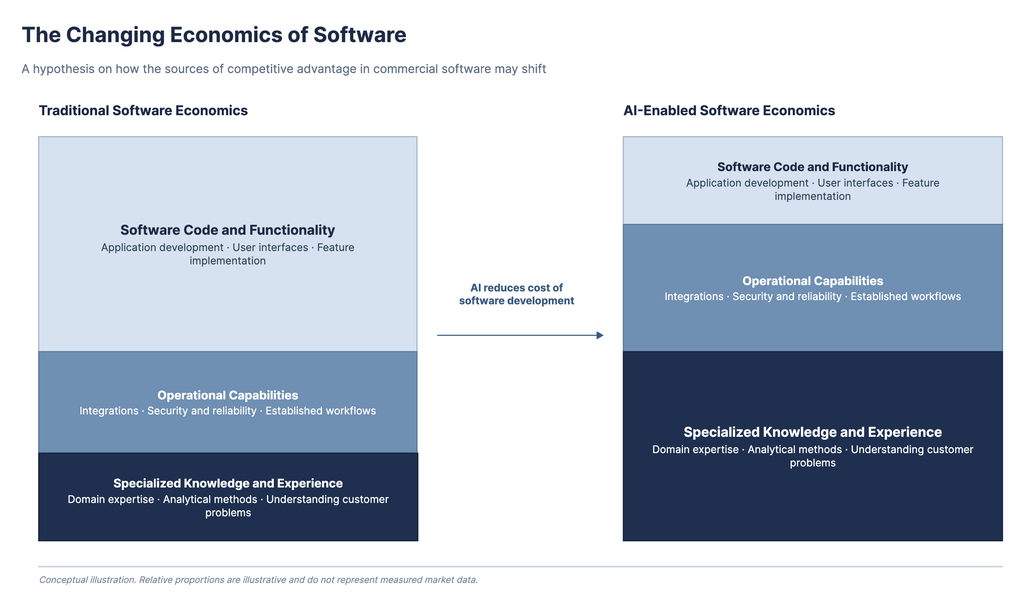
Consider Esri’s ArcGIS Utility Network. AI is making it considerably easier to develop an application that traces an electrical distribution network. The utility still needs an accurate record of its assets, rules governing how those assets can connect, a model of the network’s connectivity, and procedures for keeping that information current. The Utility Network provides tools for modeling the network and enforcing many of those rules. Reducing the cost of developing a tracing application doesn’t necessarily diminish the value of the underlying network model.
For software vendors in other industries that rely on specialized knowledge, the strategic question is how much of their competitive advantage remains when someone else can develop software with similar capabilities at a much lower cost.
What would an equilibrium look like? I’d expect SaaS valuations to be driven more by how well companies are performing and less by broad fears that AI will replace their products. Established software companies would be able to retain customers and make money from their AI capabilities. AI companies would increasingly be valued according to the returns they can generate on the capital invested in them. Valuations, customer spending, and operating performance are telling different stories. It’s too early to tell whether such an equilibrium is emerging.
As software becomes less expensive to produce, specialized knowledge and years of experience solving complex problems could account for a greater proportion of its commercial value. That leaves plenty of room for successful SaaS businesses in an AI-enabled software economy.
Header image: Dietmar Rabich, Hamburg, Kontorhausviertel, Chilehaus — 2016 — 3419, CC BY-SA 4.0